Get in touch with PCBark Company



Last updated: October 2026
The best aerospace PCB manufacturer shortlist starts with TTM Technologies for complex multilayer and RF boards, Pioneer Circuits for specialist rigid-flex, and Sierra Circuits for quick-turn fabrication and assembly. Other useful choices include FTG Circuits for aerospace-focused production and AT&S for miniaturized aviation electronics. Match the manufacturer to the construction, manufacturing site and purchasing scope.
Quick Picks
- Best for complex multilayer and RF interconnects: TTM Technologies
- Best for extended-length flex and aerospace rigid-flex: Pioneer Circuits
- Best for quick-turn prototypes with assembly: Sierra Circuits
- Best for domestic U.S. bare-board production: Calumet Electronics
- Best for miniaturized aviation and satellite constructions: AT&S
- Best for non-restricted civil aerospace engineering builds when AS9100 certification is not a purchase requirement: PCBark
Disclosure: This guide is published by PCBark. We list ourselves first because this is our website, not because we claim to be the market leader. The other 14 manufacturers are grouped by what they are best for, in no particular order within each group.
How We Selected These Aerospace PCB Manufacturers
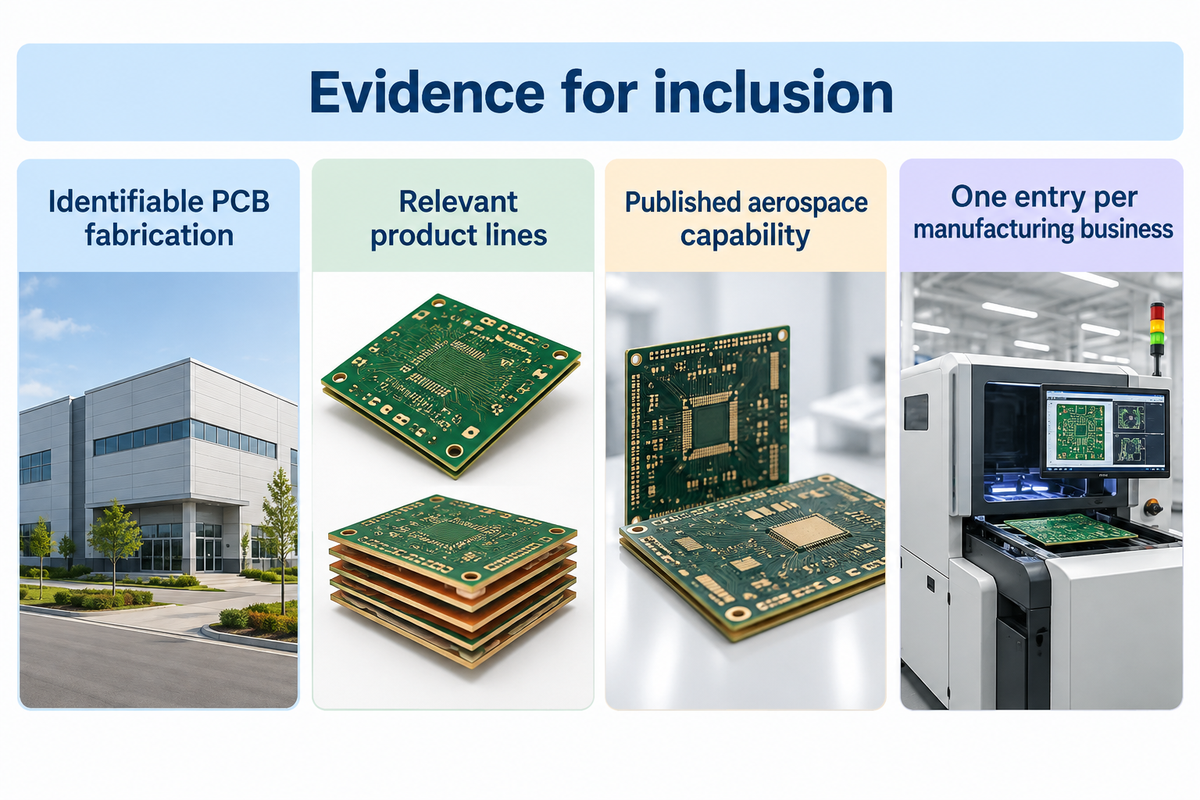
We listed manufacturers with identifiable PCB fabrication operations, with relevant product lines and with published aerospace capabilities or qualification information. Company information was cross-verified against their official websites and public sources in October 2026. The comparison was made for North America, Europe, Israel and China. We excluded trading companies, sourcing platforms, directories, assembly-only companies, design-only firms, and duplicate subsidiaries. Placement was based on purchasing fit rather than score.
Aerospace PCB manufacturer comparison
15-Company Aerospace PCB Capability Comparison: A factual shortlist of each manufacturer’s location, history, manufacturing focus and practical purchasing fit.
Use the comparison to identify which part of a PCB supplier’s offer matches your requirement. A high-layer-count rigid board fabricator serves a different need from a firm that specializes in thin flexible interconnects. Several companies provide PCB assembly, but one must keep the scope of assembly visible when comparing manufacturing services. The company cards below elaborate on the short table entries, summarize the scope and range of PCB solutions, and name the source of published capabilities.
| No. | Company name | Headquarters | Founded | Best for | Brief introduction | Manufacturing focus | Key advantages | Potential disadvantages | Official website |
|---|---|---|---|---|---|---|---|---|---|
| 1 | PCBark | Shenzhen, China | 2010 | Non-restricted civil aerospace engineering builds without an AS9100 purchase requirement | Fabricator and turnkey electronics manufacturing services provider | Rigid, HDI, multilayer, flex and assembly | Per-board traceability links material lot, process parameters, and test data | No AS9100; excludes ITAR-controlled U.S. defense work | pcbark.com |
| 2 | TTM Technologies | Santa Ana, California, USA | 1998 | Complex multilayer and RF programs | PCB, substrate and RF technology manufacturer | Conventional through ultra-HDI interconnects | Backplanes, substrate-like boards and thermal solutions | Product-specific plant selection required | ttm.com |
| 3 | Summit Interconnect | Irvine, California, USA | 2016 | North American HDI and rigid-flex sourcing | Manufacturing group with seven production facilities | Rigid HDI, flex, rigid-flex and RF | Microvias, backdrilling and prototype assembly options | Plant transfer can change technology and qualification scope | summitinterconnect.com |
| 4 | FTG Circuits | Toronto, Ontario, Canada | 1983 roots; 2003 combination | Aerospace-focused rigid and rigid-flex production | Circuit manufacturing division of Firan Technology Group | Rigid, RF, HDI and high-temperature flex | Published constructions span 1 to 40 layers | Circuits and Aerospace subsystem services are separate offers | ftgcorp.com |
| 5 | Calumet Electronics | Calumet, Michigan, USA | 1968 | U.S.-made multilayer bare boards | Domestic printed circuit board manufacturer | Multilayer, HDI, RF and mixed materials | Company states production is not offshored | Populated assemblies require a separate assembly arrangement | calumetelectronics.com |
| 6 | Sierra Circuits | Sunnyvale, California, USA | 1986 | Quick-turn prototypes and turnkey assembly | PCB fabrication and assembly manufacturer | Rigid, HDI, flex, rigid-flex and mil-spec | Construction-specific turnaround information | Fastest simple-board schedule excludes advanced constructions | protoexpress.com |
| 7 | AdvancedPCB | Aurora, Colorado, USA | 1977 roots; 2024 brand | Design-to-assembly projects | Combined APCT, Advanced Circuits and San Diego PCB Design business | Through-hole, advanced HDI, flex and rigid-flex | Layout, fabrication and assembly service coverage | Domestic orders need a specified manufacturing route | advancedpcb.com |
| 8 | Pioneer Circuits | Santa Ana, California, USA | 1981 | Extended-length flex and complex rigid-flex | Specialist circuit and circuit assembly manufacturer | Flex, rigid-flex, extended-length flex and rigid boards | Aviation and space application experience listed publicly | Custom engineering engagement rather than instant commodity pricing | pioneercircuits.com |
| 9 | All Flex Solutions | Northfield, Minnesota, USA | 1991 / 1977 roots; 2022 merger | Flex interconnects and flexible heaters | Flexible circuit and heater manufacturer | Flex circuits, rigid-flex and heaters | Up to 8 flex layers; 20-plus rigid-flex layers advertised | Rigid-only orders may not use its specialist strengths | allflexinc.com |
| 10 | Cirexx International | Santa Clara, California, USA | 1980 | RF/microwave rigid-flex with layout support | Integrated layout, fabrication, assembly and test manufacturer | RF, microwave, HDI, flex and rigid-flex | U.S. manufacturing with in-house engineering and validation | Integrated design work adds scope beyond bare-board procurement | cirexx.com |
| 11 | AT&S | Leoben, Austria | 1987 | Miniaturized aviation and satellite electronics | Advanced PCB and IC-substrate manufacturer | HDI, 2.5D and hybrid constructions | Semi-additive processing and thermal-management capabilities | Engineered high-mix service rather than universal quick-turn delivery | ats.net |
| 12 | SOMACIS | Italy; Castelfidardo and Manfredonia plants | 1972 | Complex space and avionics constructions | International high-technology PCB manufacturing group | High-layer-count, HDI, flex and rigid-flex | Published space and avionics construction examples | Capabilities and qualifications vary between production sites | somacis.com |
| 13 | Merlin Flex | Hartlepool, England, UK | 1987; group entry 2010 | UK flex and flex-rigid assemblies | Merlin PCB Group’s Hartlepool flex operation | Flexible and flex-rigid boards and assemblies | Fabrication, assembly and electrical/optical inspection | Entry excludes the group’s separate rigid-board operations | merlinpcbgroup.com |
| 14 | Eltek | Petach Tikvah, Israel | 1970 | Complex rigid-flex prototypes and low-to-medium volumes | PCB manufacturer within the Nistec group | Complex rigid and rigid-flex boards | Design-stage support plus HATS and IST testing | High-volume supply can use imported Southeast Asian boards | nisteceltek.com |
| 15 | Cicor / Cicorel SA | Boudry, Switzerland | 1966 | Ultra-miniaturized circuit constructions | Cicor Group’s Boudry PCB operation | Rigid, flex, rigid-flex and embedded-die boards | DenciTec fine-line and small-via technology | Published Boudry certificates do not include AS9100/EN9100 | cicor.com |
What does an aerospace PCB manufacturer supply?
An aerospace PCB manufacturer fabricates the printed circuit board that connects components in an electronic system. The offer may include rigid multilayer, flex, rigid-flex or RF constructions. Some manufacturers also source components, perform assembly and offer testing. A bare-board offer and a finished circuit assembly, therefore, represent different services, even if the same company provides both.
For example, Calumet provides PCB fabrication focused on bare boards, while Sierra and Cirexx describe fabrication and assembly services. Distinguishing those roles helps a buyer compare quotations with the same endpoint. The circuit card assembly process continues beyond board fabrication into component placement, soldering and the agreed inspection or test work.
Manufacturers offering broad PCB portfolios
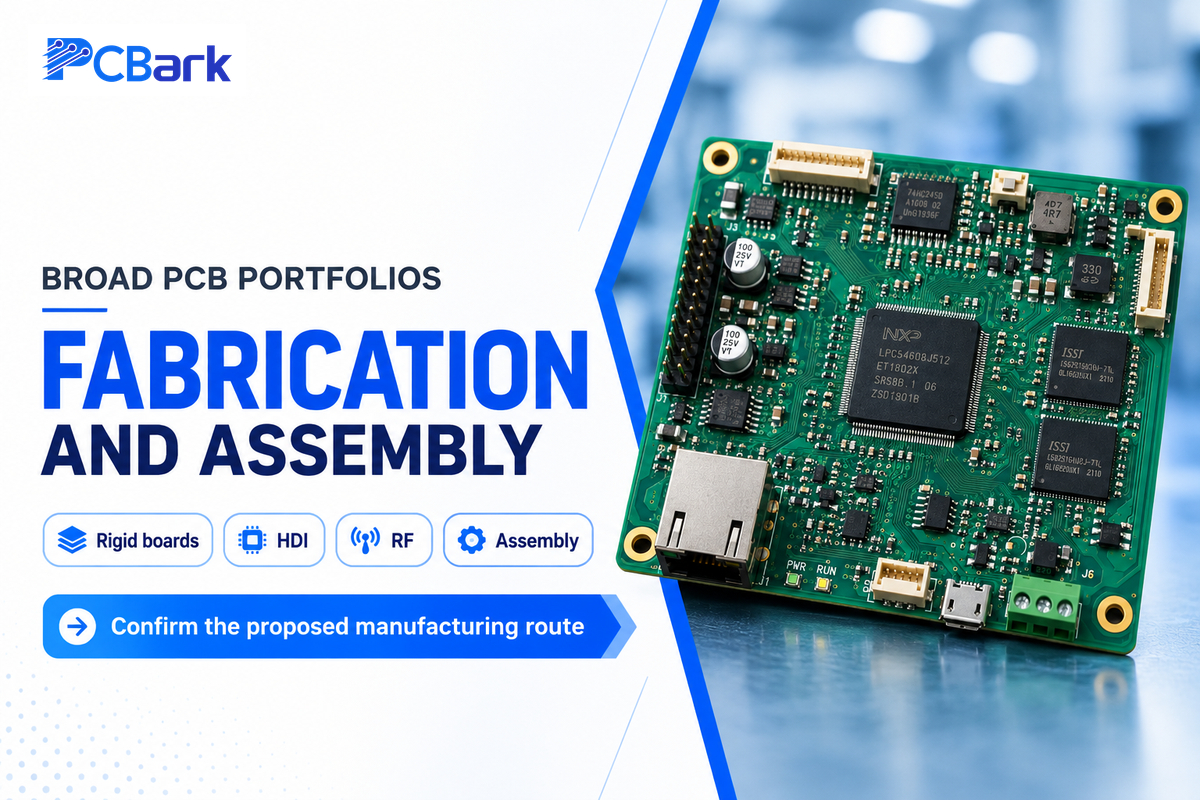
These PCB manufacturers for aerospace span multiple board constructions or combine fabrication with related services. Their range makes them useful starting points when aerospace systems within a product family have different interconnect needs. A practical distinction is the part of that range offered by the proposed manufacturing operation, together with the company’s role in assembly, engineering and production support.
1. PCBark: Best for non-restricted civil aerospace engineering builds when AS9100 certification is not a purchase requirement
Headquarters: Shenzhen, Guangdong, China · Founded: 2010 · Type: PCB fabricator and turnkey EMS provider
Official website: https://pcbark.com/
Main products: Rigid, HDI, multilayer, flexible and rigid-flex printed circuit boards, plus SMT assembly
Core capabilities: Its aerospace page advertises HDI constructions up to 32 layers, alongside per-board material-lot, process-parameter and test-data traceability
Certifications: According to its website, ISO 9001, ISO 14001, UL and IATF 16949; PCBark is not AS9100 certified
PCBark combines board production with electronics manufacturing services, making its offer relevant to non-restricted civil aerospace engineering builds that need fabrication and component assembly through one supplier when AS9100 certification is not a purchase requirement. The published aerospace PCB manufacturing capabilities cover several constructions rather than a single standard rigid-board format, while traceability is described across the manufacturing and test stages. That combination supports an initial discussion about the board, assembly scope and records as one purchasing package. Its clear limitation is qualification scope: PCBark states that it has neither AS9100 certification nor U.S. ITAR registration and doesn’t accept ITAR-controlled U.S. defense work.
2. TTM Technologies: Best for complex multilayer and RF interconnect programs
Headquarters: Santa Ana, California, USA · Founded: 1998 · Type: PCB, substrate and RF technology manufacturer
Official website: https://www.ttm.com/
Main products: Conventional, HDI, ultra-HDI, flex, rigid-flex and backplane PCBs
Core capabilities: Substrate-like PCBs, RF interconnects and constructions addressing thermal management
Certifications: Its website lists ISO 9001, AS9100 and Nadcap categories with product-specific applicability
TTM’s aerospace and defense interconnect portfolio reaches from conventional boards to ultra-HDI and substrate-like constructions, giving buyers a broad technology starting point for complex programs. Backplanes and RF products sit alongside flexible interconnects in that offer, so the comparison can begin with the complete electronic architecture rather than layer count alone. A program involving several board families may find that breadth useful when discussing related manufacturing requirements. Network size and specialization create a purchasing limitation: a product-specific manufacturing location is needed, because the company’s overall certification list doesn’t describe every product at every site.
3. Summit Interconnect: Best for North American HDI and rigid-flex sourcing
Headquarters: Irvine, California, USA · Founded: 2016 · Type: Multi-site PCB manufacturing group
Official website: https://summitinterconnect.com/
Main products: Rigid HDI, RF/microwave, flex and rigid-flex PCBs, with prototype assembly services
Core capabilities: Microvias, blind and buried vias, backdrilling and thermal-management constructions across seven manufacturing facilities
Certifications: AS9100D is listed; several sites list MIL-PRF-31032 and Nadcap, while one lists MIL-PRF-50884
Summit brings several North American fabrication operations into a portfolio covering rigid boards, RF materials and flexible interconnects. Its published process options are relevant when a design needs more than a conventional through-hole stackup, particularly where microvias or backdrilling form part of the required construction. Prototype assembly also extends the offer beyond the unpopulated printed circuit, which can simplify the initial supplier conversation for a development build. Facility differences remain the main procurement constraint: transferring an order between Summit plants can change the available technology or qualification scope, so the network shouldn’t be treated as interchangeable production capacity.
4. FTG Circuits: Best for aerospace-focused rigid and rigid-flex production
Headquarters: Toronto, Ontario, Canada · Founded: 1983 predecessor roots; FTG combination in 2003 · Type: Firan Technology Group’s PCB manufacturing division
Official website: https://www.ftgcorp.com/
Main products: Rigid, rigid-flex, RF, HDI and high-temperature flexible printed circuit boards
Core capabilities: Published circuit constructions from 1 to 40 layers
Certifications: Site-specific AS9100 and Nadcap listings include Toronto and Chatsworth
FTG Circuits gives aerospace buyers a portfolio centered on interconnect manufacturing, with rigid and flexible options listed alongside RF and HDI technology. The published layer range shows the breadth of that circuit offer without establishing that every material and via structure is available in every combination. Its separate site listings make the manufacturing operation a useful part of the initial comparison, especially for buyers considering more than one construction. The scope distinction is organizational: FTG Circuits makes interconnect boards, while the separately described FTG Aerospace business supplies aerospace subsystem products; the latter’s portfolio shouldn’t be read as an additional bare-board fabrication service.
5. Calumet Electronics: Best for U.S.-made rigid multilayer bare boards
Headquarters: Calumet, Michigan, USA · Founded: 1968 · Type: U.S. printed circuit board manufacturer
Official website: https://www.calumetelectronics.com/
Main products: Multilayer, HDI, RF and mixed-material PCBs
Core capabilities: Laser direct imaging, X-ray drilling, microvia and via-fill options; its 2024 brochure includes a 48+ hour quick-turn offer
Certifications: Its website lists AS9100D, ISO 9001, Nadcap Merit and MIL-PRF-31032/55110
Calumet states that it doesn’t offshore any aspect of production, giving its manufacturing location a direct role in the purchasing comparison. The company’s documented processes include imaging and drilling technologies relevant to advanced rigid multilayer boards, with mixed-material and RF products extending the range beyond standard laminate constructions. Its dated brochure also provides a useful example of a quoted quick-turn service, although that historic offer isn’t a current delivery commitment for an unspecified design. Assembly is the main scope limitation: the cited offer is for bare-board manufacturing, so a buyer ordering populated electronics needs a separate arrangement for the component assembly stage.
6. Sierra Circuits: Best for quick-turn aerospace prototypes and turnkey assembly
Headquarters: Sunnyvale, California, USA · Founded: 1986 · Type: PCB fabrication and assembly manufacturer
Official website: https://www.protoexpress.com/
Main products: Rigid, HDI, flex, rigid-flex and mil-spec boards, with turnkey assembly
Core capabilities: Its mil-spec page advertises 2-4 days for 4–8-layer boards and 5-10 days for advanced constructions
Certifications: The website lists AS9100D, ISO 9001:2015 and MIL-PRF-31032/3 flex qualifications
Sierra makes turnaround easier to compare by assigning different published schedules to different board constructions, rather than offering only an undifferentiated speed claim. A development team can therefore begin with a relevant fabrication category and then consider the additional component sourcing and assembly work needed for a finished prototype. The combination of rigid, flexible and HDI products also gives a buyer several starting points within the same service portfolio. Its scheduling limitation is explicit: the fastest simple multilayer offer doesn’t cover advanced HDI or rigid-flex work, and a bare-board fabrication duration doesn’t by itself describe the delivery date of a completed assembly.
7. AdvancedPCB: Best for projects spanning design, fabrication and assembly
Headquarters: Aurora, Colorado, USA · Founded: APCT roots in 1977; AdvancedPCB brand launched in 2024 · Type: PCB design, fabrication and assembly manufacturer
Official website: https://www.advancedpcb.com/
Main products: Standard through-hole, advanced HDI, flex and rigid-flex PCBs
Core capabilities: Combined APCT, Advanced Circuits and San Diego PCB Design services
Certifications: Its launch information lists ISO 9001:2015, MIL-PRF-31032 and ITAR registration
AdvancedPCB’s current identity combines businesses that buyers in the PCB industry may still encounter under their earlier names, so those names shouldn’t automatically become separate entries on a supplier shortlist. Its combined offer spans PCB design and manufacturing through assembly, with both conventional and more advanced interconnect constructions in the portfolio. That range is useful when the required engagement begins before a fabrication-ready design exists and continues into a populated prototype. One purchasing condition needs attention: the company’s history includes an offshore sourcing offer, meaning that a U.S.-production order must identify the intended manufacturing route rather than rely on the corporate headquarters alone.
Flex and rigid-flex specialists
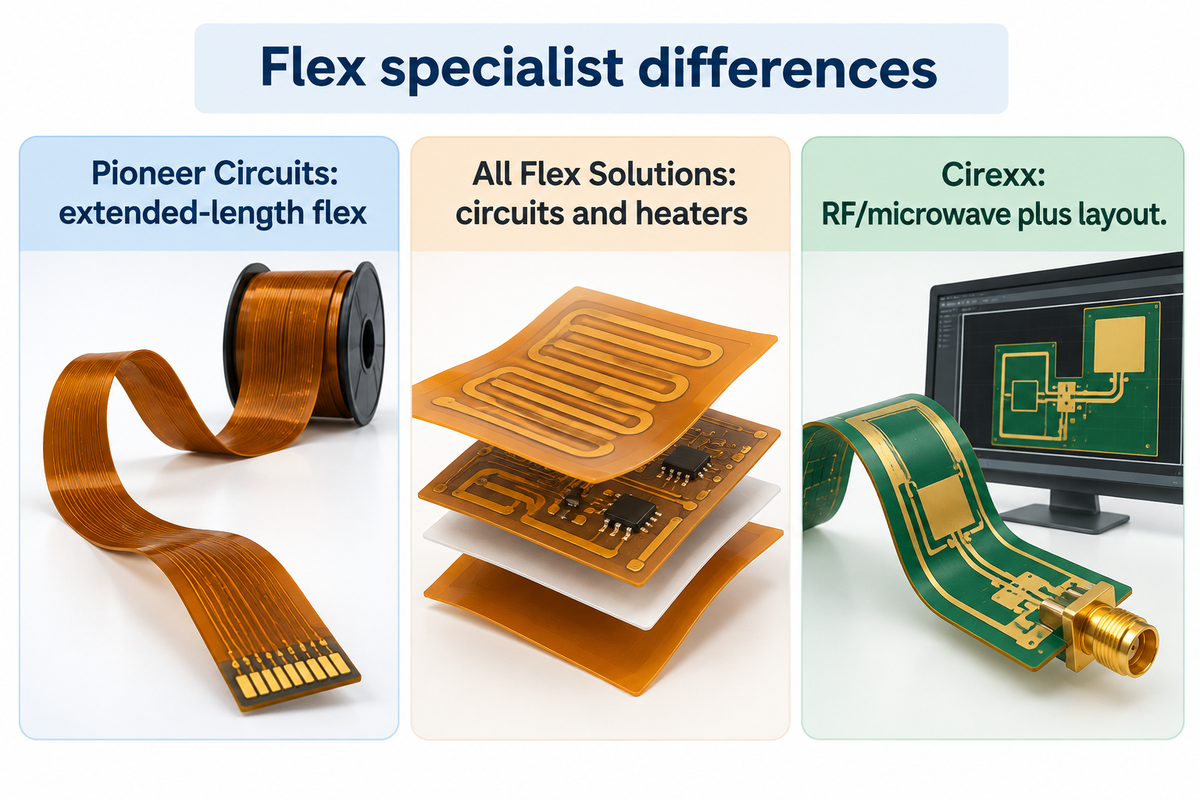
A flexible interconnect introduces mechanical requirements that a rigid-board comparison can miss. These specialists make flex or rigid-flex a central part of their offer, sometimes alongside RF constructions, heaters or assembly. That focus is useful when the circuit has to fit a constrained enclosure or connect areas that cannot be joined conveniently with a conventional rigid board.
8. Pioneer Circuits: Best for extended-length flex and complex aerospace rigid-flex
Headquarters: Santa Ana, California, USA · Founded: 1981 · Type: Flex and rigid-flex PCB and PCBA manufacturer
Official website: https://www.pioneercircuits.com/
Main products: Flexible, rigid-flex, extended-length flex and rigid printed circuit boards
Core capabilities: High-frequency, impedance-controlled and multilayer designs, including blind and buried vias
Certifications: The website lists AS9100D, ISO 9001:2015, Nadcap AC7119 and MIL-PRF-31032/1–4
Pioneer identifies aviation, near-Earth orbit and space exploration among the markets it serves, putting its specialist interconnect offer in a clear context for its aerospace PCB applications. Extended-length flex is a useful differentiator for buyers whose circuit geometry isn’t captured by a simple layer-count comparison, while rigid-flex and assembly broaden the possible scope of the manufactured part. Its high-frequency and impedance-controlled options also make the company relevant where electrical and mechanical demands meet in one high-performance interconnect. The tradeoff is the purchasing model: Pioneer presents an engineering-led custom manufacturing service, so its offer is better suited to a defined technical discussion than to instant pricing for a commodity board.
9. All Flex Solutions: Best for flexible interconnects and heaters in one portfolio
Headquarters: Northfield, Minnesota, USA · Founded: All Flex in 1991 and PCI in 1977; businesses merged in 2022 · Type: Flexible circuit, rigid-flex and heater manufacturer
Official website: https://www.allflexinc.com/
Main products: Flexible circuits, rigid-flex boards and flexible heaters
Core capabilities: Its aerospace page lists up to 8 flex layers and 20-plus rigid-flex layers
Certifications: The website lists AS9100, ISO 9001 and MIL-PRF-31032/3 and /4
All Flex brings interconnects and flexible heaters into the same specialist portfolio, a distinction that matters when both functions appear in an aerospace product’s sourcing plan. The published flex and rigid-flex layer figures provide concrete starting points for comparing constructions, while the company history explains why buyers may recognize more than one predecessor name. Flexible heaters are a separate product capability, so their presence shouldn’t be interpreted as a qualification claim for every circuit construction. For a conventional rigid-only program, the practical limitation is fit: an order that needs neither flexible circuitry nor heaters may not use the capabilities that distinguish this manufacturer.
10. Cirexx International: Best for RF/microwave rigid-flex with layout and assembly
Headquarters: Santa Clara, California, USA · Founded: 1980 · Type: PCB layout, fabrication, assembly and test manufacturer
Official website: https://www.cirexx.com/
Main products: Flex, rigid-flex, RF/microwave, HDI and rigid circuit boards
Core capabilities: In-house layout, fabrication, assembly, testing and validation with U.S. manufacturing
Certifications: Its website posts AS9100D certification, registration CIRX-001-09-24-1
Cirexx combines RF/microwave technology and rigid-flex fabrication with services that begin at board layout and continue through assembly and testing. The combination is relevant when a design’s electrical requirements and physical interconnect arrangement need to be discussed together, rather than handed to unrelated suppliers at separate stages. A buyer seeking an electronics manufacturing partner can compare that integrated engagement with a narrower fabrication-only quote using the same finished deliverable. The purchasing limitation is scope: layout and validation are broader responsibilities than bare-board production, so an integrated Cirexx engagement requires a clear division between the design work and manufacturing work being ordered.
Specialists with manufacturing outside North America
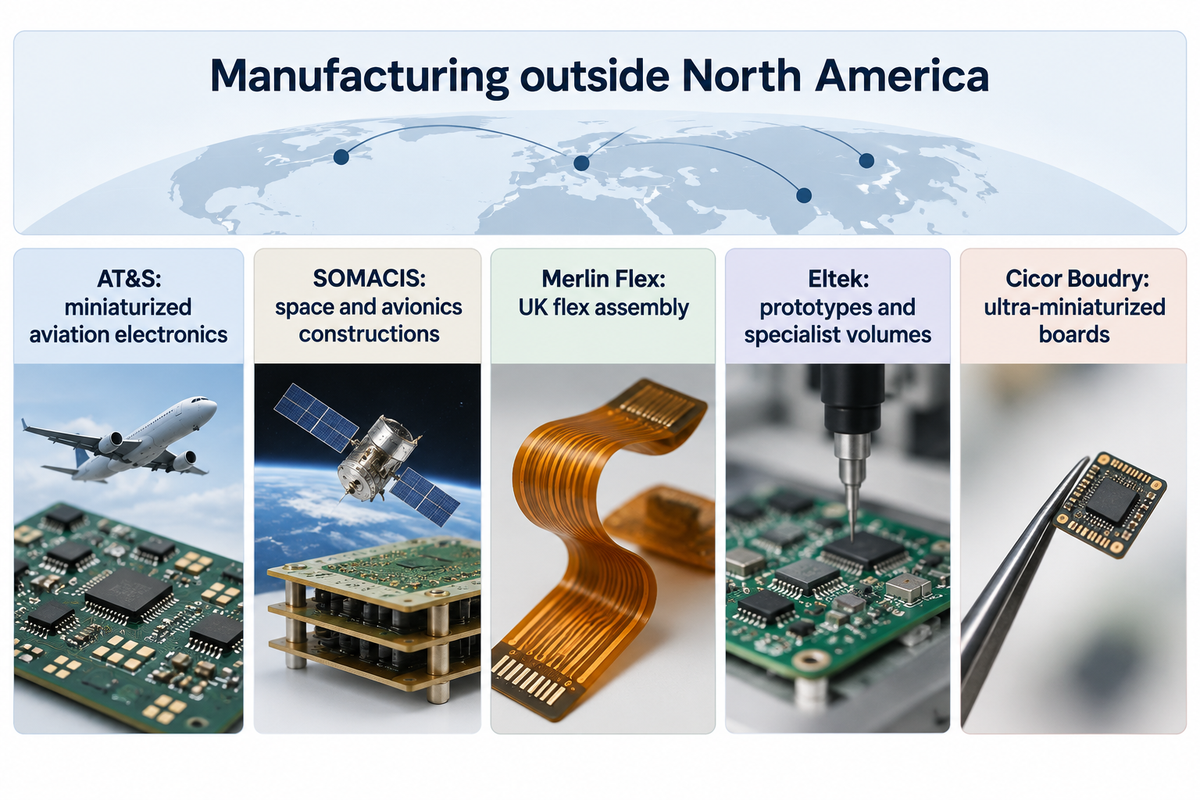
Providers in this group offer additional specialist constructions and manufacturing options in Europe and Israel. Their inclusion broadens the comparison of suppliers worldwide without suggesting that every program can use every location. Each listing specifies the operation behind published capability, which is often useful, particularly when a larger group offers both circuit boards and other electronic products.
11. AT&S: Best for miniaturized aviation and satellite HDI constructions
Headquarters: Leoben, Austria · Founded: 1987 · Type: Advanced PCB and IC-substrate manufacturer
Official website: https://ats.net/
Main products: Aviation and satellite PCBs using HDI and 2.5D technology
Core capabilities: Subtractive and semi-additive processes, miniaturization, hybrid structures and integrated thermal management
Certifications: Its aerospace page identifies EN9100 and Nadcap production sites in Austria
AT&S connects its 2.5D technology and hybrid structures with compact, semi-flexible electronics for aviation and satellite applications. AT&S emphasizes the relationship between reduced size, interconnect density and thermal requirements, giving buyers a technology-led alternative to a comparison based only on rigid-board layer count. For these solutions for aerospace, AT&S describes high-mix/low-volume platforms, which identifies the production setting for the offer rather than implying that the entire group operates on one order model. The limitation follows that positioning: an engineered aerospace construction isn’t a universal quick-turn service, so the portfolio doesn’t establish a fixed price or delivery promise for an unspecified board.
12. SOMACIS: Best for complex space and avionics PCB constructions
Headquarters: Italy; principal Italian PCB plants in Castelfidardo and Manfredonia · Founded: 1972 · Type: International high-technology PCB manufacturing group
Official website: https://www.somacis.com/
Main products: High-layer-count, HDI, flex and rigid-flex printed circuit boards
Core capabilities: Published examples include a 10-layer every-layer construction for space and a 1+N+1 construction for avionics
Certifications: Italian listings include EN9100, with a Nadcap certificate for Castelfidardo; other sites are listed separately
SOMACIS makes its aerospace offer more concrete through public construction examples, including a space-related board whose interconnect structure is described alongside its layer count. That helps buyers distinguish a demonstrated product example from a general statement that a manufacturer serves aerospace applications. The group’s portfolio also includes flex and rigid-flex, allowing the initial comparison to extend across mechanical formats as well as dense rigid constructions. Its multi-site structure creates the main purchasing limitation: the corporate technology range is broader than the offer of any one selected plant, and the proposed manufacturing route needs to match the construction and qualification scope being purchased.
13. Merlin Flex: Best for UK flexible and flex-rigid circuit assemblies
Headquarters: Hartlepool, England, UK · Founded: 1987 as Flex-Ability; joined Merlin PCB Group in 2010 · Type: Flexible and flex-rigid circuit manufacturer
Official website: https://www.merlinpcbgroup.com/
Main products: Flexible and flex-rigid printed circuit boards and assemblies
Core capabilities: Design, manufacture and assembly with 100% electrical testing, automated optical inspection and coupon inspection
Certifications and recognition: The website lists AS9100 Rev D, ISO 9001:2015, ISO 14001:2015 and the SC21 Bronze Award
Merlin Flex provides a UK manufacturing route for flexible interconnects with assembly included in the operation’s published services. Electrical, optical and coupon inspection appear in its capability description, giving buyers more information about the offer than a product list alone would provide. Merlin’s history also identifies Hartlepool as a distinct specialist operation within the wider Merlin PCB Group, which matters when comparing a flex assembly with other group products. That distinction is the entry’s scope limit: the capabilities summarized here belong to the Hartlepool flex business and don’t represent the separate rigid-board services of every company in the group.
14. Eltek: Best for complex rigid-flex prototypes and low-to-medium volumes
Headquarters: Petach Tikvah, Israel · Founded: 1970 · Type: PCB manufacturer and Nistec group company
Official website: https://www.nisteceltek.com/
Main products: Complex rigid and rigid-flex printed circuit boards
Core capabilities: Engineering support from the design stage, with HATS and IST reliability testing
Certifications: Its website lists AS9100D and ISO 9001:2015; the public Nadcap Electronics certificate shown expired on 31 May 2026
Eltek describes design-stage engineering support for complex boards, placing the manufacturing discussion early in the development of the interconnect rather than only at order release. Its 2025 annual report emphasizes quick-turn prototypes, pre-production and low-to-medium-volume runs, which supports a focused comparison for development and specialist production work. HATS and IST testing are additional published capabilities relevant to the reliability discussion, without implying that every order includes the same test package. A volume-related limitation is also disclosed in that annual report: Eltek can supply imported Southeast Asian PCBs for high-volume requirements, although it says this activity wasn’t significant in recent years.
15. Cicor / Cicorel SA: Best for ultra-miniaturized PCBs from Boudry
Headquarters: Boudry, Switzerland, for the Cicorel PCB operation · Founded: 1966 as Cicorel · Type: Advanced PCB manufacturer within Cicor Group
Official website: https://www.cicor.com/
Main products: Rigid, flexible, rigid-flex and embedded-die PCBs
Core capabilities: DenciTec technology lists 25 micrometer line/space and 30 micrometer laser vias; a published four-layer flex example is below 120 micrometers thick with a 12.5-micrometer polyimide core
Certifications: Boudry lists ISO 9001, ISO 13485, ISO 14001 and ISO 45001
Cicor’s Boudry operation offers a distinctive comparison point for miniaturization because its published data describe both fine features and a very thin flexible construction. Those examples are useful when interconnect space and thickness drive the supplier search, particularly where a conventional multilayer PCB doesn’t describe the required package. Embedded-die products further distinguish its portfolio from a general-purpose board fabrication offer. The qualification limitation is specific to the listed operation: Boudry’s published site certificates don’t include AS9100 or EN9100, so a purchasing requirement for that aerospace quality-management scope calls for an approved manufacturing site that holds it.
Which suppliers fit rigid-flex and RF aerospace boards?
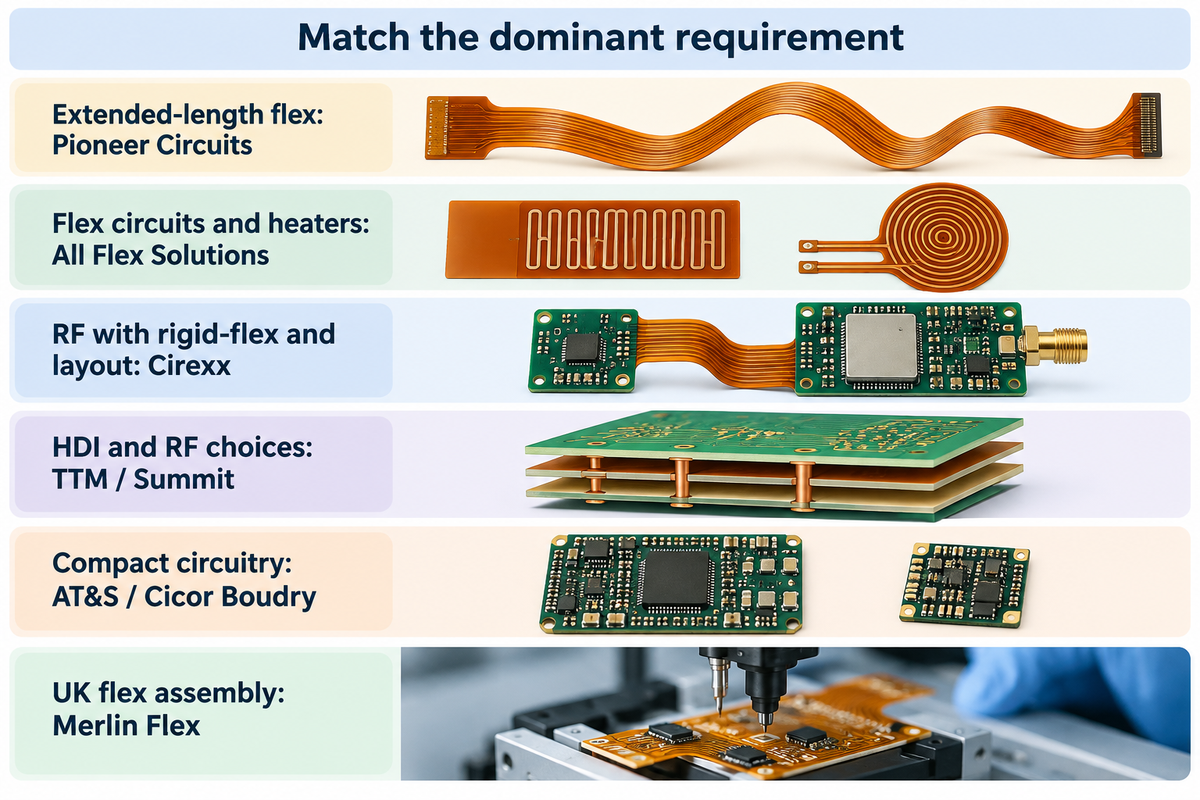
Pioneer Circuits, All Flex Solutions and Merlin Flex are useful starting points for flex-led sourcing, while TTM, Summit and Cirexx publish RF or microwave capabilities. Cirexx also combines RF/microwave with rigid-flex. These are portfolio matches for building a bid list; the intended material, interconnect structure and assembly scope determine which offer deserves a detailed technical discussion.
Construction-to-Supplier Fit Map: Use the primary board requirement to identify published specialist capabilities before comparing individual quotations for the best fit.
| Dominant requirement | Useful starting points | Published reason to consider them |
|---|---|---|
| Extended-length flexible interconnect | Pioneer Circuits | Extended-length flex within an aerospace-oriented portfolio |
| Flex circuitry plus flexible heaters | All Flex Solutions | Both product families in one specialist offer |
| RF/microwave with rigid-flex and layout | Cirexx | RF construction, flexible interconnects and in-house layout |
| Broad HDI and RF technology choices | TTM; Summit | Dense interconnect and RF options across manufacturing networks |
| Compact or very thin circuitry | AT&S; Cicor Boudry | 2.5D/HDI specialization or published fine-line flex examples |
| UK flex assembly route | Merlin Flex | Hartlepool fabrication and assembly operation |
For a flex-led design, start with the required bend duty and physical arrangement. For an RF-led design, start with the specified laminate system and electrical construction. The rigid-flex PCB design guide and RF PCB manufacturer comparison provide separate routes into those decisions. Published maximum capabilities shouldn’t be combined into a new specification that the manufacturer has never offered.
How to choose an aerospace PCB manufacturer
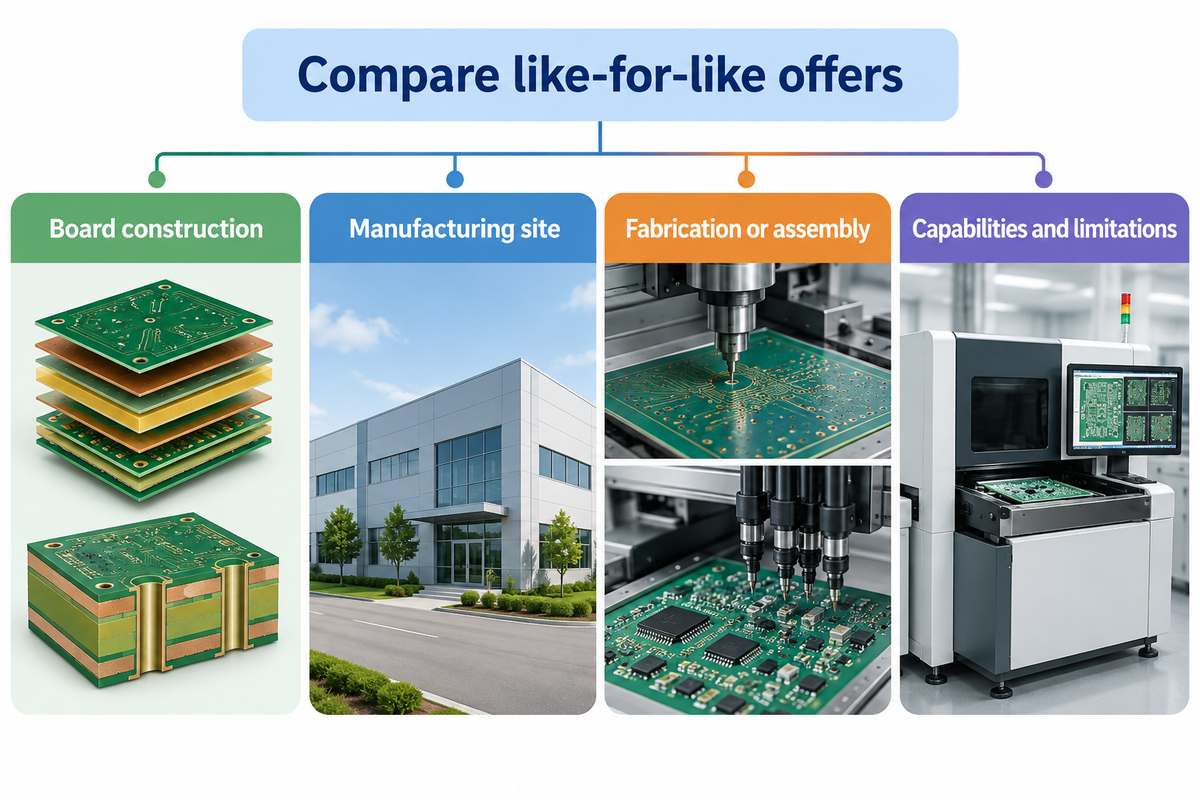
Evaluate actual board construction, the manufacturing location and the final product for bidding purposes. Certification matters where the purchasing requirements call for it, but a certificate alone does not define the board, assembly or acceptance work. The following checks refine broad company capabilities to manufacturing offers for the same aerospace projects.
Start with the board and the finished deliverable
Indicate whether the order covers bare-board fabrication, component sourcing, assembly, testing or a combination. An aerospace PCB assembly supplier may provide finished aerospace PCB assemblies, while a fabricator provides the board used by a separate assembler. Define the hand-off point so that aerospace PCB assembly solutions, test services and component costs appear in the correct quote. This prevents a low bare-board price from being misinterpreted as a competitive finished-unit price.
Then identify the construction: rigid multilayer, HDI, flex, rigid-flex or RF. State the required PCB materials, substrate, stackup and via structure before comparing maximum layer counts. For board-level preparation, the aerospace PCB design guide covers the design questions that sit behind this supplier comparison.
How does a buyer confirm a supplier’s AS9100 scope covers the work?
Compare the proposed manufacturing site’s legal name and address with those on its certificate, check the scope and current status, and then compare that scope with the work being ordered. The IAQG OASIS database names suppliers certified under its aerospace quality-management scheme. A group logo or a certificate belonging to another site doesn’t validate coverage for the proposed fabrication or assembly operation.
The IAQG OASIS resource is a good place to begin for the certification check. Keep product acceptance requirements and quality system certification requirements separate. A purchasing specification can also call for process qualifications or records that are not established by the quality-system certificate alone.
Separate quality systems, process accreditation and board acceptance
AS9100 addresses an aerospace quality-management system. Nadcap addresses defined critical-process accreditation scopes, including electronics activities; the PRI accreditation categories distinguish printed boards from printed board assemblies. Neither label replaces the acceptance criteria stated for the actual product. Treat the applicable IPC class, inspection requirements and test records as parts of the manufacturing specification.
If an order calls for Class 3 work, identify the applicable document and acceptance requirements in the package instead of relying on the phrase “aerospace quality.” The IPC Class 2 versus Class 3 comparator can help organize that discussion. The required level in the aerospace industry follows the product and purchasing specification, rather than a blanket assumption about every aerospace PCB.
Connect reliability requirements to records and tests
When negotiating procurement requirements, specify the exact material, lot and process traceability, and the records to be provided at the time of delivery. Ask which inspections and tests are included in the quoted manufacturing services and which are additional. A supplier may publish reliability-testing capabilities without including all of them in every order. The best comparison is the documented work proposed to produce the boards, not the longest list of equipment on a web site.
For aerospace electronics designed to withstand extreme temperatures or other harsh environments, requirements determine the conditions that the hardware addresses. “high-reliability PCB” or “high-reliability PCB assembly” don’t define the conditions. Ensure the reliability and performance discussion is related to the construction, material selection and agreed verification work for mission-critical hardware, especially for equipment operating in demanding aerospace environments.
Keep the production route and revision under control
Identify the actual fabrication and assembly sites, including any outsourced stages, and determine how a change in route would be signaled. The manufacturing facilities within a group may represent different technologies or qualification scopes. Keep the approved stackup, drawing revisions, material requirements, and the agreed test package together so that a repeat order specifies the same product as the development build.
For a prototype moving toward production, discuss continuity before the first order. A quick-turn development route and a later volume route can involve different manufacturing arrangements. Eltek’s disclosed high-volume import service illustrates why volume and location belong in the same sourcing conversation; AdvancedPCB’s history likewise shows why a corporate address alone doesn’t identify the build route.
Compare complete quotations and communication responsibilities
Fabrication work and assembly work should be treated as separate quotation items, as should setup, components, inspection and test work. Determine who answers design questions and who approves changes for manufacturing. An integrated PCB design and manufacturing engagement may include services that a fabrication-only quote leaves to the customer. Both types of arrangements can be useful, but their price and lead time should be evaluated with matched scope.
Use a concise package rather than an unqualified request for the “highest standards of reliability.” The aerospace request-for-quotation readiness checklist helps assemble the necessary inputs. Clear requirements give a potential partner for aerospace projects something concrete to accept, price or discuss, and make omissions easier to identify before an order is released. Choosing the right PCB partner starts with that shared definition of the deliverable.
What changes aerospace PCB prototype cost and lead time?
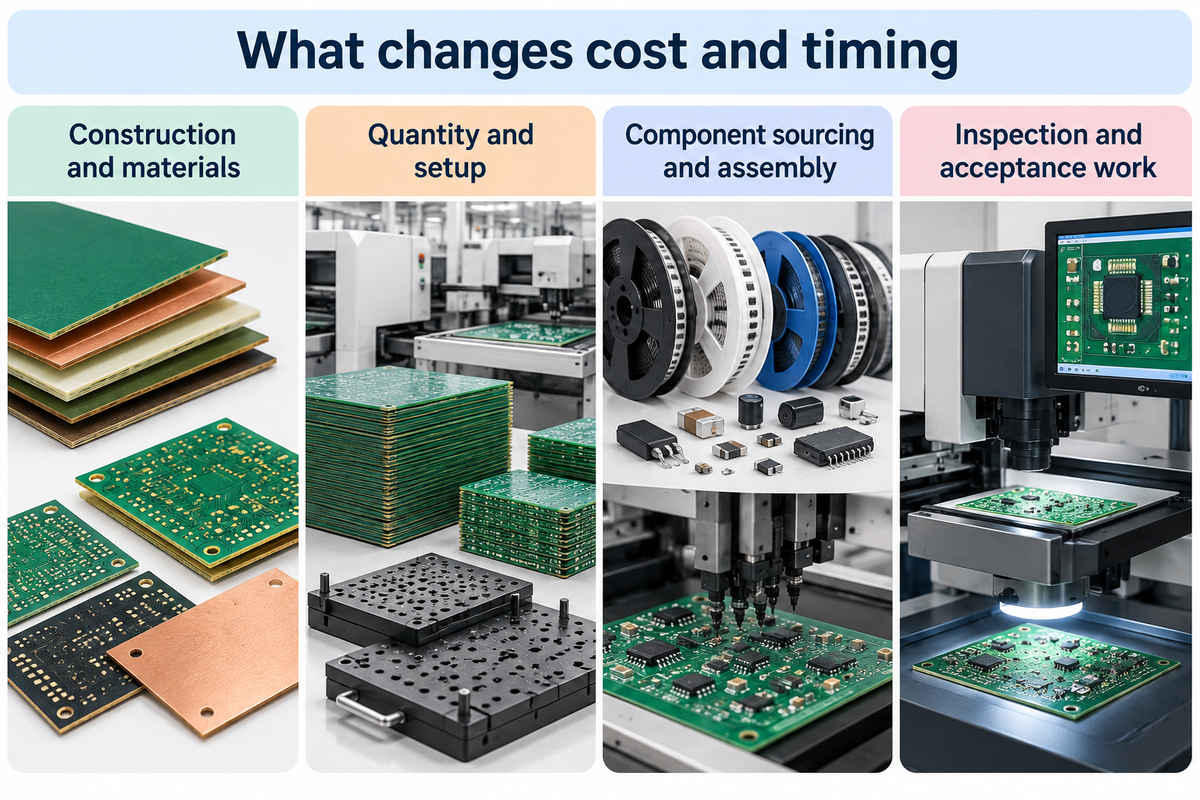
Construction, material availability, order quantity and the scope of assembly, as well as the required test and inspection packages, influence cost and lead time. A bare multilayer board, a populated prototype and a tested assembly all represent different work. Use published quick-turn schedules only if their stated construction is in line with your order.
Sierra’s mil-spec page gives a concrete scheduling example: it advertises 2-4 days for 4–8-layer boards and 5-10 days for advanced constructions. Those are supplier-published fabrication categories, not a promise that components, assembly and all acceptance work fit within the same duration. Calumet’s 2024 brochure offered a 48+ hour quick-turn service. The old brochure records the offer at publication; a current quote establishes availability for a new build.
There are a number of factors that may change a board’s manufacturing route, including the materials system. Thus, boards that have the same layer count may not receive the same quote. Other important considerations are the stackup, via structure, and final board dimensions. Special requests for documentation or testing should also be included. Otherwise, one supplier’s base price can omit work that another has included.
Component sourcing and aerospace PCB assembly services are also large factors in quotes. These include the list of components, sourcing responsibilities, placement and solder requirements, inspection and the agreed acceptance tests. Availability of components can also change the schedule separately from bare-board fabrication. The schedule for board production and assembly processes should be requested.
Prototype work and repeat production also carry different setup considerations. Show the current order quantity and any planned repeat demand as separate requirements. That lets the supplier describe the route it’s offering without treating a future production forecast as a committed order. For general service comparisons, the quick-turn PCB manufacturer guide provides a neighboring shortlist; the aerospace qualification and documentation requirements still belong in the actual request.
The cited manufacturers’ published offers don’t quote comparable constructions, quantities or acceptance packages. Thus, a range of quoted prices isn’t presented here. Rather, suppliers should provide a quotation for the acceptance package requested. Compare prices for fabrication, nonrecurring costs, components, assembly and delivery. Consider the overall value of the order.
Frequently asked questions
Which aerospace PCB manufacturer is best for complex multilayer programs?
TTM Technologies is a useful starting point for complex multilayer and RF interconnect programs.
Its aerospace and defense portfolio includes conventional boards, high-density interconnect, ultra-HDI, backplanes and flexible constructions. That range supports a technology-based shortlist for a program with several board families. Compare the specific manufacturing location, construction and production services with the other candidates, because a broad corporate portfolio doesn’t mean every facility makes every listed product.
Who are the top aerospace PCB manufacturers?
TTM, Summit, FTG Circuits, Pioneer and Sierra are useful starting points across different aerospace PCB requirements.
The wider comparison also includes specialists in flexible heaters, miniaturized circuitry and manufacturing routes outside North America. Use the company profiles to distinguish broad PCB portfolios from construction-specific strengths. The numbered sequence is an editorial grouping, with the publisher disclosed first; it doesn’t rank companies by revenue, manufacturing quality or suitability for every aerospace program.
What is the difference between a PCB manufacturer and a supplier?
A PCB manufacturer fabricates boards; a supplier may sell boards made by another company.
Some manufacturers also provide component sourcing, assembly and testing, while some suppliers coordinate work across outside factories. For aerospace purchasing, identify the actual fabrication site and the scope of any subcontracted stages. A manufacturing company with an integrated offer and a sourcing business can present similar quotation headings, even though the production arrangements and responsibilities differ.
What is the difference between AS9100 and Nadcap?
AS9100 concerns an aerospace quality-management system; Nadcap accredits defined critical-process scopes.
They answer different qualification questions. Match the required credentials to the relevant manufacturing site and process, and keep the board’s product acceptance requirements separate from both.
Which manufacturer is best for aerospace rigid-flex prototypes?
Sierra is a quick-turn starting point; Pioneer, All Flex and Cirexx offer specialist rigid-flex capabilities.
Sierra publishes construction-specific prototype schedules alongside fabrication and assembly services. Pioneer emphasizes complex and extended-length flexible interconnects, All Flex combines circuits and heaters, and Cirexx adds RF/microwave and layout capabilities. The useful comparison is the proposed stackup, flex duty, assembly scope and manufacturing location. A static folded interconnect and a repeatedly moving flexible circuit can require different constructions, so a matching layer count alone doesn’t establish that the offers perform the same job.
How much does one aerospace PCB cost?
An aerospace PCB needs a specification-based quote; there is no comparable single-board price in these published offers.
Layer count, material, dimensions, quantity, documentation and assembly scope change the charge. Separate the bare-board price from setup, components and acceptance work before comparing suppliers.
Discuss a suitable PCB build
PCBark offers fabrication and assembly for non-restricted civil aerospace engineering projects within its published scope. For a build that doesn’t require AS9100 certification or ITAR-controlled U.S. defense work, send your PCB manufacturing requirements with the stackup, materials, quantity and assembly needs. We can discuss the proposed board and documentation package so that the quotation addresses the work you actually need.
Related reading
References & Sources
- Eltek 2025 annual report Eltek filing hosted by the U.S. Securities and Exchange Commission
- OASIS supplier certification resource International Aerospace Quality Group
- Nadcap accreditation categories Performance Review Institute