Get in touch with PCBark Company


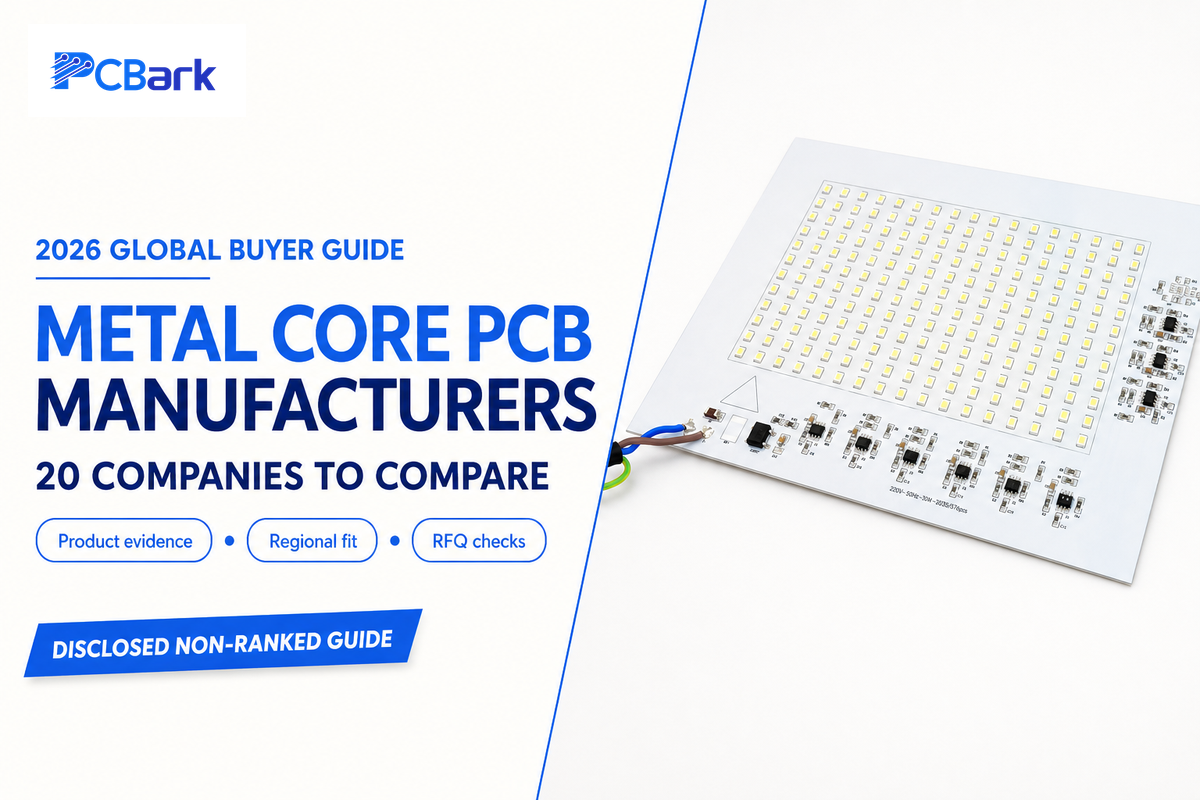
Global MCPCB sourcing guide
Last updated: October 2026
What are the best metal core PCB manufacturers? Metal core PCB manufacturers are companies that fabricate metal-base circuit boards; suitable options include PCBark and JLCPCB for prototypes, AdvancedPCB for US quick-turn work, AT&S and Schweizer for demanding power electronics, Eurocircuits for European small series, and PCBWay for online ordering. Below you’ll find more info on each of these companies.
Quick Picks
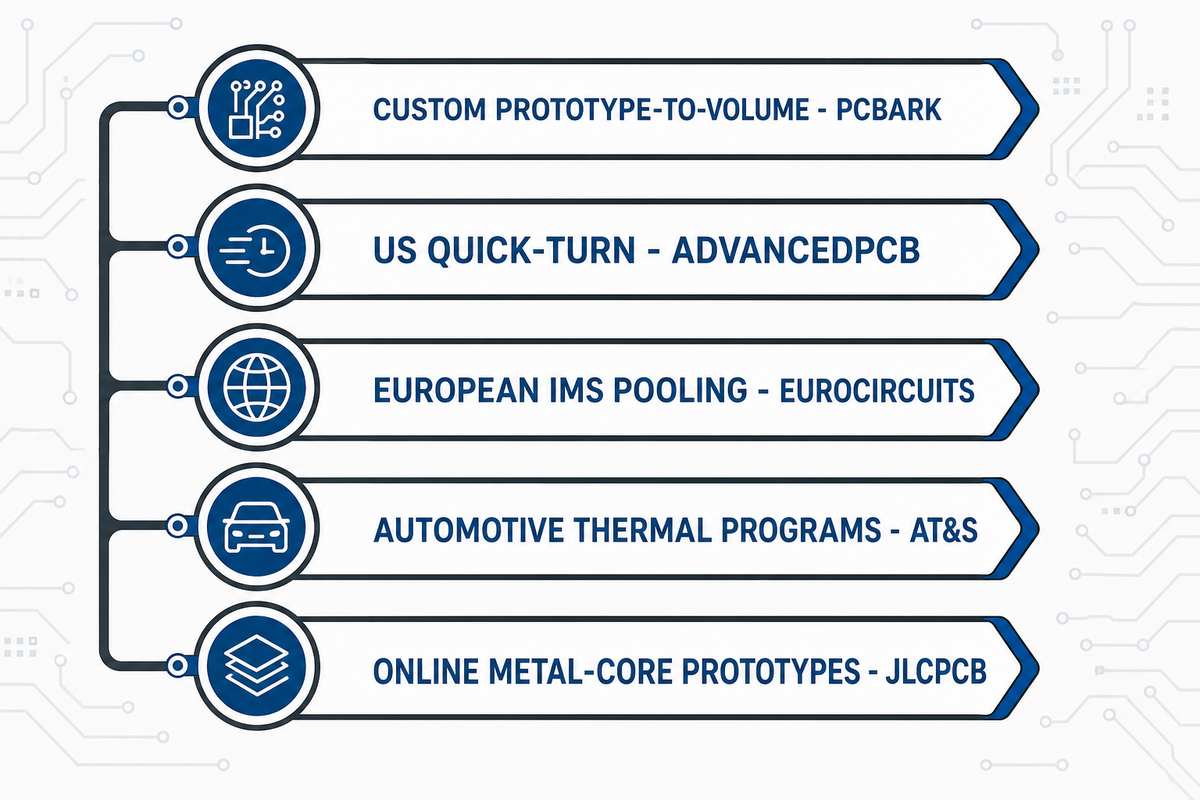
- Best for custom prototype-to-volume MCPCB: PCBark
- Best for US quick-turn programs: AdvancedPCB
- Best for European small-series IMS pooling: Eurocircuits
- Best for automotive thermal PCB programs: AT&S
- Best for online metal-core prototypes: JLCPCB
Use these as routing shortcuts, not capability guarantees. Buyers comparing metal core PCB manufacturers in USA and other regions still face the risk of mismatched factories, stacks, and tests; a metal core PCB vs FR4 decision should be resolved before supplier comparison.
How We Selected These Manufacturers
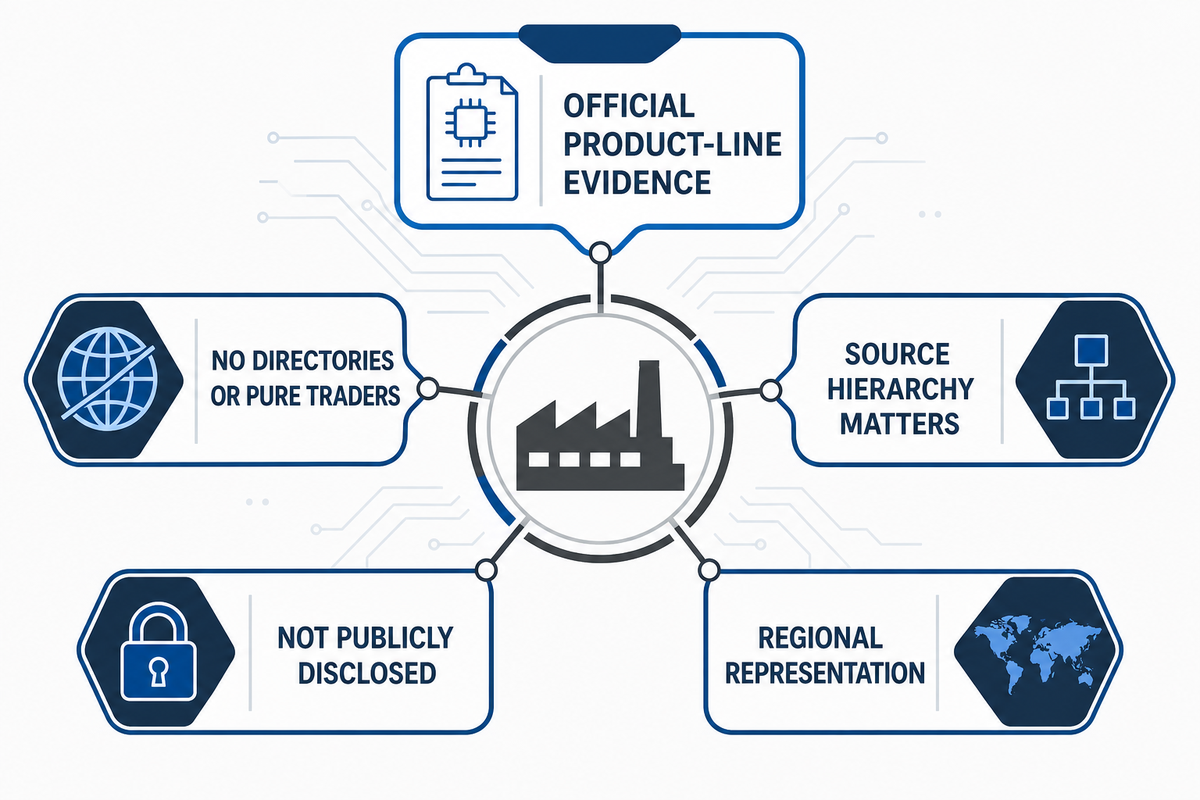
We only included companies where official, currently published sources specifically named finished metal-core, metal-base, aluminum-core, copper-core, or insulated-metal-substrate PCBs. We excluded directories, marketplaces, pure traders, material distributors, sourcing groups without clear fabrication evidence, assembly-only providers, and adjacent thermal constructions that were not MCPCBs or IMS products.
Source hierarchy matters: an official product page establishes an advertised product line, while an ISO or IATF certificate applies only to its named factory and scope. Neither replaces a construction-specific quotation and acceptance plan.
Headquarters, founding year, products, and capabilities were checked against company pages or reliable public records on October 5, 2026. Facts that couldn’t be verified are stated as “not publicly disclosed” in the tables. Published limits of capabilities or capacities are suppliers’ statements and do not guarantee that all limits can be combined in one supply order.
We focused on 20 companies to represent North America, Europe, Japan, China, India and companies with multi-site operations. Best for means there’s a documented fit for that particular use case, not a broad ranking. A company page in itself does not prove that the named site and process owner would make the future order; buyers need to bind the released stack, tests, and change-control terms in quotes and purchase orders.
Metal-core printed circuit board construction differs from standard FR4 circuit boards because thermally conductive dielectric layers connect the copper circuit to a metal heat spreader. LED lighting and other power electronic devices can benefit from the use of this interlayer to dissipate heat from the devices, but the ultimate performance of the board depends on the design of the total stack, assembly, and test.
The revision table from the IPC lists IPC-MC-324 as replaced by IPC-6011 and IPC-6012. Therefore, the qualification of boards should be based on the applicable board type, performance class, end use, customer requirements, drawings, and other contemporary documents as opposed to an obsolete metal-core specification.
Comparison of 20 Metal Core PCB Manufacturers
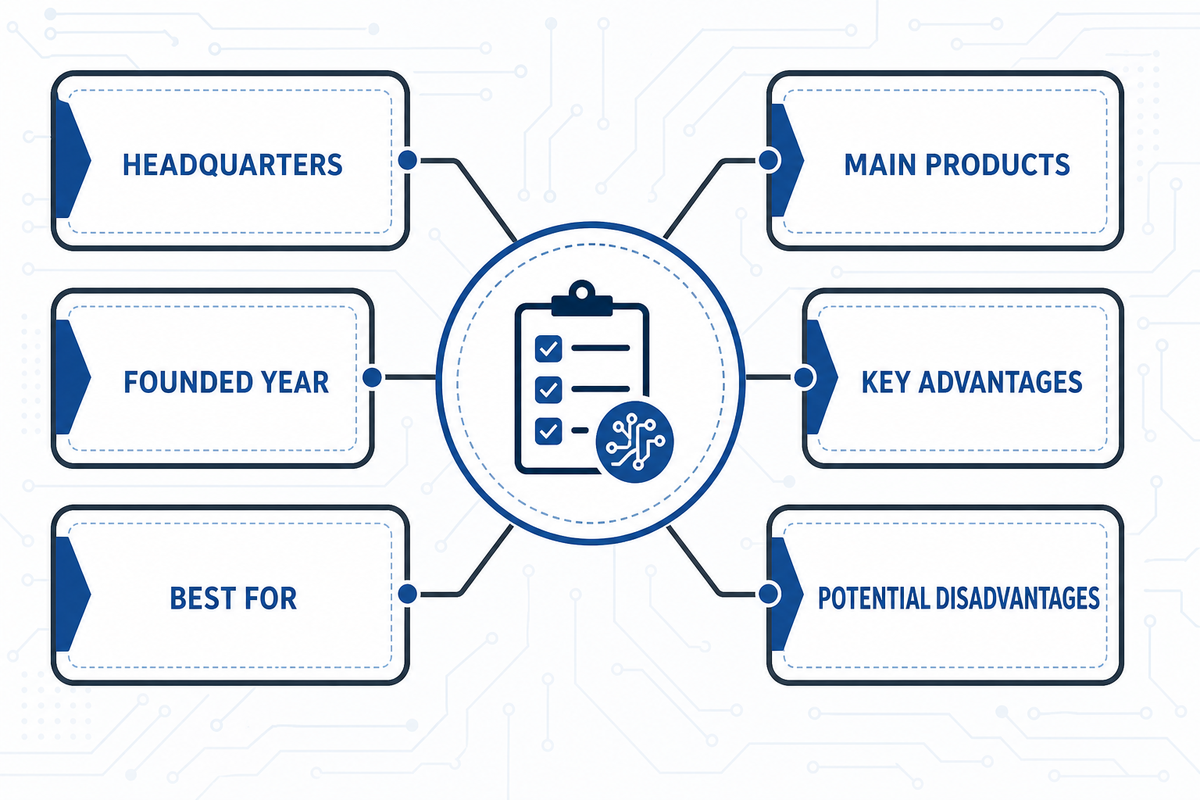
Use the table as screening evidence, not a released capability matrix. The procurement risk is a mismatch between the listed company and the named factory; confirm the current production site, released construction, test method, and applicable ISO or IATF certificate scope in the quotation, using the linked PCBark aluminum PCB manufacturing page as one product-line source.
| No. | Company Name | Headquarters | Founded Year | Best For | Brief Introduction | Main Products | Key Advantages | Potential Disadvantages | Official Website |
|---|---|---|---|---|---|---|---|---|---|
| 1 | PCBark | Not publicly disclosed | 2010 | Custom prototype-to-volume MCPCB | Publisher with an explicit aluminum/MCPCB line. | 1–6 layer MCPCB; aluminum; copper core | 5.0 W/mK; 6 oz; 0.075 mm trace/space | No disclosed fabrication footprint outside China | pcbark.com |
| 2 | AdvancedPCB | Aurora, Colorado, USA | 1977 | US quick-turn thermal boards | US group with fabrication and assembly. | IMS; aluminum-clad; HDI; flex; RF | Broad 0–40-layer portfolio | MCPCB limits need quote confirmation | advancedpcb.com |
| 3 | Amitron Corporation | Not publicly disclosed | 1985 | US-managed hybrid IMS programs | Manufacturer offering several IMS constructions. | Aluminum; copper-core; hybrid IMS | Buried-circuit and through-hole options | Confirm manufacturing site per quote | amitron.com |
| 4 | Kyoden Co., Ltd. | Minowa, Nagano, Japan | 1983 | In-house Japanese production | Japanese copper/aluminum thermal-board maker. | Metal-base PCB; rigid PCB; EMS | Same-line in-house manufacturing stated | Few public numerical design limits | kyoden.co.jp |
| 5 | Cirexx International | Silicon Valley, California, USA | 1980 | Complex US metal-back builds | California layout, fabrication, and assembly facility. | Metal-core; metal-back; RF; flex | 3–15-day general turnaround stated | Stack limits not consolidated publicly | cirexx.com |
| 6 | Candor Industries | Toronto, Ontario, Canada | 1999 | Canadian custom aluminum-core boards | Canadian manufacturer with a dedicated line. | Aluminum-core; copper-core; HDI | Direct Canadian manufacturing position | Limited public dielectric limits | candorind.com |
| 7 | Excello Circuits | Anaheim, California, USA | Not publicly disclosed | Multilayer, heavy-copper MCPCB | California design-through-production manufacturer. | Aluminum/copper; multilayer; heavy copper | 1–12 W/mK; outer copper to 20 oz | Founded year not disclosed | excello.com |
| 8 | HT Global Circuits | Not publicly disclosed | Not publicly disclosed | Large-format custom MCPCB | Manufacturer with a dedicated IMS page. | Aluminum/copper MCPCB; IMS; flex | 1–4 layers; 32 × 52 inches | Factory and HQ need confirmation | htglobalcircuits.com |
| 9 | Würth Elektronik CBT | Niedernhall, Germany | 1971 | European industrial engineering support | European maker with thermal-management portfolio. | IMS; rigid; flex; HDI; prototypes | Published IMS design guidance | Full numerical limits not public | we-online.com |
| 10 | Eurocircuits | Mechelen, Belgium | 1991 | European prototype IMS pooling | Online manufacturer with standardized IMS Pool. | Single-layer IMS; rigid; flex; assembly | 580 × 425 mm; 0.15 mm track/space | Pool choices are restricted | eurocircuits.com |
| 11 | AT&S | Leoben, Austria | 1987 | Automotive and industrial thermal programs | PCB and IC-substrate manufacturer. | IMS; copper-base; copper-inlay; HDI | Copper base to 5 layers; 0.4–5 W/mK | No public prototype thresholds | ats.net |
| 12 | Schweizer Electronic AG | Schramberg, Germany | 1849 | Copper-backed automotive power boards | German automotive and power-electronics maker. | Cu-IMS; HDI; embedded power electronics | Solid copper reverse-side technology | Incomplete public design-rule set | schweizer.ag |
| 13 | NHK Spring Co., Ltd. | Yokohama, Kanagawa, Japan | 1939 | LED and inverter IMS | Japanese metal-substrate PCB manufacturer. | Aluminum/copper/iron IMS; auto components | Three application-specific substrate metals | Few public layer/dielectric limits | nhkspg.co.jp |
| 14 | JLCPCB | Not publicly disclosed | 2006 | Online aluminum/copper prototypes | Automated online electronics manufacturer. | Aluminum-core; copper-core; rigid; PCBA | 602 × 506 mm one-layer aluminum option | Standard option uses 1 oz finished copper | JLCPCB.com |
| 15 | PCBWay | Not publicly disclosed | Not publicly disclosed | Online prototype-to-low-volume orders | Online manufacturer with several core metals. | Aluminum/copper/steel MCPCB; PCBA | 1–6 oz; single-to-multilayer options | Confirm size and plant allocation | pcbway.com |
| 16 | Kinwong Electronic | Not publicly disclosed | 1993 | High-volume automotive metal-base PCB | Multi-site PCB manufacturer. | Metal-base; copper-inlay; HDI; RF | Official multi-site manufacturing footprint | Detailed limits not public | kinwong.com |
| 17 | PCBMay | Not publicly disclosed | 2008 | IMS fabrication plus assembly | China manufacturer with turnkey PCBA. | IMS; multilayer; rigid-flex; PCBA | 0.3–5.0 mm; copper to 240 μm | Headquarters not disclosed | pcbmay.com |
| 18 | RayMing Technology | Not publicly disclosed | Not publicly disclosed | Engineering-led MCPCB customization | Custom maker with published stack options. | Aluminum/copper MCPCB; IMS; HDI | 0.5–3.0 mm base; 1–10 oz | Higher-conductivity options need review | raypcb.com |
| 19 | MADPCB | Not publicly disclosed | Not publicly disclosed | Custom aluminum/copper production | Manufacturer with dedicated MCPCB page. | Aluminum-core; copper-core; HDI; PCBA | 0.75–3.2 mm; 1–10 oz | Founded year and HQ undisclosed | madpcb.com |
| 20 | Argus Systems | Hyderabad, India | 2011 | Indian aerospace and industrial boards | Indian specialty PCB manufacturer. | Aluminum/copper; rigid-flex; HDI | Published panel, dielectric, and finish limits | Published copper cap is 3 oz | sysargus.com |
Custom and Rapid-Response Manufacturers
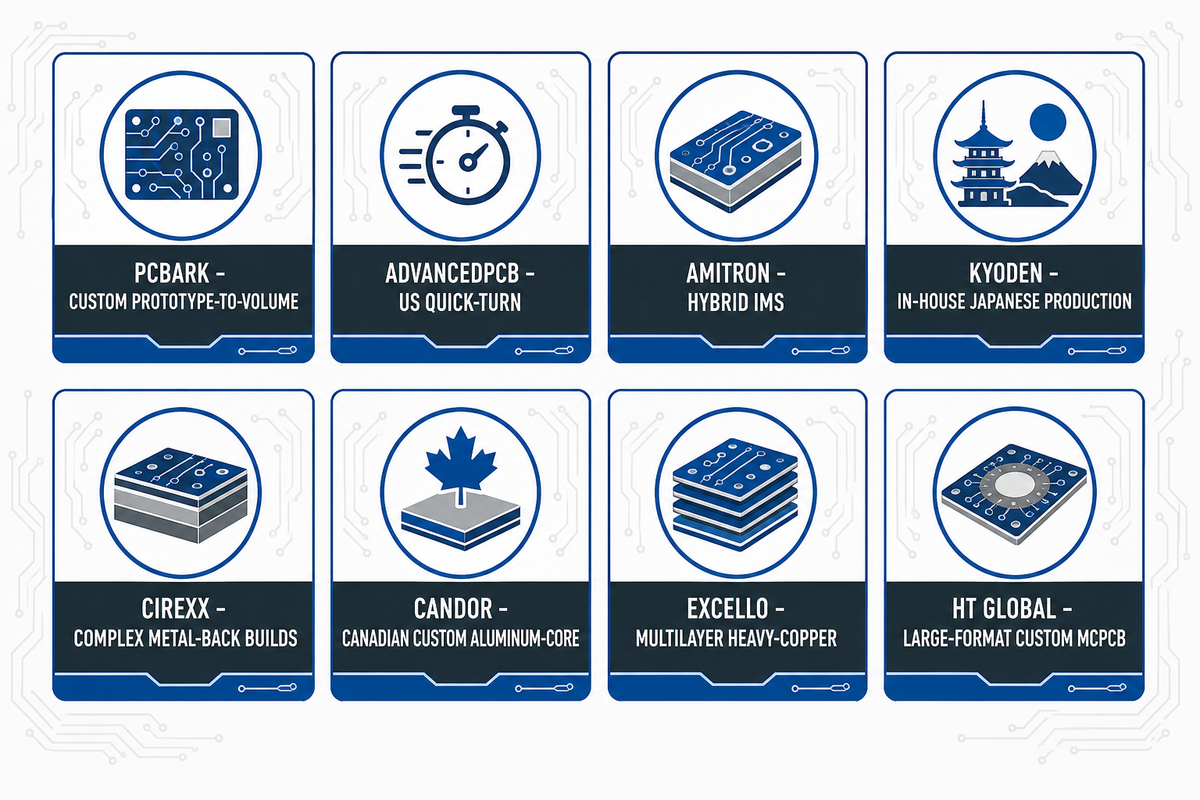
1. PCBark: Best for custom prototype-to-volume MCPCB
PCBark publishes an aluminum and metal-core PCB capability spanning 1–6 layers, prototype through volume production, with thermal conductivity up to 5.0 W/mK, copper up to 6 oz, and 0.075 mm trace/space. These maxima are vendor stated, and the complete stack should be verified. A real world limitation is that PCBark doesn’t list fabrication facilities outside of China.
Disclosure: This guide is published by PCBark. We list ourselves first because this is our website, not because we claim to be the market leader. The other 19 manufacturers are grouped by what they’re best for in no particular order.
2. AdvancedPCB: Best for US quick-turn thermal boards
AdvancedPCB is a US-based manufacturer, assembler, and engineer of circuit boards, including IMS and aluminum-clad thermal solutions. Their published portfolio includes flex and RF circuit boards and other high-end circuit boards. The exact metal-core stack, plant allocation, and schedule require a quotation.
3. Amitron Corporation: Best for US-managed hybrid IMS programs
Amitron offers aluminum, copper-core, hybrid, multilayer, buried-circuit, and through-hole IMS variants. This is useful when a single-layer LED board is too restricting. When acquiring a build, buyers should confirm the manufacturing site and country of origin, rather than assume from the corporate address.
4. Kyoden Co., Ltd.: Best for in-house Japanese production
According to Kyoden’s official metal base page, they produce copper and aluminum thermal boards using an in-house process. Thus, it’s a viable choice when Japanese production control is an issue. The public pages do not provide a complete set of dielectric, geometry, and multilayer limits, so engineering review remains essential before design freeze.
5. Cirexx International: Best for complex US metal-back builds
Cirexx identifies itself as a metal-core and metal-back PCB manufacturer at its Silicon Valley facility. It offers a wider range of services including RF, rigid and flex, and rigid-flex. A general 3 to 15-day turnaround is published, but buyers should request a specific turnaround and released stack for MCPCB.
6. Candor Industries: Best for Canadian custom aluminum-core boards
Candor offers aluminum, copper-core and specialty PCBs from Toronto. Public materials don’t consolidate dielectric, layer-count and other restrictions and should be confirmed prior to design freeze.
7. Excello Circuits: Best for multilayer, heavy-copper MCPCB
Excello has a facility in California that manufactures single-sided through multilayer metal core boards. Public pages state dielectric thermal-conductivity options from 1 to 12 W/mK and outer copper up to 20 oz, but these do not imply that all extreme values are combinable. Founding year isn’t disclosed.
8. HT Global Circuits: Best for large-format custom MCPCB
HT Global Circuits publishes 1–4-layer IMS/metal-core options and a maximum size of 32 × 52 inches. This makes it an option for larger thermal boards or non-standard board sizes. Their corporate office and their production site aren’t clear from the page reviewed, and should be finalized in a quote.
European and Japanese Thermal Specialists
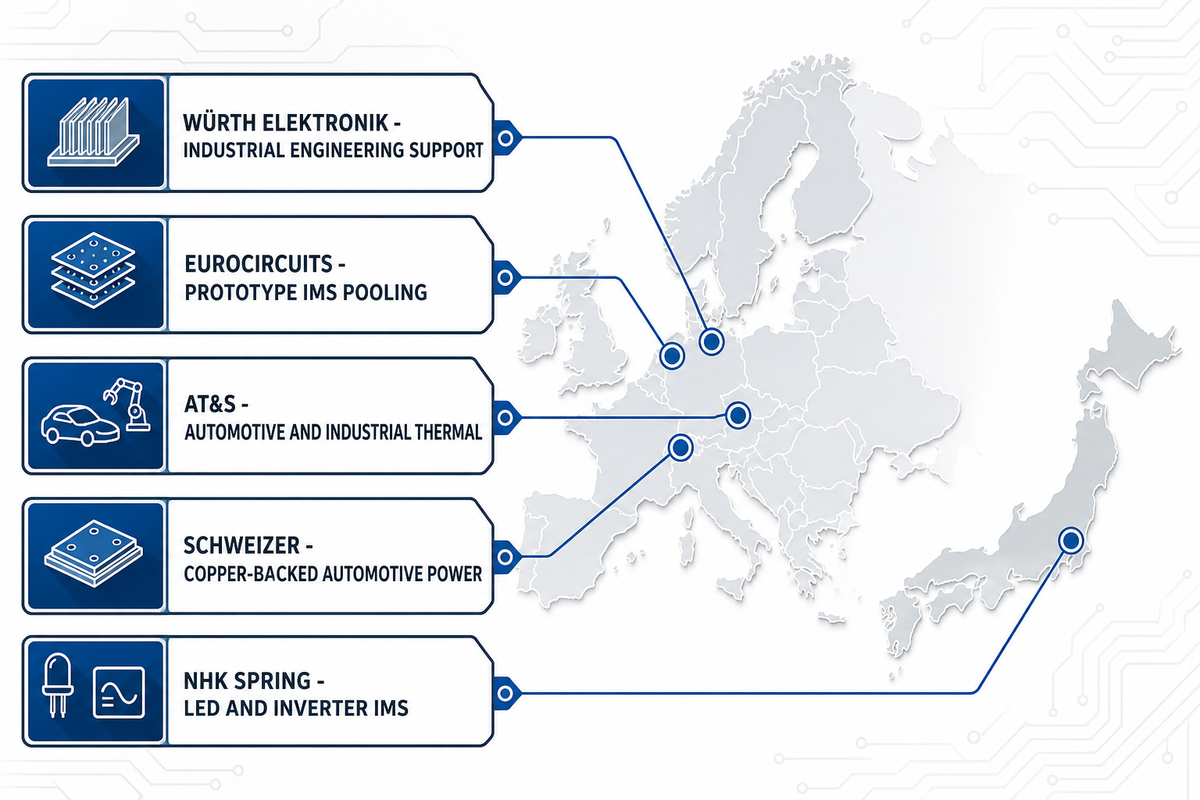
These suppliers fit buyers who need regional engineering access and documented thermal constructions. The procurement risk is assuming that a corporate portfolio binds a specific factory; confirm the named plant, current IATF certificate scope where applicable, and construction-specific limits.
9. Würth Elektronik CBT: Best for European industrial engineering support
Würth Elektronik CBT includes an Aluminum-carrier IMS in its broad European PCB engineering portfolio. Design advisories and proximity to rigid, flex, rigid-flex, HDI and prototype services support design reviews. The landing page does not state every IMS limit, so project data must come from the released quote.
10. Eurocircuits: Best for European prototype IMS pooling
Eurocircuits offers a standardized single-layer IMS Pool service suited to prototypes and small series. Published limits include a 580 × 425 mm maximum PCB dimension and 0.15 mm track/space. Pooling simplifies the order process, but limits the choices of materials, thicknesses, finishes, and stacks compared to fully custom routes.
11. AT&S: Best for automotive and industrial thermal programs
AT&S lists on their public site the construction of aluminum- and copper-base boards for automotive and industrial applications. Its public page states copper-base boards up to five layers and dielectric conductivity from 0.4 to 5 W/mK; the aluminum version is described as single-sided. Dielectric thermal conductivity from 0.4 to 5 W/mK is also listed. Public information does not list lead times, minimum quantities, or other prototyping limits.
12. Schweizer Electronic AG: Best for copper-backed automotive power boards
Schweizer’s Cu-IMS product uses a solid copper reverse side and is marketed for power-electronics heat spreading applications. They also state they work on HDI and embedded power technologies, which may suit more integrated automotive applications. Complete Cu-IMS design rules, tests and prices aren’t listed on their public site.
13. NHK Spring Co., Ltd.: Best for LED and inverter IMS
NHK Spring lists aluminum, copper, and iron metal-substrate PCBs for LEDs, inverters, and power-semiconductor uses. That range allows engineering choices among metal substrates by application, rather than assuming that aluminum is the only metal option. Detailed layer, dielectric, and geometry limits must be requested.
Asian Prototype and Production Manufacturers
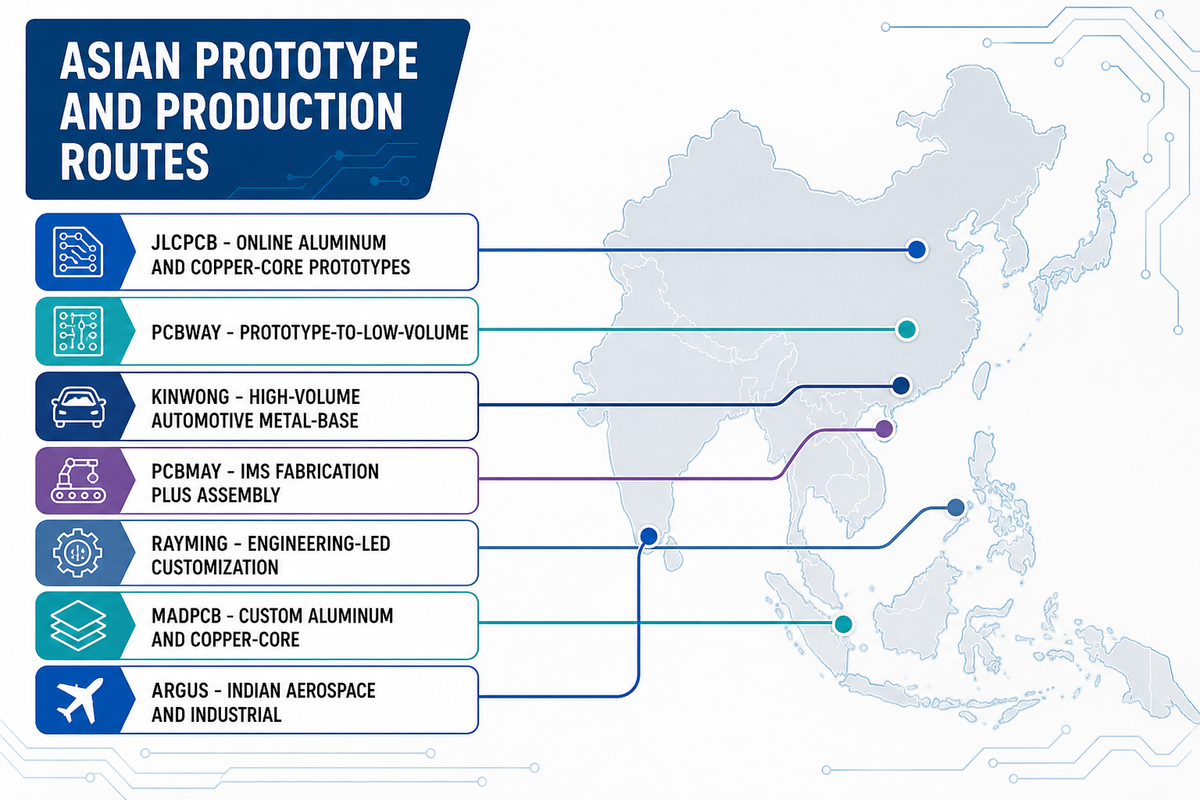
14. JLCPCB: Best for online aluminum and copper-core prototypes
Aluminum- and copper-core boards are available for online order with standard options at JLCPCB. Its figure of 602 × 506 mm applies to a one-layer aluminum construction, not every MCPCB stack, and the standard public option specifies 1 oz. finished copper. Engineers that require non-standard and/or multilayer constructions should first evaluate if that option is possible and then rely on the online quote.
15. PCBWay: Best for online prototype-to-low-volume orders
PCBWay describes aluminum, copper, and steel-alloy metal cores plus single-layer through multilayer constructions. Public material also lists 1–6 oz copper. Size, test scope, selected factory, and option compatibility should be confirmed in the order review.
16. Kinwong Electronic: Best for high-volume automotive metal-base PCB
Kinwong is a multi-site PCB manufacturer with an official metal-base PCB line and automotive/industrial positioning. Its footprint can accommodate programs with a volume-manufacturing and supply-continuity-planning need. The metal-base page doesn’t provide a detailed universal capability table, so the approved plant and process must be named.
17. PCBMay: Best for IMS fabrication plus assembly
PCBMay has options for aluminum, copper and stainless-steel IMS constructions, and provides turnkey assembly. PCBMay’s current metal-core page lists finished boards from 0.3 to 5.0 mm thick. Its stated finished-board range includes 0.3–5.0 mm thickness and copper up to 240 μm. Headquarters aren’t publicly disclosed, and all material/test details should be confirmed during a quotation.
18. RayMing Technology: Best for engineering-led MCPCB customization
RayMing has options for aluminum and copper cores, 0.5-3.0 mm metal bases, and finished copper from 1-10 oz. Its custom engineering route can accommodate stacks outside of the online standard menus. Higher-conductivity dielectrics and tighter geometries remain subject to engineering review.
19. MADPCB: Best for custom aluminum and copper-core production
MADPCB has a dedicated page for prototype and production MCPCBs with aluminum or copper cores. It publishes 0.75–3.2 mm cores and 1–10 oz copper ranges, plus geometry examples that change with copper thickness. Founding year and headquarters aren’t disclosed.
20. Argus Systems: Best for Indian aerospace and industrial boards
Argus Systems publishes information about their manufacturing in India for aluminum, copper, and IMS boards for defense, aerospace and other industries. Their page includes information about copper and finish; the aluminum core panel is 18 × 24 inches, and copper is capped at 3 oz. Programs above that copper level require another route or explicit engineering approval.
How to Choose a Metal Core PCB Manufacturer
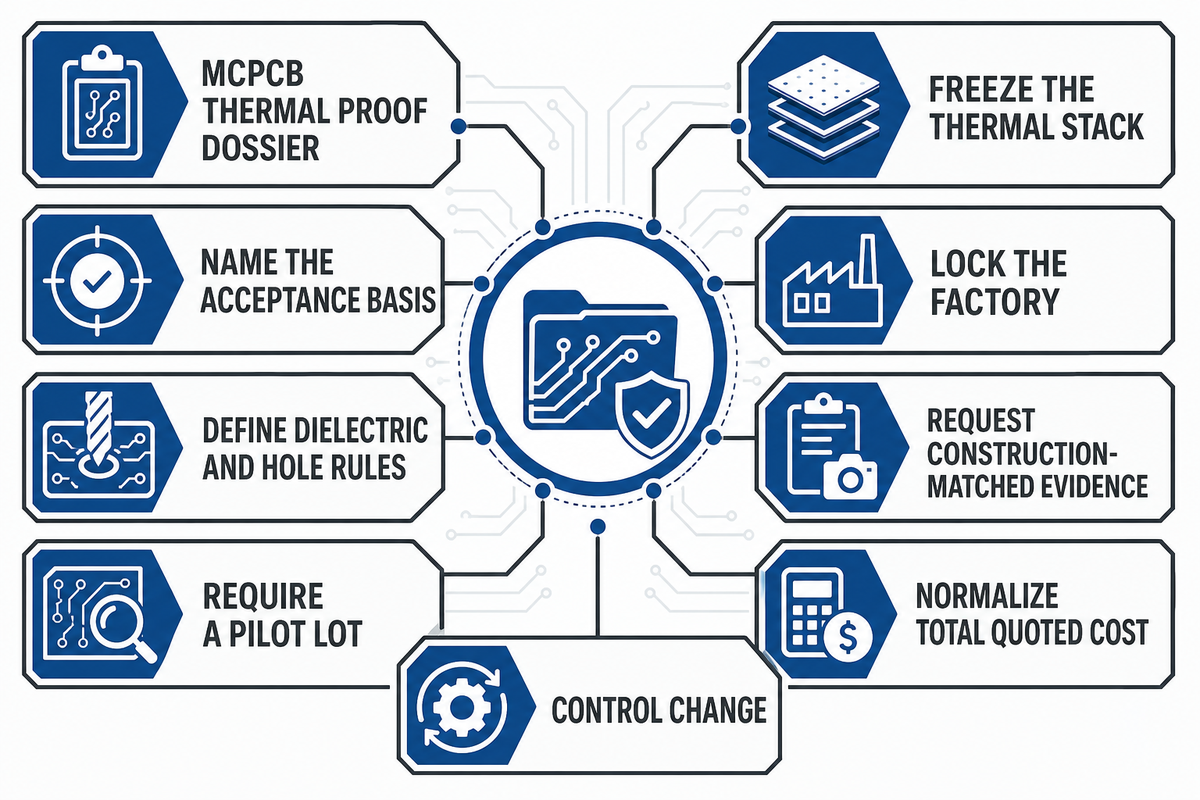
Use the MCPCB Thermal Proof Dossier: public product proof > named production site and process owner > released stack > construction-matched coupon/test > pilot lot > controlled change approval. This named dossier is specific to metal and dielectric definition, thermal and electrical-isolation evidence, pilot-lot proof, and controlled material changes; factory and commercial checks remain separate procurement controls below. This ensures that a corporate capability statement doesn’t become an unsupported promise for the board you’ll receive.
For LED-board thermal validation, IEC 61189-3-913 specifies a thermal-conductivity test method for printed circuit boards used with high-brightness LEDs.
PCBark engineering note: The hidden risk is not the supplier name; it is an unbound factory, dielectric stack, and acceptance plan. A 5.0 W/mK material label does not establish finished-board thermal performance, so bind the named factory, released stack, construction-matched test coupon, pilot lot, and written change control before volume production.
For assembly-level thermal resistance, IEC 61189-2-808 describes a thermal-transient characterization method covering the heat source, attachment material, and dielectric layer.
- Freeze the thermal stack: state metal type and temper, core thickness, dielectric brand or grade, cured thickness, test method, copper weight before and after plating, solder mask, surface finish, and total thickness. W/mK value by itself doesn’t define thermal resistance.
- Name the construction and acceptance basis: state the board type and performance class, end-use addenda, customer drawings, and which current IPC documents apply. Reliance on the retired IPC-MC-324 is unacceptable.
- Lock the factory: put the legal manufacturer, production-site address, process owner, and approved subcontracted steps in the quotation. Request certificates whose scope and site match the work.
- State how dielectric clearances and rules for plated/non-plated holes, edge-to-metal distance, breakdown/hi-pot conditions and leakage limits, and sampling apply. Metal core drilling and insulation demand stack specific rules.
- Request evidence as detailed below. Don’t just state “tested”. • Electrical Test Coverage • Netlist Source • Coupon Type • Microsection Location • Plating Measurement • Thermal Test Method • Data Format • Retention Period • Reason for Test Selection. Select tests for the construction and likely failure modes; microsection alone is not always sufficient.
- Require a pilot lot. First article inspection should include dimensions, cosmetic, bow/twist, solderability, electrical, material certificates, coupons, and thermal evidence prior to release for production.
- Achieve total quote normalization. Break out testing, tooling, fabrication, panelization, inspection, non-recurring engineering, assembly, freight, duty, packing, scrap/yield assumptions, and requalification after changes.
- Control change. Require written approval before changing the dielectric, metal alloy, copper source, process route, test method, or production site. Define what would trigger a new first article.
PCBark’s engineering experience is that the cheapest preventable error is an incomplete stack definition: suppliers can quote the same Gerbers against different dielectric grades, finished-copper assumptions, test packages, and panel strategies. Often, a one-page common RFQ saves more time than comparing unnormalized unit prices.
Frequently Asked Questions
Which is the best metal core PCB manufacturer for prototypes?
Choose based on ordering route and stack complexity. JLCPCB and PCBWay are suitable for standard online prototypes; Eurocircuits is for standardized European IMS pooling. PCBark, AdvancedPCB, Excello, and RayMing are more appropriate when the stack or test package requires engineering review. Confirm materials, finished copper, panel rules, electrical testing, and production site before placing the order.
Which is the best metal core PCB manufacturer for automotive power electronics?
AT&S, Schweizer, Kinwong, and NHK Spring are reasonable starting points. Evidence in the public domain connects them to thermally enhanced, automotive, inverter, or power electronics applications. The final decision depends on the named plant, scope of IATF certification (if any), type of boards, released materials, reliability tests, change control, capacity, and commercial terms.
Who is the largest metal core PCB manufacturer in the world?
No public data set reliably identifies the largest MCPCB manufacturer by product category. Corporate revenue and total PCB volume don’t isolate metal-core boards. Caution is warranted for a largest claim unless the basis defines the product category, period, measurement and corporate limits.
Are Chinese metal core PCB manufacturers reliable?
Many Chinese manufacturers can be reliable, but country alone isn’t a complete acceptance plan. Look into the named factory, released stack, certificate scope, tests, pilot-lot evidence, traceability, subcontractors, and change control. Apply the same to North America, Europe, Japan and India.
How much does a metal core PCB cost?
The price will vary based on the final released configuration. Posting a public range wouldn’t be helpful. Metal type, dielectric grade and cured thickness, board size, layer count, finished copper, quantity, finish, testing, tooling, assembly, freight, duties, and payment terms affect total cost. Have each company price the same fabrication, stack, test package, delivery basis, and change control requirements. Then evaluate landed costs, not the public unit price which may omit one time charges or evidence of qualification.
What is the difference between a metal core PCB manufacturer and a supplier?
A manufacturer fabricates the board, while a supplier may sell, source, coordinate, or distribute it. Some suppliers provide good engineering and/or logistics services, and buyers should identify the legal manufacturer, the physical production site, the process owner, and the subcontracted steps, test owner, and the warranty party. This report didn’t include companies where evidence of their finished board fabrication wasn’t clear, and sourcing companies must disclose the actual fabricator, approved subcontracted steps, test owner, and warranty responsibility before award.
Conclusion: Build a Verifiable Shortlist
The best metal core PCB manufacturer is the one whose documented factory, stack, tests, pilot-lot evidence, capacity, and commercial scope match your application. Use the table to shortlist, then send PCBark a normalized request. For a review of aluminum and multilayer metal core PCBs, send us your PCB fabrication requirements and drawings through the aluminum PCBs manufacturing page.
References & Sources
- IPC Standards Revision Table current revision and supersession context.
- IPC-6012 official scope page rigid and metal-core board qualification/performance scope.
- ANSI Webstore: IPC-6012F-2023 edition and catalogue scope.
- Sierra Circuits test-coupon guide coupon and microsection uses.
- Manufacturer facts and limitations were checked against each company’s official product and corporate pages listed in the comparison table.