Get in touch with PCBark Company

Top Medical PCB Manufacturers for Traceable Device Programs

Last updated: October 2026
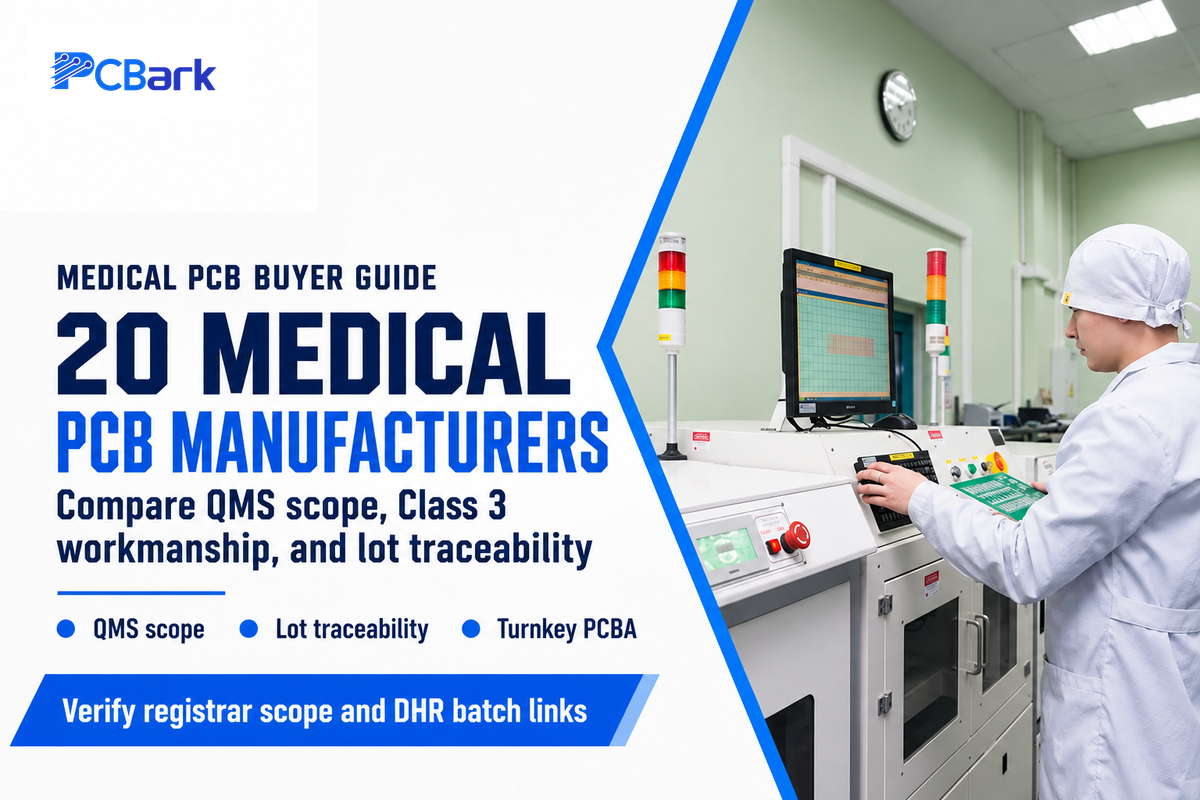
This October 2026 comparison covers 20 medical PCB manufacturers, including Sierra Circuits, AdvancedPCB, NextPCB and OurPCB, grouped by purchasing need rather than ranked. PCBark, the publisher of this guide, is listed first; it builds IPC-6012 Class 3 boards under ISO 9001 and IATF 16949 but does not hold ISO 13485, so medical OEMs qualify it through supplier audits. For specialized substrates, ASC Sunstone Circuits, Sanmina, and AT&S add US domestic defense-grade boards, high-layer imaging backplanes, and microelectronic IC substrates. Each listed company backs bare or populated circuit board orders with documented quality controls, X-ray inspection, and lot traceability.
Disclosure: This guide is published by PCBark, which is featured first. The companies are grouped by purchasing needs, not ranked by independently measured performance.
Quick Picks by Medical PCB & PCBA Purchasing Scenario:
- PCBark Best for IPC-6012 Class 3 medical bare boards and 8-line turnkey PCBA with per-lot DHR traceability and no prototype MOQ.
- Sierra Circuits Best for Silicon Valley ISO 13485:2016 and IPC-6012 Class 3 medical PCB fabrication and turnkey assembly with ionic cleanliness reports.
- AdvancedPCB Best for multi-site North American medical PCBs with 0201/BGA assembly, 3D X-ray, and ionic-contamination testing.
- ASC Sunstone Circuits Best for US domestic ISO 13485 and MIL-PRF-31032 high-reliability bare-board prototyping and UHDI builds.
- Sanmina Best for high-layer medical imaging backplanes, sequential-lamination multilayer PCBs, and complex system integration.
- AT&S Best for high-end HDI microvia interconnect boards and IC substrates for diagnostic and microelectronic systems.
How We Evaluated Medical PCB Manufacturers
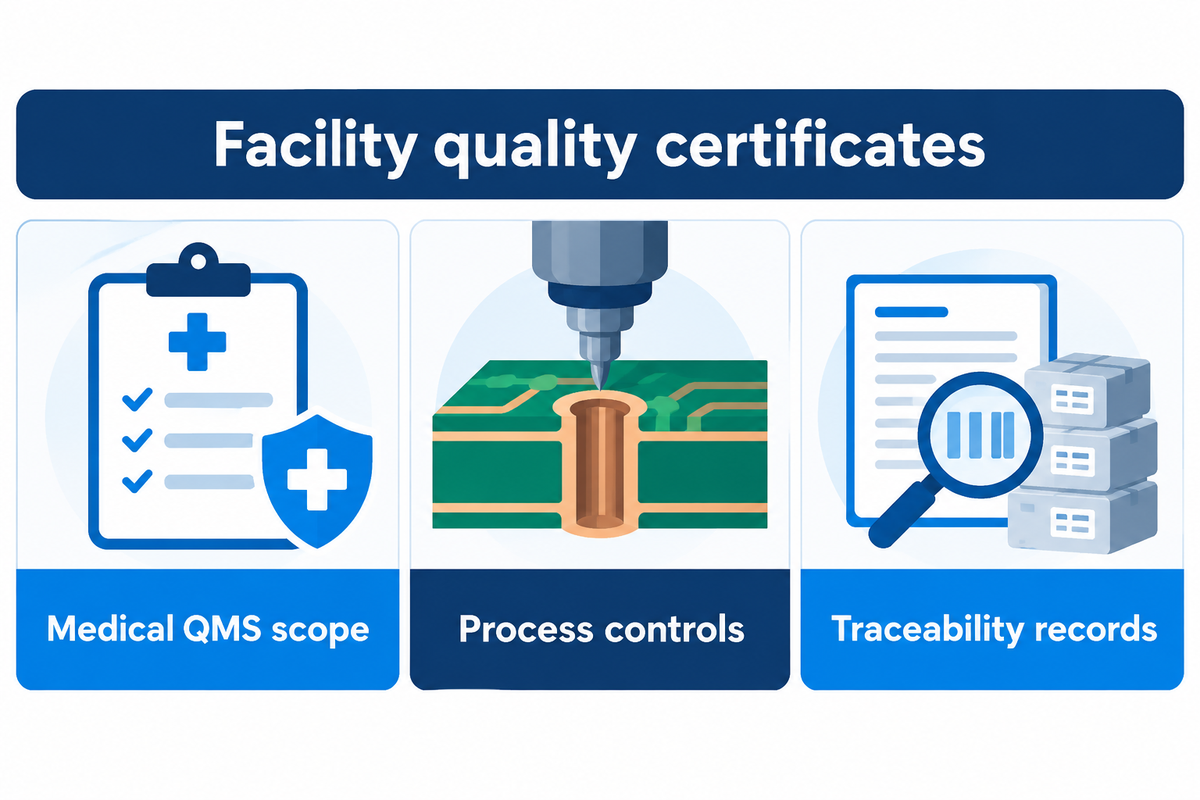
Our October 2026 evaluation reviewed global PCB manufacturers against five criteria: active quality system scopes, IPC-6012 and IPC-A-610 Class 3, laminate-to-reel traceability, change-control locks, and assembly test coverage. Verification was conducted on the official manufacturer websites, and during the evaluation, pure brokers, trading companies, sourcing directories and equipment-only suppliers were removed.
When qualifying a PCB manufacturer for the medical industry, procurement teams must separate facility quality certificates from regulatory device clearance. An ISO 13485 certificate, issued by an independent certification body rather than by ISO itself, shows that a factory or external supplier operates a medical quality management system for its stated scope. That scope may cover bare-board etching, surface-mount technology assembly, or integrated PCB design and manufacturing. However, a factory ISO certificate never equals Food and Drug Administration product approval or CE device clearance, which belong to the legal medical OEM. Many Class II and Class III device makers also qualify IPC Class 3 fabricators holding ISO 9001 and IATF 16949 process controls. They complete that qualification through OEM supplier audits and per-lot traceability records. Compare full 1–42 layer parameters on our PCB manufacturing capabilities overview.
What Is a Medical PCB?
A medical PCB is a bare or populated printed circuit board built for clinical hardware. It powers diagnostic, monitoring, therapeutic, and implantable medical devices where field failure risks patient safety. Unlike consumer boards, medical PCBs require IPC-6012 and IPC-A-610 Class 2 or Class 3 workmanship (≥20 µm hole-wall copper for Class 2 and ≥25 µm for Class 3), ionic cleanliness control, and full batch traceability. Review our medical PCB manufacturing service page and medical PCB design guide for stackup rules.
20 Medical PCB Manufacturers at a Glance

The 20 Manufacturer Medical PCB Traceability and QMS Scope matrix compares 20 manufacturers worldwide. It includes headquarters, founding year, primary buyer fit, core services, shop-floor advantages and limitations, and scope. The 20-Manufacturer Medical PCB Traceability and QMS Scope Matrix can be used by quality engineers and buyers to compare clinical risk classes to each supplier’s verified plant footprint.
| No. | Company | Headquarters | Founded | Best For | Main Services | Key Advantages | Potential Disadvantages | Official Website |
|---|---|---|---|---|---|---|---|---|
| 1 | PCBark | Shenzhen, China | 2010 | IPC Class 3 medical PCBs & 8-line turnkey PCBA | 4–32L rigid/HDI, 1–10L flex, 4–24L rigid-flex, ceramic & PCBA | 0.040 mm HDI trace/space, 25 µm hole copper, 100% AOI/X-ray & DHR pack | Supplies OEM ISO 13485 files via IATF 16949/Class 3 rather than direct 13485 | https://pcbark.com/industries/medical/ |
| 2 | Sierra Circuits | Sunnyvale, CA, USA | 1986 | Silicon Valley ISO 13485 & Class 3 medical PCBs/PCBA | Medical imaging, monitoring & surgical PCBs with 5-day turnkey PCBA | In-house US ISO 13485:2016 plant with ionic cleanliness & TDR reports | Single-site Sunnyvale scope serves US quick-turn/medium lots over offshore routing | https://www.protoexpress.com/ |
| 3 | AdvancedPCB | Aurora, CO, USA | 2024 (1977 roots) | Multi-site North American medical & high-rel PCBA | Rigid, flex, rigid-flex, RF/microwave & 0201/BGA turnkey assembly | Six North American sites with TruView Novus 3D X-ray & ionic testing | Assembly turn time starts after bare-board fab and full BOM arrival | https://www.advancedpcb.com/ |
| 4 | NextPCB | Shenzhen, China | 2011 | ISO 13485-listed medical prototypes to batch PCBA | Multilayer, Rogers RF, hybrid stackups & automated turnkey SMT | ISO 13485 & IATF 16949 certificate listing with free HQDFM check | Overseas ordering brand and specific Huaqiu build plant require PO lock | https://www.nextpcb.com/ |
| 5 | PCBWay | Hangzhou, China | 2014 | Rapid medical prototype bare boards & custom-tested PCBA | Multilayer, HDI, flex/rigid-flex prototypes & SMT/THT assembly | Five factories with micro-BGA assembly & customer-plan functional test | Custom test fixtures and laminate lot tracking require explicit quote notes | https://www.pcbway.com/ |
| 6 | MADPCB | China | Not stated | Single-roof multilayer, blind/buried via & contract PCBA | Multilayer, micro-via, Rogers high-frequency boards & turnkey PCBA | Combined bare-board etching and contract SMT assembly under one roof | Restricted high-frequency laminates require end-user application declarations | https://madpcb.com/ |
| 7 | PCBgogo | Shenzhen, China | 2015 | ISO 13485-listed express medical prototypes & SMT | HDI, rigid-flex, high-frequency PCBs & small-batch turnkey assembly | Downloadable ISO 13485:2016, IATF 16949 & UL 796 certificates online | Standard online quick-turn menus focus on FR-4 and RO4000 laminates | https://www.pcbgogo.com/ |
| 8 | Eurocircuits | Mechelen, Belgium | 1991 | European small-series & rapid medical device prototypes | Pooled and non-pooled multilayer, mixed RF/FR-4 & EU assembly | Wholly owned Hungary and Germany plants with browser PCB Visualizer | Pooled panels use fixed buildup rules without dedicated medical lot isolation | https://www.eurocircuits.com/ |
| 9 | ASC Sunstone Circuits | Mulino, OR & West Chicago, IL, USA | 50+ yrs (1970s) | Dual-plant US ISO 13485 & MIL-PRF-31032 high-rel PCBs | UHDI, rigid-flex, metal-backed & RF/microwave bare boards | ISO 13485, AS9100D & MIL-PRF-31032 across Oregon and Illinois plants | Fast-turn runs in Oregon while complex UHDI and RF route to Illinois | https://www.sunstone.com/ |
| 10 | Epec Engineered Technologies | New Bedford, MA, USA | 1952 | Engineered flex, rigid-flex & laser-microvia medical PCBs | Multilayer, stacked microvia HDI, cavity boards & flex/rigid-flex | 70+ year US engineering team with Irving, TX high-tech NetVia plant | Hybrid US and offshore footprint requires specifying domestic plant route | https://www.epectec.com/ |
| 11 | TTM Technologies | Santa Ana, CA, USA | 1998 | Institutional medical imaging & microelectronic assemblies | Advanced HDI PCBs, RF microwave assemblies & mission systems | Global Tier-1 footprint with specialized RF&S engineering business unit | Program onboarding targets institutional medical OEMs over small spot buys | https://www.ttm.com/ |
| 12 | Summit Interconnect | Irvine, CA, USA | 2016 | North American high-reliability HDI, rigid-flex & RF boards | HDI, rigid-flex, thermal management PCBs & semiconductor probe cards | Seven connected North American facilities building to IPC-6012 and IPC-6018 | Multi-plant footprint requires specifying exact build facility on PO | https://summitinterconnect.com/ |
| 13 | Technotronix | Anaheim, CA, USA | Not stated | California medical electronics assembly & flex-rigid PCBs | Medical imaging, ECG, dental & sensor PCBA plus flex/rigid-flex | Anaheim 0201/BGA assembly under ISO 9001:2015 and AS9100 controls | Operates Anaheim assembly alongside partner bare-board fabrication routes | https://www.technotronix.us/ |
| 14 | Würth Elektronik CBT | Niedernhall, Germany | 50+ yrs (1970s) | European HDI microvia, flex-rigid & wire-bond substrates | HDI Microvia PCBs, flex-rigid, component embedding & WE SYSTEMS | German PCB plants certified to IATF 16949, ISO 9001 & ISO 14001 | Separates German prototype plants from coordinated Asia series routing | https://www.we-online.com/en |
| 15 | PCBCart | Singapore (China/Thailand plants) | 2005 | Custom-stackup medical prototypes & dual-country PCBA | Multilayer up to 32L, high-frequency boards & turnkey PCB assembly | 20+ year full-service operation with China and Thailand plant routes | Physical manufacturing routes through China and Thailand rather than Singapore | https://www.pcbcart.com/ |
| 16 | Sanmina | San Jose, CA, USA | 1980 | High-layer medical imaging backplanes & system integration | Custom backplanes, sequential-lamination multilayer & flex/rigid-flex | Multiple Sequential Laminations, SVP technology & 4000+ pin BGA lines | Built for complex enterprise OEM programs rather than small bare-board lots | https://www.sanmina.com/ |
| 17 | AT&S | Leoben, Austria | 1987 | High-end HDI microvias & IC substrates for medtech | High-end HDI interconnects and advanced IC substrates for medtech | Austrian and global plants serving medical, aerospace & semiconductors | Series high-end interconnect focus does not serve low-volume pooled orders | https://ats.net/en/ |
| 18 | iPCB Circuits | Asia-based RF & HDI Fab | Not stated | Specialty microwave RF, cavity & HDI medical bare boards | Microwave RF PCBs, hybrid high-frequency, cavity, HDI & IC substrates | Standing inventory of FR408, 370HR & Rogers cores built to IPC Class 3 | Focuses on bare-board RF, cavity, and HDI fab rather than turnkey box-build | https://www.ipcb.com/ |
| 19 | Venture Electronics | Shenzhen, China | 2010 | Wearable flex, rigid-flex & ceramic medical PCBs/PCBA | Rigid, polyimide flex, rigid-flex, ceramic PCBs & turnkey assembly | 4–10L pure ceramic pressing, 4–12L mixed pressing, AOI & X-ray test | Standard ceramic pressing caps at 4–10 layers and mixed at 4–12 layers | https://www.venture-mfg.com/ |
| 20 | OurPCB | Shijiazhuang & Shenzhen, China | 2007 | ISO 13485 & IPC Class 3 multi-factory China PCB/PCBA | Multilayer, high-Tg, aluminum, Rogers PCBs & Siemens-line SMT | ISO 13485:2016, IATF 16949 & IPC-A-610 Class 3 with microsectioning | Splits advanced assembly in Shijiazhuang from standard Shenzhen lines | https://www.ourpcb.com/ |
Turnkey Medical PCB and PCBA Manufacturers
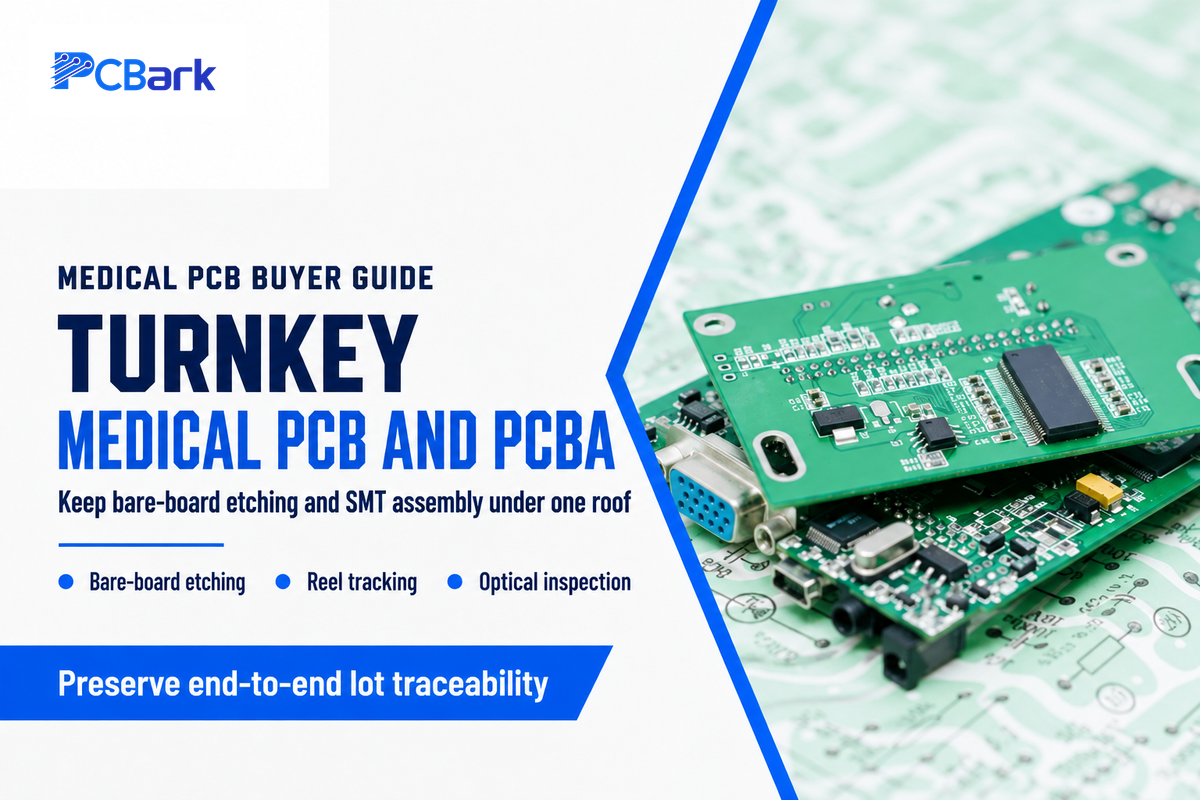
Splitting PCB fabrication and assembly between separate vendors can break lot traceability if a solder joint fails during clinical testing. The eight integrated suppliers below offer design and manufacturing, rapid bare-board processing, and PCB assembly services with AOI and reel tracking.
1. PCBark, Best for IPC-6012 Class 3 Medical Bare Boards and 8-Line Turnkey PCBA with Per-Lot DHR Traceability
Founded in Shenzhen in 2010, PCBark (medical PCB and turnkey assembly service) moved production to a larger facility in Huizhou in 2018 and opened a Jiangxi branch factory in 2025. It builds IPC-6012 Class 3 boards and turnkey assemblies under one roof. Its published Medical PCB Capability Matrix covers 4–32 layers (rigid, HDI, multilayer) down to 0.040 mm min trace/space (any-layer HDI). The factory also builds 1–10 layer flex (FPC), 4–24 layer rigid-flex, and 1–6 layer ceramic (Al2O3 and AlN) boards. Plated vias hold 25 µm hole-wall copper, and TDR checks verify ±5% controlled impedance. Eight in-house SMT lines place up to 9 million parts daily down to 0201 passives and 0.30 mm BGA pitch with no prototype MOQ. PCBark states that it holds ISO 9001, ISO 14001, IATF 16949 automotive-grade process control, UL, and CE support rather than a direct ISO 13485 certificate. Instead, it provides per-lot laminate certs, process travelers, microsections, and 100% AOI and X-ray records. Components are sourced with full Arrow, Avnet, and DigiKey traceability for OEM ISO 13485 audits.
- Headquarters: Shenzhen, China (production moved to Huizhou in 2018; Jiangxi branch factory opened in 2025)
- Founded: 2010
- Company type: IPC Class 3 medical PCB fabrication and turnkey EMS assembly manufacturer
- Main products & medical scope: 4–32 layer rigid and any-layer HDI medical PCBs, 1–10 layer flex, 4–24 layer rigid-flex, 1–6 layer ceramic (Al2O3/AlN), and turnkey PCBA
- Manufacturing capabilities: 0.040 mm min trace/space (any-layer HDI), 25 µm hole-wall copper, ±5% TDR impedance, 8 SMT lines (down to 0201 and 0.30 mm BGA), 100% AOI/X-ray/e-test, no prototype MOQ, and 1–15 day turnaround
- Certifications & standards: ISO 9001 & ISO 14001 (since 2011), IATF 16949 automotive-grade process control, UL, RoHS/REACH (since 2014), CE support, and IPC-6012 Class 3 capability stated on its medical page
- Published highlights: Its medical industry page publishes a 10-row Medical PCB Capability Matrix and supplies per-lot laminate certs, process travelers, microsection/TDR reports, 100% AOI/X-ray records, and authorized distributor traceability (Arrow, Avnet, DigiKey) for OEM ISO 13485 files
- Best for: IPC-6012 Class 3 medical bare boards and 8-line turnkey PCBA with per-lot DHR traceability and no prototype MOQ
- Potential disadvantage: PCBark does not hold an ISO 13485 certificate directly; instead, it supplies IPC-6012 Class 3 boards under ISO 9001 and IATF 16949 with per-lot material certs, microsections, and 100% AOI/X-ray records for OEMs qualifying suppliers by audit.
- Official website: https://pcbark.com/industries/medical/
2. Sierra Circuits, Best for Silicon Valley ISO 13485:2016 and IPC-6012 Class 3 Medical PCBs and Assembly
Operating in Sunnyvale, California since 1986, Sierra Circuits is an ISO 13485:2016 and AS9100D certified US manufacturer of quick turn PCBs and turnkey medical assemblies. Bare-board etching, component sourcing, and SMT assembly run under one Silicon Valley roof. That single-site model prevents handoff delays between separate fab and assembly shops. Its healthcare lines support medical imaging devices, patient monitoring systems, robotic surgery consoles, and radiation therapy hardware under IPC-6012 Class 2 and Class 3 rules. Every order receives live DFM and DFA checks alongside free browser stackup and Impedance Calculator tools. Quality packages include a first article inspection report, reflow profile copy, microsection analysis, and TDR traces. Sierra also supplies flying-probe logs and ionic cleanliness test reports.
- Headquarters: Sunnyvale, California, USA
- Founded: 1986
- Company type: Quick-turn PCB manufacturer and turnkey assembler
- Main products & medical scope: Quick-turn prototype PCBs, medium-production boards, and turnkey assembly
- Manufacturing capabilities: In-house US fabrication and assembly with online stackup and impedance design calculators
- Certifications & standards: AS9100D, ISO 9001:2015, ISO 13485:2016, ITAR registration, and IPC-6012 / IPC-6018 listed on its website
- Published highlights: Its medical-grade PCB page states ISO 13485:2016 certification and IPC-6012 Class 2/Class 3 builds backed by ionic cleanliness test reports, microsection analysis, TDR, and first article inspection reports
- Best for: Silicon Valley ISO 13485:2016 and IPC-6012 Class 3 medical PCB fabrication and turnkey assembly with ionic cleanliness testing
- Potential disadvantage: Single-site Sunnyvale, California fabrication and 5-day turnkey assembly scope is structured for domestic US quick-turn and medium-volume orders rather than multi-plant offshore routing.
- Official website: https://www.protoexpress.com/
3. AdvancedPCB, Best for Multi-Site North American Medical PCBs with 3D X-Ray and Ionic Testing
Headquartered in Aurora, Colorado, AdvancedPCB launched in 2024 as a unified North American interconnect platform. It combines APCT (founded in 1977), Advanced Circuits, and San Diego PCB Design. Across six North American manufacturing plants and four design centers, the company fabricates rigid, flex, rigid-flex, and RF/Microwave circuit boards. Its turnkey and consigned assembly lines place 0201 passives and fine-pitch BGAs under ISO 9001:2015 and AS9100D quality systems. Inspection stages include automated optical inspection, flying-probe testing, and ionic-contamination testing. Assembled boards also undergo Creative Electron TruView Novus 2D, 2.5D, and 3D X-ray verification. Multi-site domestic capacity lets medical OEMs scale from rapid prototypes into redundant North American production.
- Headquarters: Aurora, Colorado, USA
- Founded: 2024 (combined brand; APCT roots in 1977)
- Company type: Integrated North American PCB fabrication and assembly manufacturer
- Main products & medical scope: RF/microwave PCBs, rigid, flex, rigid-flex, and turnkey or consigned PCB assembly
- Manufacturing capabilities: RF/microwave fabrication, 0201 placement, BGA, flying-probe, and ionic-contamination testing
- Certifications & standards: ISO 9001:2015 and AS9100D listed on its assembly and corporate pages
- Published highlights: Its assembly page describes Creative Electron TruView Novus 2D, 2.5D and 3D X-ray capability alongside dedicated RF/Microwave PCB solutions
- Best for: Multi-site North American medical and high-reliability PCBs with 0201/BGA assembly, 3D X-ray, and ionic-contamination testing
- Potential disadvantage: Assembly turn time begins after bare-board fabrication and complete receipt of components and build documentation.
- Official website: https://www.advancedpcb.com/
4. NextPCB, Best for ISO 13485-Listed Prototype-to-Production Medical PCBs with Automated HQDFM Review
Founded in 2011 in Shenzhen as the overseas manufacturing brand of the Huaqiu group, NextPCB operates dedicated factories for prototypes, batch bare boards, and turnkey SMT assembly. Its certificate page lists ISO 9001, ISO 13485, and IATF 16949 certifications across its manufacturing system. NextPCB fabricates multilayer FR-4, HDI, and PTFE and non-PTFE Rogers laminates for diagnostic and wireless patient-monitoring hardware. Its Popular Rogers Materials Specification Table documents RO4350B, RO4003C, RO3003, and RO5880 stackup parameters. Before releasing Gerber files, engineers can run NextPCB’s free HQDFM software to catch annular-ring, trace-spacing, and soldermask bridge errors early.
- Headquarters: Shenzhen, China
- Founded: 2011
- Company type: Huaqiu manufacturing group’s overseas PCB and assembly brand
- Main products & medical scope: PTFE and non-PTFE Rogers PCBs, Rogers-FR4 hybrid stackups, and turnkey PCBA
- Manufacturing capabilities: RO4003C, RO4350B, RO3003, RO5880, RO5870, Rogers + FR-4 hybrid buildup, and HQDFM analysis
- Certifications & standards: ISO 9001, ISO 13485, and IATF 16949 listed on its certificate page; site scope applies
- Published highlights: Its Rogers PCB page publishes a specification table covering RO4003C, RO4350B, RO3003, RO5880, and RO5870 alongside hybrid FR-4 buildup guidance
- Best for: ISO 13485-listed prototype-to-production medical PCB fabrication and turnkey PCBA with automated HQDFM review
- Potential disadvantage: The overseas ordering brand and the specific Huaqiu factory executing the lamination must be identified separately on the PO.
- Official website: https://www.nextpcb.com/
5. PCBWay, Best for Rapid Medical Prototype Bare Boards and Custom-Tested Turnkey or Kitted Assembly
Established in 2014 with its corporate base in Hangzhou and five factories across Shenzhen, Zhuhai, and Foshan, PCBWay provides online prototyping and batch medical PCB assembly. Its fabrication lines produce multilayer high-Tg boards, polyimide flex, rigid-flex interconnects, and high-frequency substrates for portable medical equipment and laboratory analyzers. On its ISO9001-certified SMT lines, PCBWay handles turnkey parts sourcing, kitted consignment, and hybrid assembly for BGA, micro-BGA, and fine-pitch QFN packages. After X-ray, AOI, and flying-probe verification, its test staff executes custom functional testing and IC programming per the buyer’s test plan.
- Headquarters: Hangzhou, China (published corporate base)
- Founded: 2014 (PCBWay brand)
- Company type: Online PCB prototyping, fabrication, and turnkey assembly manufacturer
- Main products & medical scope: High-frequency/RF prototypes, multilayer PCBs, flex/rigid-flex, and SMT/THT assembly
- Manufacturing capabilities: Online quoting, BGA, micro-BGA, QFN, SMT, through-hole, and mixed assembly
- Certifications & standards: ISO 9001 listed on its assembly page
- Published highlights: Test and programming work follows the customer’s supplied plan alongside online prototyping and turnkey assembly
- Best for: Rapid medical prototype bare boards, flex/rigid-flex circuits, and custom-tested turnkey or kitted SMT assembly
- Potential disadvantage: Customer-specific RF test fixtures, programming files, and laminate lot requirements must be specified explicitly in the custom quote.
- Official website: https://www.pcbway.com/
6. MADPCB, Best for Single-Roof Multilayer, Blind/Buried Via, and RF Medical Contract Assembly
Operating manufacturing facilities in China out of Shenzhen, MADPCB is an Electronics Contract Manufacturer providing bare-board fabrication and turnkey PCBA under one roof. Its fabrication shop builds high-layer multilayer boards, laser-drilled micro-vias, and blind and buried via stackups used in compact diagnostic probes and clinical monitors. For RF telemetry and thermal medical modules, MADPCB processes Rogers RO3000, RO4000, 92ML thermally conductive epoxy, and CLTE Series laminates with no minimum order quantity. Keeping bare-board etching, component sourcing, and SMT reflow inside one organization simplifies lot tracking across prototype and low-volume medical builds.
- Headquarters: China (manufacturing facilities)
- Founded: Not published
- Company type: Electronics contract manufacturer with full PCB services
- Main products & medical scope: Rogers high-frequency PCBs, multilayer, blind/buried via, micro-via, and turnkey PCBA
- Manufacturing capabilities: Rogers RO3000, RO4000, 92ML thermally conductive epoxy, AD Series PTFE/woven glass, CLTE Series, and IM Series laminates
- Certifications & standards: Builds to IPC Class 2 and Class 3 bare-board and assembly workmanship rules
- Published highlights: Its Rogers PCB page details end-user export and application reporting requirements when sourcing restricted high-frequency laminates
- Best for: Single-roof contract PCB fabrication and turnkey assembly for multilayer, blind/buried via, and RF medical boards
- Potential disadvantage: Its Rogers page notes that restricted high-frequency laminates require end-user company name, address, nationality, and application declarations before sourcing.
- Official website: https://madpcb.com/
7. PCBgogo, Best for ISO 13485:2016-Listed Express Medical Prototyping and Certificate Transparency
Operating since 2015 in Shenzhen across more than 20,000 square meters of factory space, PCBgogo specializes in quick-turn PCB prototype fabrication and small-to-medium volume medical PCBA. Its website provides downloadable PDF copies of its ISO 13485:2016 medical quality certificate alongside ISO 9001:2015, IATF 16949, and UL 796 Certification records. For urgent benchtop and pre-clinical validation builds, PCBgogo offers 12-hour and 24-hour express turnaround on stocked FR-4. It also keeps RO4003C and RO4350B available in local plant inventory. Live online production tracking lets quality engineers monitor every step from CAM file audit through SMT reflow and AOI inspection.
- Headquarters: Shenzhen, China
- Founded: 2015
- Company type: Quick-turn PCB prototype, small-to-medium volume fabrication, and assembly manufacturer
- Main products & medical scope: High-frequency PCBs (RO4003C and RO4350B), HDI, rigid-flex, and turnkey PCB assembly
- Manufacturing capabilities: RO4003C and RO4350B fabrication, controlled impedance, 12-to-24-hour express options, and online order tracking
- Certifications & standards: ISO 9001:2015, IATF 16949, ISO 13485:2016, ISO 14001:2015, and UL listed on its website
- Published highlights: Its homepage explicitly lists RO4003C and RO4350B availability alongside downloadable ISO 9001:2015, ISO 13485:2016, and UL 796 certificates
- Best for: ISO 13485:2016-listed express medical PCB prototyping and turnkey SMT assembly with downloadable certificate transparency
- Potential disadvantage: Standard quick-turn online menus center on RO4003C and RO4350B; specialized PTFE grades require custom engineering review.
- Official website: https://www.pcbgogo.com/
8. Eurocircuits, Best for European Small-Series and Rapid Prototype PCBs for EU Medical Teams
Founded in 1991 in Mechelen, Belgium, Eurocircuits runs wholly owned plants in Eger, Hungary and Baesweiler, Germany, plus Eurocircuits Erkelenz. It builds rapid prototype and small-series PCBs for European medical teams. Its order-pooling system combines multiple designs onto shared panels under fixed RF-pool service parameters and standard FR-4 rules. That scope includes mixed RF and FR4 build-ups with Rogers RO4350 cores. Upon uploading Gerber and BOM data, engineers inspect every trace, drill, and footprint in the browser PCB Visualizer before etching starts. European manufacturing eliminates non-EU customs delays during IEC 60601-1 and EU MDR engineering iterations.
- Headquarters: Mechelen, Belgium
- Founded: 1991
- Company type: European PCB prototype and small-series manufacturer
- Main products & medical scope: RF pool bare boards and assembly, mixed RF and FR-4 build-ups, and small-series PCBs
- Manufacturing capabilities: Order-pooled 2- and 4-layer RF boards using Rogers RO4350, Rogers 4003, and Isola I-TERA with Isola PCL370HR prepreg
- Certifications & standards: ISO 9001:2015 certificate listed for Eurocircuits Erkelenz GmbH
- Published highlights: Its RF pool page specifies 0.250 mm and 0.500 mm 2-layer thicknesses and 1.00 mm 4-layer mixed RF/FR-4 build-ups with ENIG, LF HAL, or Immersion Silver finishes
- Best for: European small-series and rapid prototype PCB fabrication and assembly for EU medical development teams
- Potential disadvantage: Its RF pool service is fixed to specific 2- and 4-layer buildup rules (with UL marking noted as not yet available in RF pool); non-standard layer counts require non-pooled quoting.
- Official website: https://www.eurocircuits.com/
North American and European High-Reliability Medical PCB Specialists
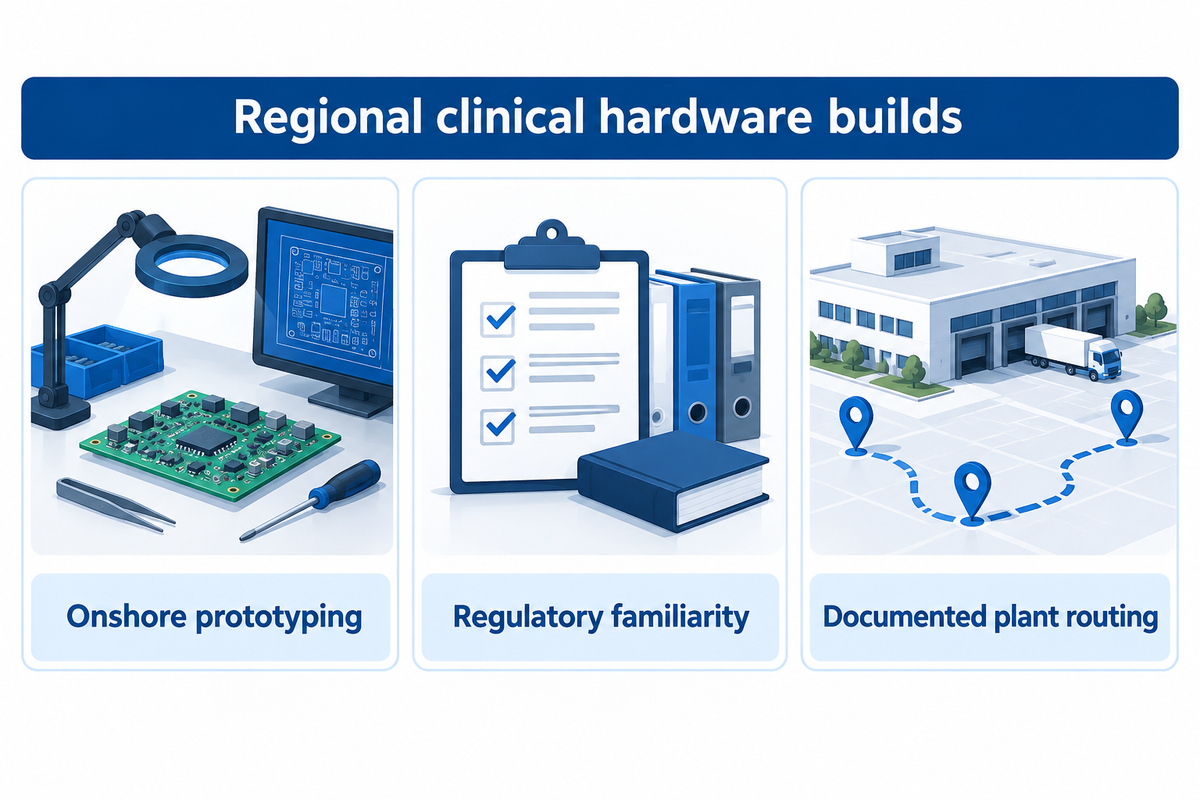
Device programs running clinical trials in the United States and the European Union often favor onshore prototyping and suppliers familiar with regional regulations, and several specialists below also build to defense-grade rules such as MIL-PRF-31032. Because medical devices often go through several hardware revisions during trials, a nearby supplier shortens failure-analysis loops. This group covers North American and European specialists alongside dual-country custom-stackup fabricators, each documenting which plant builds a medical order.
9. ASC Sunstone Circuits, Best for US Domestic ISO 13485 and MIL-PRF-31032 High-Reliability Bare Boards
ASC Sunstone Circuits combines Sunstone Circuits in Mulino, OR with American Standard Circuits (West Chicago, IL – ASC). Together, the two plants bring over 50 years of US domestic PCB fabrication to medical and aerospace programs. Its published certification scope includes ISO 13485, AS9100D, MIL-PRF-31032, MIL-PRF-55110, MIL-PRF-50884, IATF 16949, and ITAR registration. Fast-turn multilayer prototypes run on dedicated lines in Mulino, OR. Complex RF/microwave, metal-backed, rigid-flex, and semi-additive UHDI boards route to West Chicago, IL using stocked Rogers and Arlon materials. This dual-plant US structure gives medical OEMs a domestic path from rapid clinical prototypes to audited production lots.
- Headquarters: Mulino, Oregon and West Chicago, Illinois, USA
- Founded: Over 50 years of US PCB operation across Sunstone and ASC legacy plants
- Company type: US prototype and high-reliability PCB manufacturer
- Main products & medical scope: RF/microwave PCBs, metal-backed boards, UHDI, rigid-flex, and high-layer-count multilayer PCBs
- Manufacturing capabilities: Rogers and Arlon laminates, controlled impedance, engineered stackups, semi-additive UHDI, and metal-backed RF constructions
- Certifications & standards: AS9100D, MIL-PRF-31032, MIL-PRF-55110, MIL-PRF-50884, ISO 13485, IATF 16949, ITAR, DFARS, ISO 9001, and UL listed on its RF page
- Published highlights: Its RF/microwave page pairs Mulino, Oregon fast-turn quoting with West Chicago, Illinois fabrication under AS9100D, MIL-PRF-31032, and ITAR compliance
- Best for: US domestic ISO 13485 and MIL-PRF-31032 high-reliability bare-board prototyping and complex multilayer builds
- Potential disadvantage: Quick-turn standard prototypes run in Mulino, Oregon while complex RF/microwave and metal-backed stackups route to West Chicago, Illinois.
- Official website: https://www.sunstone.com/
10. Epec Engineered Technologies, Best for Engineered Flex, Rigid-Flex, and Laser-Microvia Medical PCBs
Founded in 1952 and headquartered in New Bedford, Massachusetts, Epec Engineered Technologies manufactures custom rigid, flex, rigid-flex, and electro-mechanical assemblies. Time-sensitive domestic builds run at Epec’s NetVia Group plant in Irving, Texas under DOD/ITAR and AS9100 controls. That Texas line produces Multilayer Advanced RF/Microwave boards, stacked laser microvias, via-in-pad structures, and precision cavity boards. Every order undergoes a manual pre-production DFM review by US engineers. That review prevents polyimide flex cracking and annular-ring breakout in portable medical equipment and patient-worn monitors.
- Headquarters: New Bedford, Massachusetts, USA (with RF/high-tech manufacturing in Irving, Texas)
- Founded: 1952
- Company type: Engineered PCB, flex/rigid-flex, and custom electro-mechanical manufacturer
- Main products & medical scope: Multilayer advanced RF/microwave PCBs, cavity boards, HDI, stacked microvias, and flex/rigid-flex
- Manufacturing capabilities: Laser-drilled microvias, cavity boards, heavy/extreme copper, via-in-pad, 16-layer controlled impedance, and free DFM file review
- Certifications & standards: AS9100, DOD/ITAR, and UL referenced across its PCB and corporate pages
- Published highlights: Its PCB page highlights NetVia Group in Irving, Texas for time-sensitive, high-technology Multilayer Advanced RF/Microwave and cavity boards
- Best for: Engineered flex, rigid-flex, and laser-microvia multilayer PCBs for medical diagnostic and portable instruments
- Potential disadvantage: Because Epec operates a hybrid US and offshore manufacturing model, buyers requiring domestic DOD/ITAR builds must specify the Irving, Texas NetVia route.
- Official website: https://www.epectec.com/
11. TTM Technologies, Best for Institutional Medical Imaging, Mission-System, and RF Microelectronic Assemblies
Headquartered in Santa Ana, California and traded on Nasdaq (TTMI), TTM Technologies is a Tier-1 global manufacturer of advanced PCBs and RF microwave/microelectronic assemblies. Across its global footprint, specialized facilities build high-layer boards for CT scanners, MRI systems, ultrasound consoles, and surgical platforms. In addition to complex HDI and rigid-flex fabrication, TTM’s RF&S Components Business Unit develops custom high-frequency solutions and Xinger passive RF components for imaging coils and diagnostic hardware. Its institutional program management supports multi-year life-cycle control for large medical OEMs.
- Headquarters: Santa Ana, California, USA
- Founded: 1998 (Redmond, Washington); listed on Nasdaq as TTMI
- Company type: Global manufacturer of mission systems, RF components, RF microwave/microelectronic assemblies, and advanced PCBs
- Main products & medical scope: Advanced PCBs, RF microwave/microelectronic assemblies, and Xinger brand RF passive components
- Manufacturing capabilities: Custom high-frequency solutions, balun transformers, hybrid couplers, power dividers, RF crossovers, and quick-turn advanced PCBs
- Certifications & standards: Plant-specific medical, defense, and aerospace qualifications managed across global facilities
- Published highlights: Its RF&S Components Business Unit designs and manufactures custom high-frequency solutions and Xinger components for wireless infrastructure, defense electronics, and test and measurement
- Best for: Institutional medical imaging, mission-system, and high-frequency microelectronic assemblies and advanced PCBs
- Potential disadvantage: Enterprise defense and telecom program onboarding is structured for institutional OEMs rather than small hobbyist orders.
- Official website: https://www.ttm.com/
12. Summit Interconnect, Best for North American High-Reliability Multilayer, HDI, and Rigid-Flex Boards
Founded in 2016 and headquartered in Irvine, California, Summit Interconnect operates seven connected PCB manufacturing facilities across North America, plus its Irvine head office. The company fabricates high-layer multilayer boards, sequential HDI microvias, rigid-flex interconnects, thermal-management PCBs, and semiconductor reference cards for clinical diagnostics and aerospace hardware. Its engineering teams process PTFE, hydrocarbon, and hybrid laminates such as RO4350B under IPC-6012 and IPC-6018 performance standards. Early stackup simulation and controlled-impedance modeling help medical hardware teams prevent signal-integrity failures on high-speed diagnostic backplanes.
- Headquarters: Irvine, California, USA
- Founded: 2016
- Company type: Advanced PCB manufacturer for defense, aerospace, commercial RF, and computing
- Main products & medical scope: RF and microwave PCBs, rigid-flex, HDI, thermal management PCBs, and semiconductor reference/probe cards
- Manufacturing capabilities: RO4350B, RO3003, PTFE, hydrocarbon, and hybrid laminates, tight-tolerance stripline, bondable gold, and sintering
- Certifications & standards: IPC-6018, IPC-4103, IPC-2221, IPC-2222, and IPC-6012 standards referenced across its RF and homepage materials
- Published highlights: Its RF/microwave page highlights PTFE, hydrocarbon, and hybrid laminate processing with early simulation and stack-up optimization for GHz and mmWave frequencies
- Best for: North American high-reliability multilayer, HDI, rigid-flex, and RF/microwave boards for clinical and defense hardware
- Potential disadvantage: Multi-plant North American operations require specifying the exact build facility and qualification scope on the purchase order.
- Official website: https://summitinterconnect.com/
13. Technotronix, Best for California-Coordinated Medical Electronics Assembly and Flex-Rigid Interconnects
Located in Anaheim, California, Technotronix provides custom PCB fabrication and turnkey medical electronics assembly under ISO 9001:2015 and AS9100-certified processes. Its medical portfolio covers flex and rigid-flex interconnects, imaging system boards, ECG recorders, bio-analytical instruments, dialysis equipment, hearing aids, digital X-ray panels, and dental electronics. In-house Anaheim assembly lines handle 24-hour prototype turns, 0201 passive placement, BGA rework, X-ray inspection, AOI, and conformal coating. Supported substrates include FR-4, RO4000 (2.55-6.15 Dk), and TMM thermoset laminates. Buyers can select kitted or full turnkey procurement with local California engineering support.
- Headquarters: Anaheim, California, USA
- Founded: —
- Company type: PCB fabrication and electronics assembly manufacturer
- Main products & medical scope: Custom Rogers PCBs (RO3000, RO4000, TMM), rigid, flex, metal-core, and turnkey PCBA
- Manufacturing capabilities: Rogers RO3000, RO4000 (Dk 2.55–6.15), and TMM thermoset laminates, controlled impedance, 0201/BGA placement, X-ray, and AOI
- Certifications & standards: ISO 9001:2015 and AS9100-certified manufacturing processes listed on its Rogers PCB page
- Published highlights: Its Rogers PCB page details RO3000, RO4000, and TMM thermoset laminate options alongside ISO 9001:2015 and AS9100-certified manufacturing and assembly
- Best for: California-coordinated medical electronics assembly, flex/rigid-flex interconnects, and AS9100/ISO 9001 fabrication
- Potential disadvantage: Operates Anaheim, California assembly alongside partner bare-board fabrication routes rather than a single-site vertical laminate mill.
- Official website: https://www.technotronix.us/
14. Würth Elektronik CBT, Best for European HDI Microvia, Flex-Rigid, and Wire-Bonding Medical Substrates
Headquartered in Germany with three German PCB factories in Niedernhall, Rot am See, and Schopfheim, Würth Elektronik CBT manufactures high-precision circuit boards for medical, industrial, and automotive systems. Its technical portfolio spans basic multilayer boards, laser-drilled HDI Microvia PCBs, flex-rigid solutions, component embedding, and WE SYSTEMS – Bonding and systems substrates for gold and aluminum wire bonding. On its corporate quality page, Würth Elektronik CBT is explicitly certified according to IATF 16949, ISO 9001, ISO 14001, and ISO 50001. Those systems provide strict process traceability across German prototype builds and coordinated Asia series production.
- Headquarters: Germany (Würth Elektronik Group PCB & component operations)
- Founded: Over 50 years of German circuit board production within the Würth Elektronik Group
- Company type: Manufacturer of printed circuit boards, electronic/electromechanical components, and intelligent power systems
- Main products & medical scope: Basic multilayer PCBs, HDI Microvia PCBs, PCB Flex Solutions, Embedding PCBs, and WE SYSTEMS bonding
- Manufacturing capabilities: HDI microvia, component embedding, gold wire-bonding substrates (WE SYSTEMS), flex solutions, and Asia Production Coordination
- Certifications & standards: ISO 9001, IATF 16949, ISO 14001, and ISO 50001 explicitly listed for Würth Elektronik CBT on its quality management page
- Published highlights: Its quality page explicitly confirms that Würth Elektronik CBT holds ISO 9001, IATF 16949 automotive, ISO 14001 environmental, and ISO 50001 energy certifications
- Best for: European HDI microvia, flex-rigid, and wire-bonding substrate PCBs backed by IATF 16949 process controls
- Potential disadvantage: Würth Elektronik offers both German/European manufacturing and an Asia Production route, so RF buyers must specify the required production location.
- Official website: https://www.we-online.com/en
15. PCBCart, Best for Custom-Stackup Medical Prototypes and Dual-Country China/Thailand Turnkey Assembly
Operating since 2005 with a Singapore corporate base and production routes in China and Thailand, PCBCart is a full service PCB manufacturer delivering custom bare boards and turnkey medical PCBA. Its manufacturing scope covers rigid multilayer boards up to 32 layers and flex-rigid circuits. It also delivers high-frequency PCB fab services using RO4003C, RO4350B, Ro3003, Ro3010, RT5880 cores bonded with Rogers 4450F prepreg. Under ISO 9001 quality management and IPC Class 2 and Class 3 inspection options, PCBCart supports medical OEMs from DFM-verified prototypes through dual-country volume production.
- Headquarters: Singapore (corporate base; manufacturing in China and Thailand)
- Founded: 2005
- Company type: Full-service PCB fabrication and turnkey assembly manufacturer
- Main products & medical scope: High-frequency PCBs, standard and multilayer PCBs, prototypes, and turnkey PCB assembly
- Manufacturing capabilities: RO4003C, RO4350B, Ro3003, Ro3010, RT5880 cores with Rogers 4450F prepreg, ENIG, Immersion Silver, Immersion Tin, and 4 mil min annular ring
- Certifications & standards: ISO 9001 listed on its company story page, with IPC 2 high-frequency capability parameters
- Published highlights: Its high-frequency capability table explicitly separates Rogers 4450F prepreg from domestic prepreg options alongside RO4003C, RO4350B, Ro3003, Ro3010, and RT5880
- Best for: Custom-stackup medical prototypes and full-service turnkey PCB assembly across China and Thailand production routes
- Potential disadvantage: A Singapore corporate story and multiple Asian production routes (China and Thailand) mean buyers should specify whether domestic or Rogers 4450F prepreg is used.
- Official website: https://www.pcbcart.com/
High-Complexity HDI, Rigid-Flex, and Implantable-Grade PCB Manufacturers

Medical and wearable devices increasingly pack high-speed sensor interfaces and wireless telemetry into a compact space. Sequential laser microvias, polyimide flex and ceramic pressing are the main processes for these miniaturized boards. High-frequency catheter sensors, endoscopic cameras and MRI consoles also rely on low-loss RF substrates from specialized Rogers PCB manufacturers.
16. Sanmina, Best for High-Layer Medical Imaging Backplanes and Sequential-Lamination System Integration
Founded in 1980 and headquartered in San Jose, California, Sanmina is a global integrated PCB, custom backplanes, and electronics contract manufacturer. Its advanced interconnect plants fabricate high-layer boards for MRI, CT, and clinical laboratory systems using Multiple Sequential Laminations and Simultaneous Via Partitioning (SVP). In-house electrical engineers perform pre-layout signal integrity and EMC/RFI simulation before boards enter 01005 and 4000+ pin BGA assembly lines. Across its global network, plant-specific quality systems support complex medical equipment integration.
- Headquarters: San Jose, California, USA
- Founded: 1980
- Company type: Global integrated PCB, backplane, and electronics contract manufacturer
- Main products & medical scope: High-reliability PCBs, custom backplanes, flex/rigid-flex, and RF/optical electronics assemblies
- Manufacturing capabilities: Multiple sequential laminations, Simultaneous Via Partitioning (SVP), signal integrity and EMC/RFI analysis, 01005 and 4000+ pin BGA assembly
- Certifications & standards: Site-specific medical, aerospace, defense, and automotive quality management systems across global plants
- Published highlights: Its PCB page highlights in-house signal integrity and EMC/RFI simulation alongside Multiple Sequential Laminations and Simultaneous Via Partitioning (SVP)
- Best for: High-layer-count medical imaging backplanes, sequential-lamination multilayer PCBs, and complex system integration
- Potential disadvantage: Sanmina’s integrated PCB and backplane model is built for complex aerospace, defense, and telecom OEM programs rather than small bare-board spot buys.
- Official website: https://www.sanmina.com/
17. AT&S, Best for High-End HDI Microvia Interconnects and IC Substrates for Medical and Microelectronics
Founded in 1987 in Leoben, Austria, AT&S (Austria Technologie & Systemtechnik AG) is a leading European and global manufacturer of high-end PCBs and IC substrates. Its microelectronics division supplies ultra-fine-pitch interconnects and advanced IC substrates across mobile, automotive, industrial, medical, aircraft and satellite applications. When miniature diagnostic modules or high-density sensor packages require trace geometries beyond conventional PCB shop limits, AT&S provides industrialized substrate engineering across its Austrian and Asian factories.
- Headquarters: Leoben, Austria (Fabriksgasse 13, 8700 Leoben)
- Founded: 1987
- Company type: Global manufacturer of high-end PCBs and IC substrates
- Main products & medical scope: High-end printed circuit boards and advanced IC substrates
- Manufacturing capabilities: High-frequency microelectronics interconnects and IC substrates for mobile, automotive, industrial robotics, medical, airplanes, and satellites
- Certifications & standards: Global medical, automotive, and semiconductor substrate quality systems across Austrian and Asian plants
- Published highlights: Founded in 1987 in Leoben, Austria, AT&S supplies high-end PCBs and IC substrates across mobile, automotive, medical, airplane, and satellite applications
- Best for: High-end HDI microvia interconnect boards and IC substrates for implantable, hearing-aid, and medical imaging systems
- Potential disadvantage: AT&S focuses on series high-end PCBs and IC substrates for industrial, automotive, aerospace, and semiconductor programs rather than quick-turn prototype pooling.
- Official website: https://ats.net/en/
18. iPCB Circuits, Best for Specialty Microwave RF, Cavity, and HDI Bare Boards Built to IPC Class 3
iPCB Circuits Limited is a specialized Asian bare-board fabricator producing microwave RF, cavity, HDI, IC substrate, and hybrid high-frequency printed circuit board designs. Its plant supports rapid engineering turns on RF ablation generators, wireless telemetry modules, and MRI front-end boards. Standing inventory includes FR408, 370HR, TU872, RO4350B, RO4003C, RT5880, RO3010, RO3003 and Megtron6 laminates. In-house plasma desmear, precision depth-controlled cavity milling, and optical/flying-probe inspection verify bare substrates against IPC-A-600E and IPC Class 2 and Class 3 acceptance rules.
- Headquarters: Asia-based RF and HDI facility
- Founded: Over 10 years of RF, HDI, and microwave bare-board manufacturing operation
- Company type: Microwave RF PCB, hybrid high-frequency PCB, and IC substrate manufacturer
- Main products & medical scope: Microwave RF PCBs, hybrid high-frequency PCBs, cavity PCBs, radar PCBs, Teflon PCBs, HDI, and IC substrates
- Manufacturing capabilities: Stocked RO4350B, RO4003C, RT5880, RO3010, RO3003, F4BM, and Megtron4/6 materials; cavity and countersink RF boards
- Certifications & standards: IPC-A-600E and IPC Class 2 / Class 3 acceptance standards referenced on its PCB manufacturing page
- Published highlights: Its homepage lists stocked prototype materials including RO4350B, RO4003C, RT5880, RO3010, RO3003, RF35, TLY-5, and Megtron6
- Best for: Specialty microwave RF, hybrid high-frequency, cavity, and HDI bare boards built to IPC Class 2 and Class 3 standards
- Potential disadvantage: Focuses on bare-board microwave RF, cavity, and HDI substrate fabrication rather than turnkey component kitting and box-build assembly.
- Official website: https://www.ipcb.com/
19. Venture Electronics, Best for Wearable Flex, Rigid-Flex, and Ceramic Medical PCBs with Turnkey Assembly
Operating in Shenzhen, China since 2010, Venture Electronics is a turnkey solution provider offering medical PCB layout support, bare-board fabrication, and SMT assembly. Its medical line produces polyimide flexible circuits, rigid-flex boards with embedded components for body-worn monitors, aluminum boards for surgical lighting, and ceramic substrates. On its high-frequency and ceramic pressing lines, Venture builds 4–10 layer pure ceramic and 4–12 layer mixed-pressing boards alongside RO4350B PCB fabrication under IPC workmanship rules. Every assembled lot undergoes AOI, X-ray BGA inspection, and impedance verification.
- Headquarters: Shenzhen, China
- Founded: 2010
- Company type: PCB design, fabrication, and turnkey PCB assembly manufacturer
- Main products & medical scope: Rogers high-frequency PCBs (RO4350B, RO4003C, RO3003, RO3006, RO3010, RO4360) and turnkey PCBA
- Manufacturing capabilities: 4–10 layers of pure ceramic pressing, 4–12 layers of mixed pressing, impedance control, AOI, and X-ray inspection
- Certifications & standards: UL and IPC-Standard compliance referenced on its Rogers PCB page
- Published highlights: Its Rogers PCB page specifies 4–10 layers of pure ceramic pressing and 4–12 layers of mixed pressing with AOI and X-ray inspection before shipment
- Best for: Wearable flex, rigid-flex, and 4–10 layer ceramic/mixed-pressing medical PCBs with turnkey assembly and X-ray inspection
- Potential disadvantage: Pure ceramic pressing is stated at 4–10 layers and mixed pressing at 4–12 layers on its Rogers page; higher layer counts require separate engineering review.
- Official website: https://www.venture-mfg.com/
20. OurPCB, Best for ISO 13485:2016 and IPC-A-610 Class 3 Multi-Factory China PCB Fabrication and PCBA
Operating since 2007 with its advanced Shijiazhuang factory and Shenzhen quick-turn plant, OurPCB delivers multilayer bare boards and turnkey medical PCBA across five Chinese facilities. Its quality system is certified to ISO 9001, ISO 13485, ISO 14001, IATF 16949, and UL standards, with assemblies inspected to IPC-A-610 Class 2 and Class 3 criteria. The Shijiazhuang factory runs five Siemens SMT lines capable of 0201 placement, fine-pitch BGA reflow, and assembly on high-Tg or Rogers (RO4350B, RO3003, RO3006) boards. Every batch receives microsection analysis, AOI testing, E-testing, X-RAY, and impedance control before shipment.
- Headquarters: Shijiazhuang and Shenzhen, China (manufacturing plants)
- Founded: 2007
- Company type: PCB fabrication, Rogers RF PCB, and turnkey PCB assembly manufacturer
- Main products & medical scope: Rogers PCBs, multilayer PCBs, high-Tg, aluminum PCBs, custom wire harnesses, and turnkey PCBA
- Manufacturing capabilities: RO4350B, RO3003, RO3006, RO3010, RO4835, RO5880, RO6002, RO6010, RO4003, RO4360G2, impedance testing, and microsection analysis
- Certifications & standards: ISO 9001:2015, ISO 13485:2016, ISO 14001, IATF 16949:2016, IPC-A-610 Class 2 and 3, and UL certified
- Published highlights: Its Rogers PCB page compares 10 Rogers laminates (RO4350B, RO3003, RO3006, RO3010, RO4835, RO5880, RO6002, RO6010, RO4003, and RO4360G2) with AOI, E-test, X-ray, and impedance control
- Best for: ISO 13485:2016 and IPC-A-610 Class 3 multi-factory China PCB fabrication and turnkey assembly with microsection testing
- Potential disadvantage: Manufacturing is split between its Shijiazhuang advanced assembly plant and Shenzhen standard assembly plant, so buyers should specify the plant route.
- Official website: https://www.ourpcb.com/
ISO 13485 Scope, IPC Class 3, and Lot Traceability Tiers by Medical Device Class
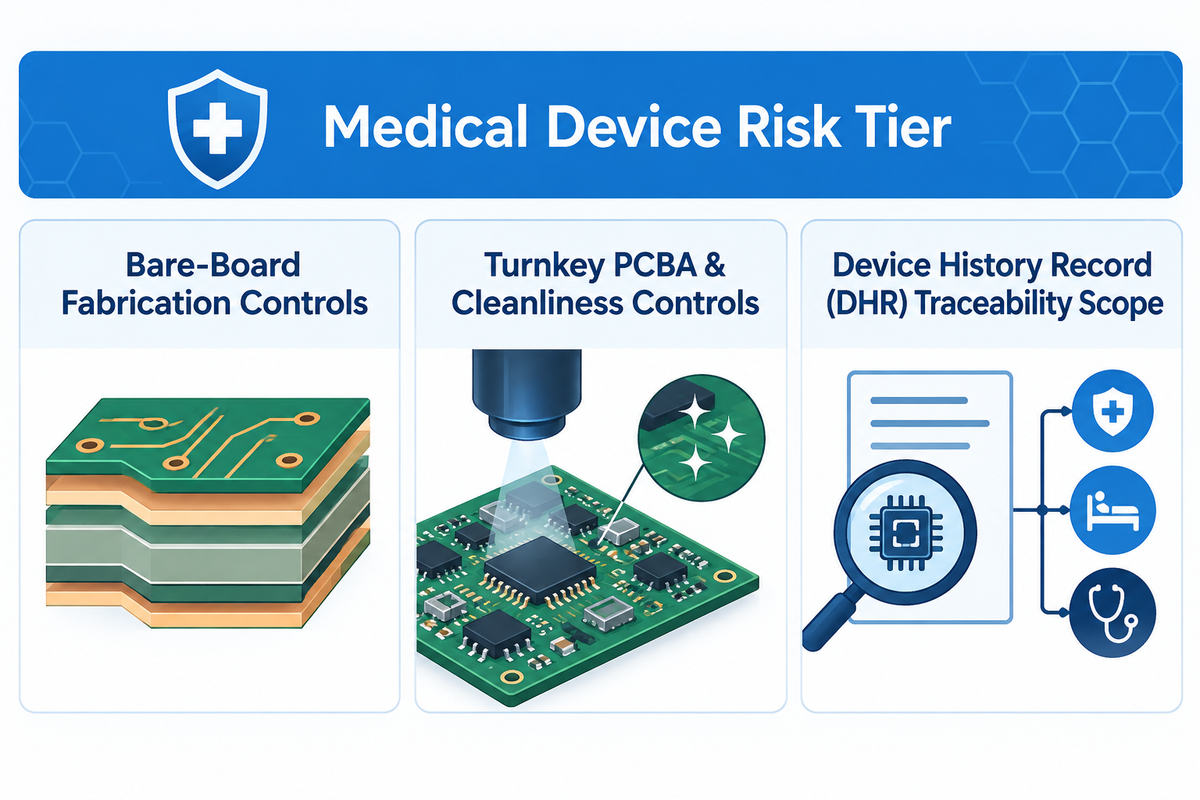
Not every medical device PCB needs destructive testing on every panel, but under-specifying a life-sustaining board creates recall risk. Hardware teams should match their medical PCB design to the clinical risk tier of the end product. Regulators such as the FDA group medical devices into Class I, Class II and Class III by risk. Core medical industry standards then cover quality management (ISO 13485), bare-board qualification (IPC-6012/6013), assembly workmanship (IPC-A-610, J-STD-001) and electrical safety (IEC 60601-1); the IPC class shown for each risk tier in the table below is our editorial recommendation, not a regulatory requirement.
Buyers evaluating medical PCB manufacturers must also distinguish bare-board fabrication scope from turnkey electronics manufacturing services scope. A bare-board fabricator controls laminate lot, copper foil thickness, plasma desmear and plating, and performs electrical testing to IPC-6012 or IPC-6013 acceptance requirements. A turnkey medical PCBA plant controls solder paste printing, component reel date codes and post-solder cleaning under J-STD-001, with workmanship judged to IPC-A-610. Newer medical designs center on flexible biosensor patches and dense diagnostic modules, which demand tight tolerances across all three risk tiers.
| Medical Device Risk Tier | Representative Medical Equipment | Recommended IPC Workmanship Class | Bare-Board Fabrication Controls | Turnkey PCBA & Cleanliness Controls | Device History Record (DHR) Traceability Scope |
|---|---|---|---|---|---|
| Class I (Low Risk) | Diagnostic laboratory analyzers and general-purpose lab instruments | IPC-6012 Class 2 & IPC-A-610 Class 2 | Standard high-Tg FR-4; ≥20 µm plated hole copper; 100% netlist e-test | RoHS lead-free SMT reflow; automated optical inspection (AOI); authorized part sourcing | Certificate of Conformance (CoC) and batch-level production lot number |
| Class II (Moderate to High Risk) | Patient monitoring consoles, electrocardiography (ECG) units, ultrasound & medical imaging equipment, infusion pumps, AC-powered hospital beds, robotic surgical systems | IPC-6012 Class 3 (or Class 2 with Class 3 hole copper) & IPC-A-610 Class 3 | ≥25 µm hole-wall copper; annular ring ≥0.05 mm (2 mil) external and ≥0.025 mm (1 mil) internal, no breakout; TDR ±5% impedance report | 100% 3D AOI + BGA X-ray; ionic contamination test; zero X-out arrays; ICT or flying probe | Per-lot laminate & copper certs, microsection coupon report, reflow profile & reel date-code log |
| Class III (Life-Supporting & Implantable) | Implantable pacemakers, implantable neurostimulators, automated defibrillators | Strict IPC-6012/6013 Class 3 & IPC-A-610/J-STD-001 Class 3 | Polyimide, ceramic or high-Tg low-CAF substrates; via-in-pad copper fill; 100% microsection & X-ray | ENEPIG or wire-bondable gold; ROSE & ion chromatography cleanliness; Parylene/conformal coating; burn-in | Board-level laser serialization linking laminate batch, operator ID, X-ray images & component UIDs across the device service life |
How to Qualify a Medical PCB Manufacturer for Traceable Device Programs
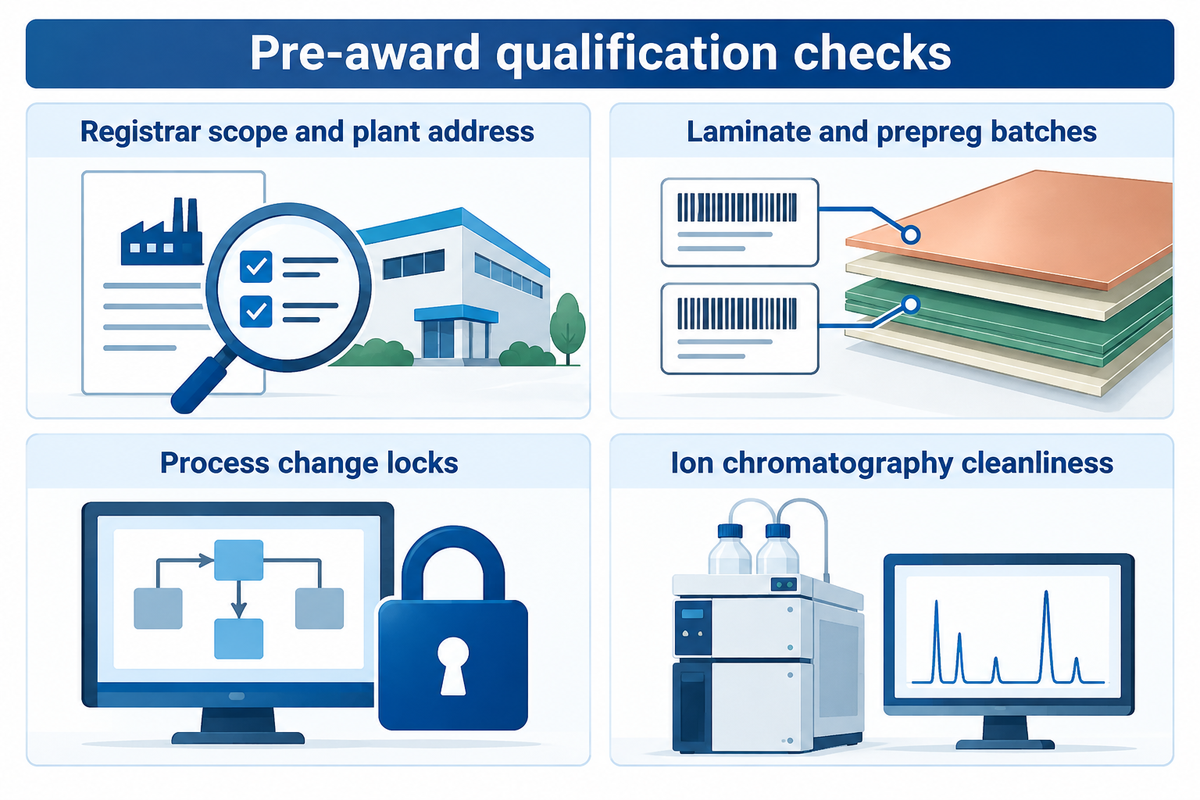
Before choosing a medical PCB manufacturer, run the 7-Gate Medical PCB Traceability Protocol across certificate scope, DHR batch linking and ECO locks. The same seven checkpoints also cover IQ/OQ/PQ validation, ionic cleanliness, zero-X-out panels and archive retention, because a website logo alone is never enough. Used as a pre-award routine, the protocol collects the evidence that internal audits and external regulatory reviews ask for.
- Registrar Scope and Plant Address on ISO Certificates: Accredited registrar databases list the exact street address and process scope for every valid quality certificate. That scope statement shows whether certification covers bare printed circuit fabrication, populated PCB assemblies, or sales coordination only. Some fabricators operate under ISO 9001 and IATF 16949 rather than direct ISO 13485, as PCBark discloses on its medical page. In those cases, OEM auditors qualify the plant using its IPC Class 3 lot packets and process travelers.
- DHR Batch Linking: A traceable medical PCB project links copper-clad laminate batches, prepreg batches and plating bath logs. For turnkey builds it also links moisture-sensitivity logs, component MPNs and distributor invoices.
-
Engineering Change Order (ECO) and Process Change Notification (PCN) Locks: Medical device manufacturers can’t tolerate silent laminate substitutions. Formal Quality Agreements require written OEM approval for any process change. Locked items include dielectric brands, solder mask ink, surface finish chemistry, drill location, and sub-tier plating lines.
- Installation, Operational, and Process Qualification (IQ/OQ/PQ) Deliverables: Class II and Class III production programs rely on documented process validation deliverables. Standard validation packages include reflow oven thermal profiling, First Article Inspection (FAI) reports, and gage R&R and SPC data for CPK on critical dimensions, impedance, annular rings, and other critical measurements.
- Quantitative Ionic Cleanliness and Surface Insulation Resistance Records: Flux residues and etching salts trapped beneath low-standoff BGAs cause dendritic growth and leakage currents in humid clinical environments. Several class III lines perform ion chromatography prior to the application of conformal coating. Qualified plants run Resistivity of Solvent Extract (ROSE) or ion chromatography tests using IPC-TM-650 methods; because IPC-TM-650 defines how to test rather than the pass limit, write the acceptance limit (for example the legacy 1.56 µg/cm² NaCl equivalent) into the purchase specification.
- Standard Commercial Practice, Panel Yield, and Auto Pick-and-Place Traceability: In standard commercial practices, panel yields are improved by a shipping strategy where assembly arrays containing crossed-out defective boards (“X-outs”) are shipped to the final assembly site. On Medical SMT lines, X-out boards can disrupt the traceability of pick-and-place machines, resulting in mix-up of defective units. Medical contracts require 100% good-board panels and component purchasing exclusively through franchised distributors such as Arrow, Avnet, and DigiKey.
- Sterilization Compatibility and Long-Term Archive Retention: Assemblies that go through steam autoclave cycles need laminates whose Tg sits well above the cycle temperature, such as high-Tg FR-4 (Tg ≥170°C) or polyimide; ethylene oxide (EtO) and gamma sterilization run at low temperature, so their review covers material and component compatibility rather than Tg. Check that the supplier reviews the intended sterilization method at DFM and chooses the laminate, surface finish (for example ENIG) and conformal coating to suit it. Manufacturers archive microsections, Gerber revisions and inspection logs for the regulatory lifetime of the medical device.
Medical PCB RFQ & Device Master Record (DMR) Checklist
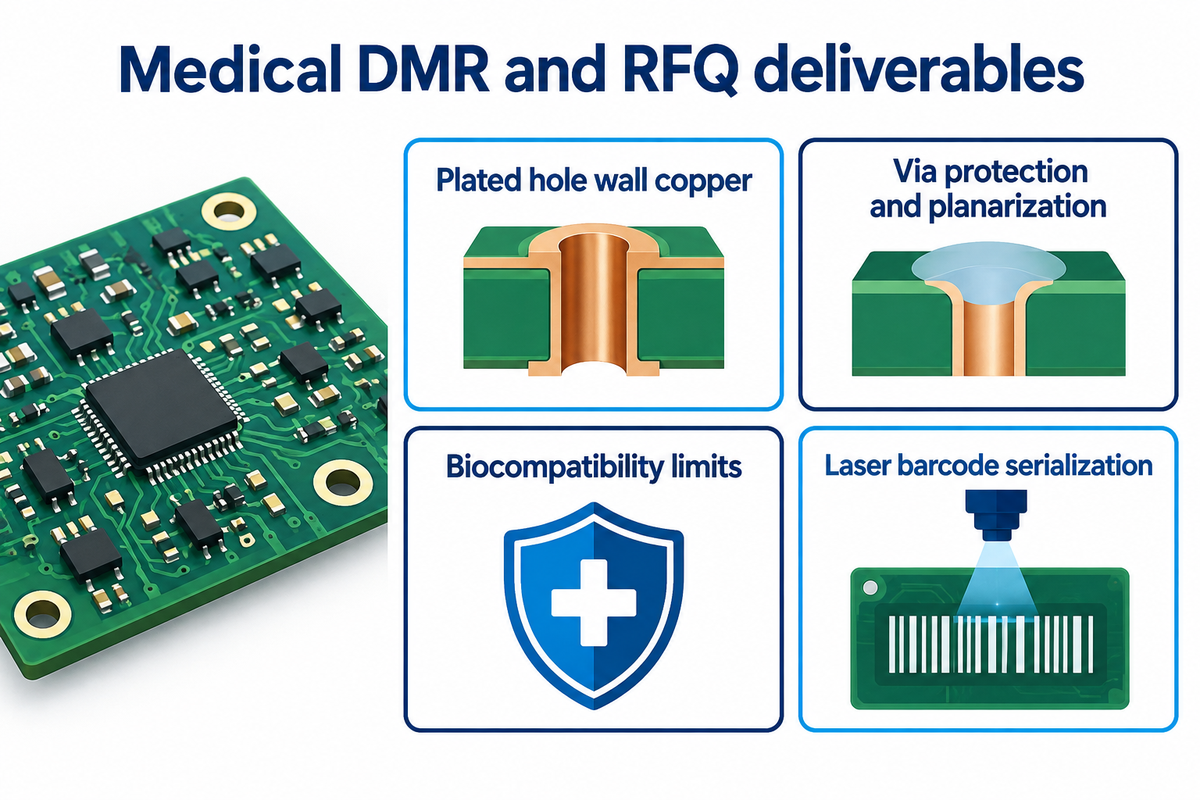
Turning a validated medical device PCB design into repeatable production starts from a complete Device Master Record (DMR); the RFQ package should carry the fabrication and assembly requirements drawn from it. When engineering teams omit explicit workmanship or isolation callouts on the master drawing, contract shops default to commercial Class 2 tolerances. Proper document control protects boards in portable medical equipment and hospital consoles from silent quality escapes.
Why do you require EMC for medical PCBs?
Medical PCBs require electromagnetic compatibility (EMC) under IEC 60601-1-2 because radiated or conducted interference can corrupt ECG and EEG signals and/or trigger actuators in infusion pumps. For protection of patient safety, isolation and clearance distance shielding may be required for certain hospital equipment electronics.
Before supplying your Gerber, ODB++, or IPC-2581 documents to any supplier of the assembly services for medical hardware, lock the following seven requirements in your fabrication and assembly notes:
- Explicit IPC-6012 and IPC-A-610 Class 3 Callout and Minimums: the master drawing must indicate whether the bare board fabrication requirements of IPC-6012 Class 3, and/or IPC-A-610 Class 3 solder fillet inspection are applicable. Rigid Class 3 boards require at least 25 µm (0.001 inch) of plated hole wall copper, zero annular ring breakout, and IPC-A-600 Class 3 visual inspection.
- Laminate Brand Lock and Equivalent-Material Prohibition: Fabrication notes should specify the exact dielectric slash sheet, such as IPC-4101/126 high-Tg FR-4, IPC-4204 polyimide for a flexible PCB, or Rogers RO4350B for telemetry. Adding the note “No material substitution permitted without written OEM engineering sign-off” locks verified pcb materials and prevents thermal delamination during lead-free rework.
- Via Protection Type (IPC-4761 Type VII) and Planarization: For fine-pitch BGA and LGA medical sensors, epoxy resin plugs or copper caps (VIPPO) are used. For vias of BGAs or other active devices, caps prevent solder from wicking down into the vias during reflow.
- IEC 60601-1 Means of Patient Protection (MOPP) and Creepage/Clearance: For high voltage electrical isolation, milled air trenches, and/or Comparative Tracking Index (CTI) requirements must be dimensioned on the fabrication drawing. Those physical barriers preserve patient electrical safety between mains circuit and patient applied electrodes.
- Biocompatibility Limits: Drawings must specify exact ENIG, ENEPIG, or wire-bondable gold thicknesses as per IPC-4552 or IPC-4556. Skin-contact wearables and compact medical devices also require a nickel-free or biocompatible surface treatment, as aligned with the clinical biocompatibility assessment.
- Mandatory Test Coverage and Per-Lot Quality Deliverables: Purchase orders should itemize required inspection artifacts for bare boards and populated PCB assemblies. Standard bare-board deliverables include 100% netlist e-test (IPC-D-356), TDR impedance coupon reports (±5% or ±10%), and cross-section microsections. Turnkey lots add 100% 3D AOI, 100% BGA/QFN X-ray, ionic cleanliness certificates, and functional test logs.
- Bar coding, Zero-X-Out Arrays, and Packaging: Assembly drawings must show 2D DataMatrix barcodes that are laser etched or UID labels tied to the Lot Traveler and prohibit X-Out boards. Completed PCB assemblies are shipped in vacuum-sealed, moisture-barrier bags, with desiccant and a Humidity Indicator Card.
Frequently Asked Questions
What Makes Medical PCBs Different from Standard PCBs?
Medical PCBs differ from standard commercial circuit boards through strict quality management under ISO 13485 and IPC-6012 Class 3 workmanship. Specify plated hole-wall copper by workmanship class: the comparison table lists ≥20 µm for Class 2 and ≥25 µm for Class 3, with zero annular-ring breakout on Class 3 builds. Every lot also includes ionic cleanliness verification and full laminate-to-component Device History Record (DHR) traceability.
What is the role of ISO 13485 Quality Management in making medical PCBs?
ISO 13485 establishes a medical quality management system covering risk management, incoming laminate and component verification, and calibrated process parameters. It also mandates Engineering Change Order (ECO) locks, Corrective and Preventive Action (CAPA) loops, and full batch traceability. Holding ISO 13485 proves factory process discipline, not FDA clearance of the finished medical device.
What standards apply to medical PCBs?
Core medical PCB standards include ISO 13485 for quality management, IPC-6012 and IPC-6013 for rigid and flexible bare-board qualification, and IPC-A-600 for bare-board inspection. Populated assemblies follow IPC-A-610 and J-STD-001 Class 2 or Class 3 rules. Finished equipment must also satisfy IEC 60601-1 electrical isolation, IEC 60601-1-2 EMC, and FDA 21 CFR Part 820.
What type of substrates do you use for medical PCBs?
High-Tg FR-4 (Tg ≥170°C) serves diagnostic consoles and stationary monitors. Polyimide supports dynamic wearable flex and catheter cables. Aluminum Nitride or Alumina ceramics handle implantable sensors, while Rogers PTFE laminates support MRI and wireless telemetry.
What test coverage is available for medical electronics?
Bare-board medical PCB fabrication undergoes 100% netlist flying-probe or fixture electrical testing per IPC-D-356. Fabricators perform automated optical inspection (AOI) on the inner and outer copper layers. Fabricators also run Time-Domain Reflectometry (TDR) coupons for ±5% controlled impedance and destructive microsectioning to confirm ≥25 µm hole-wall copper plating.
For medical PCBA builds, tests also include 3D solder paste inspection (SPI) and 3D AOI. Lines also perform 100% 2D or 3D X-ray inspection of BGA, LGA and QFN packages. Plants also run in-circuit testing (ICT), ROSE or ion chromatography ionic cleanliness testing, thermal burn-in, and customer-protocol functional verification.
What is the minimum order quantity for medical PCBA?
Turnkey medical PCB manufacturers including PCBark, Sierra Circuits, NextPCB, PCBWay, and PCBgogo require no minimum order quantity (1-piece MOQ) for engineering prototypes. That policy supports benchtop, biocompatibility, and clinical trials before high-volume tooling.
Request a Traceable Medical PCB & PCBA Quote from PCBark

Building a reliable medical PCB or turnkey medical device PCBA takes documented process discipline from the first prototype to volume production. At PCBark, one documented process covers 4–32 layer rigid and HDI fabrication, 1–10 layer flex, 4–24 layer rigid-flex, ceramic substrates, and 8 SMT lines. Every Class 3 lot ships with 100% AOI, X-ray, e-test, and per-lot auditor documentation packages, with no prototype MOQ and free DFM review. Visit PCBark’s medical PCB and turnkey assembly page to upload your Gerber and BOM files for an engineering review today.
References and Sources
- International Organization for Standardization, ISO 13485:2016, Medical devices, Quality management systems, Requirements for regulatory purposes, and ISO 9001:2015, Quality management systems.
- International Electrotechnical Commission, IEC 60601-1, Medical electrical equipment, Part 1: General requirements for basic safety and essential performance, and IEC 60601-1-2, Electromagnetic disturbances.
- The Association Connecting Electronics Industries (IPC), IPC-6012 (Qualification and Performance Specification for Rigid Printed Boards), IPC-6013 (Flexible/Rigid-Flex Printed Boards), IPC-A-600, IPC-A-610, and IPC J-STD-001.
- U.S. Food and Drug Administration (FDA), Quality System Regulation / Quality Management System Regulation (21 CFR Part 820), Center for Devices and Radiological Health.
- PCBark Official Medical PCB Capability Matrix, IPC Class 3 Tolerances & Auditor Traceability Documentation, https://pcbark.com/industries/medical/
- Official manufacturer capability, medical industry and quality system pages, checked in October 2026 (Sierra Circuits, AdvancedPCB, NextPCB, PCBWay, MADPCB, PCBgogo, Eurocircuits, ASC Sunstone Circuits, Epec Engineered Technologies, TTM Technologies, Summit Interconnect, Technotronix, Würth Elektronik CBT, PCBCart, Sanmina, AT&S, iPCB Circuits, Venture Electronics, and OurPCB); each company’s website is listed in the comparison table.
WHY WE WRITE THIS
About PCBark Engineering Insights
PCBark shares technical PCB fabrication and assembly guides based on real engineering review and manufacturing experience. We help teams compare materials, stackups, DFM risks, component sourcing, inspection plans, and production routes before they move from prototype to volume builds.
16+ yrs EMS experience
1-42 PCB layers
500,000 m2 annual PCB capacity
IPC Class 2/3 build discipline
DFM + test review