Get in touch with PCBark Company


Last updated: October 2026
Key takeaway
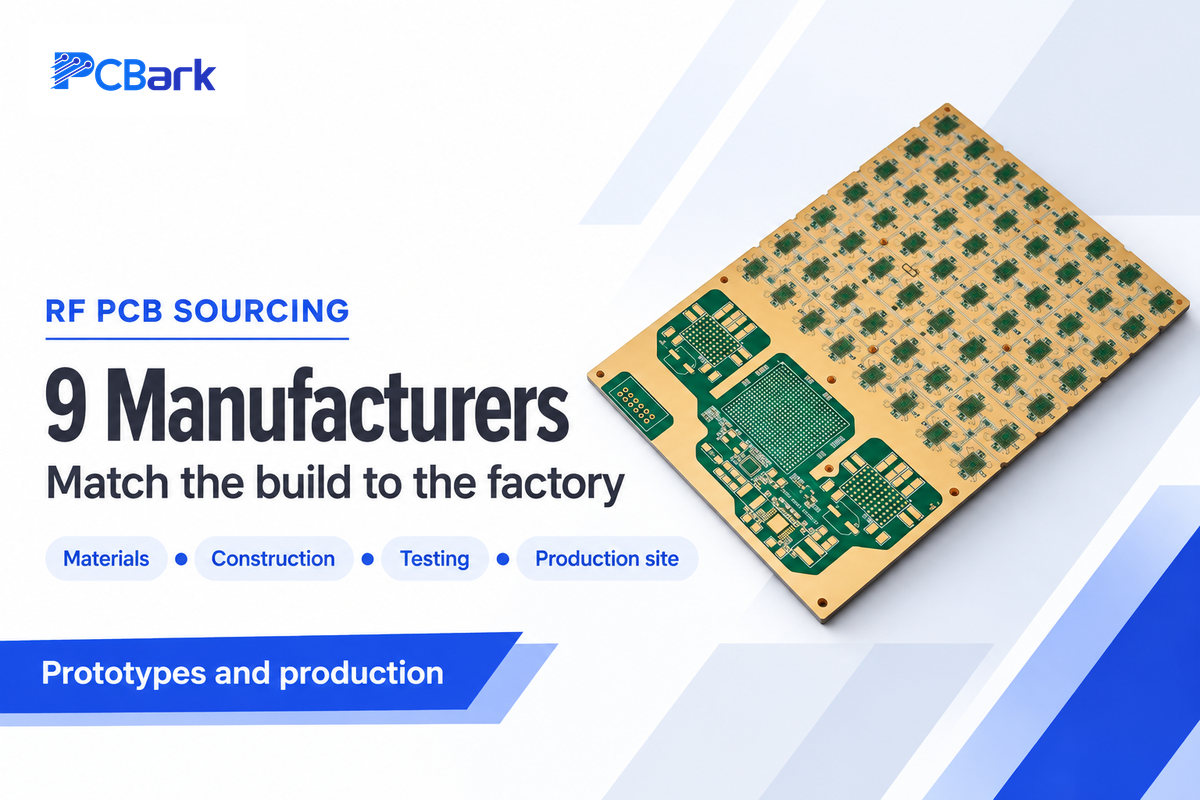
The best RF PCB manufacturers for your shortlist include TTM for complex RF structures, Sierra Circuits for US prototypes with assembly, ASC for metal-backed boards, and Schweizer for radar development. PCBark offers China-based fabrication and assembly. Choose by the material stack-up, manufacturing site and test deliverables your board needs.
RF and digital projects require materials and PCB solutions suited to their construction: Rogers or PTFE laminates for the RF layers of a mixed RF and digital circuit board, a metal-backed microwave module or a radar antenna board. Different production processes are needed to address these differences, and original equipment manufacturers use these comparisons to identify potential shops for custom PCB quotes.
Quick picks by buying need
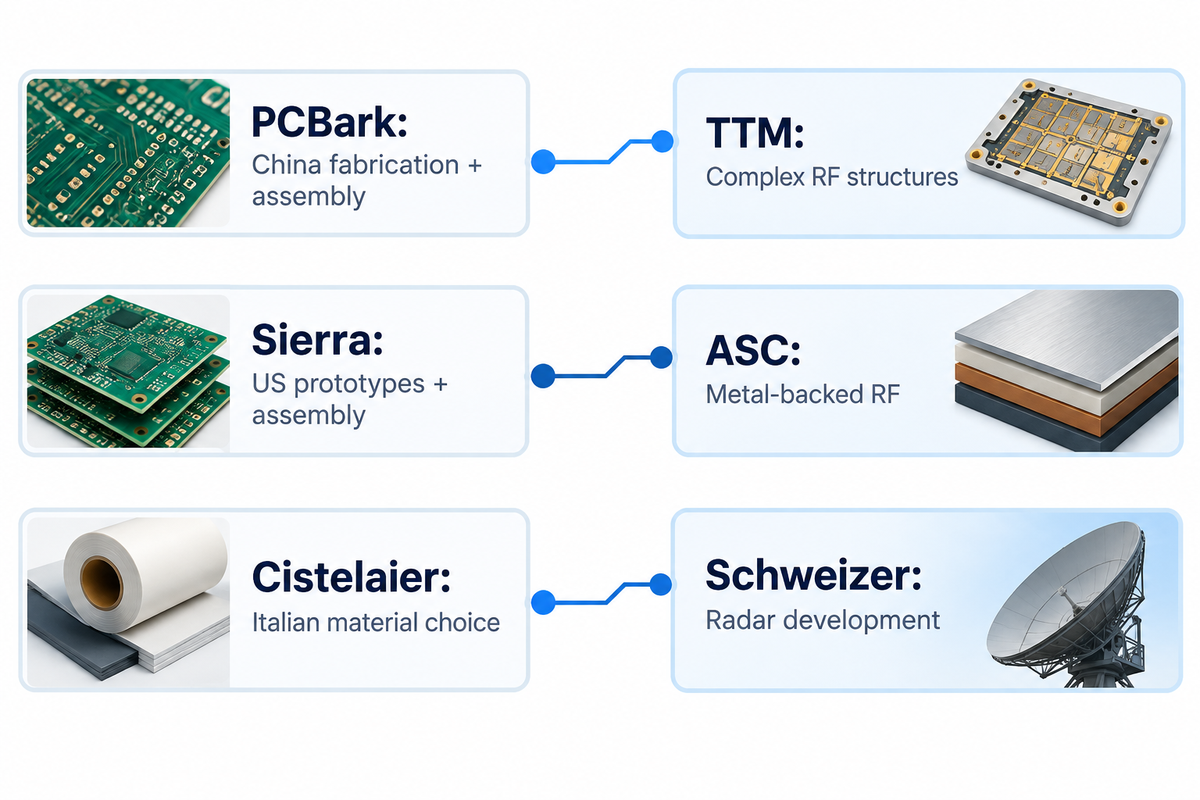
- Best for China-based RF fabrication and assembly: PCBark.
- Best for complex multilayer RF structures: TTM Technologies.
- Best for US prototypes with assembly services: Sierra Circuits.
- Best for metal-backed RF construction: American Standard Circuits.
- Best for Italian production and material choice: Cistelaier.
- Best for radar development: Schweizer Electronic.
Disclosure: PCBark publishes this guide and is included as a manufacturing option. The other companies are independently operated alternatives; list order isn’t a measured quality or market-share ranking.
How we selected these manufacturers
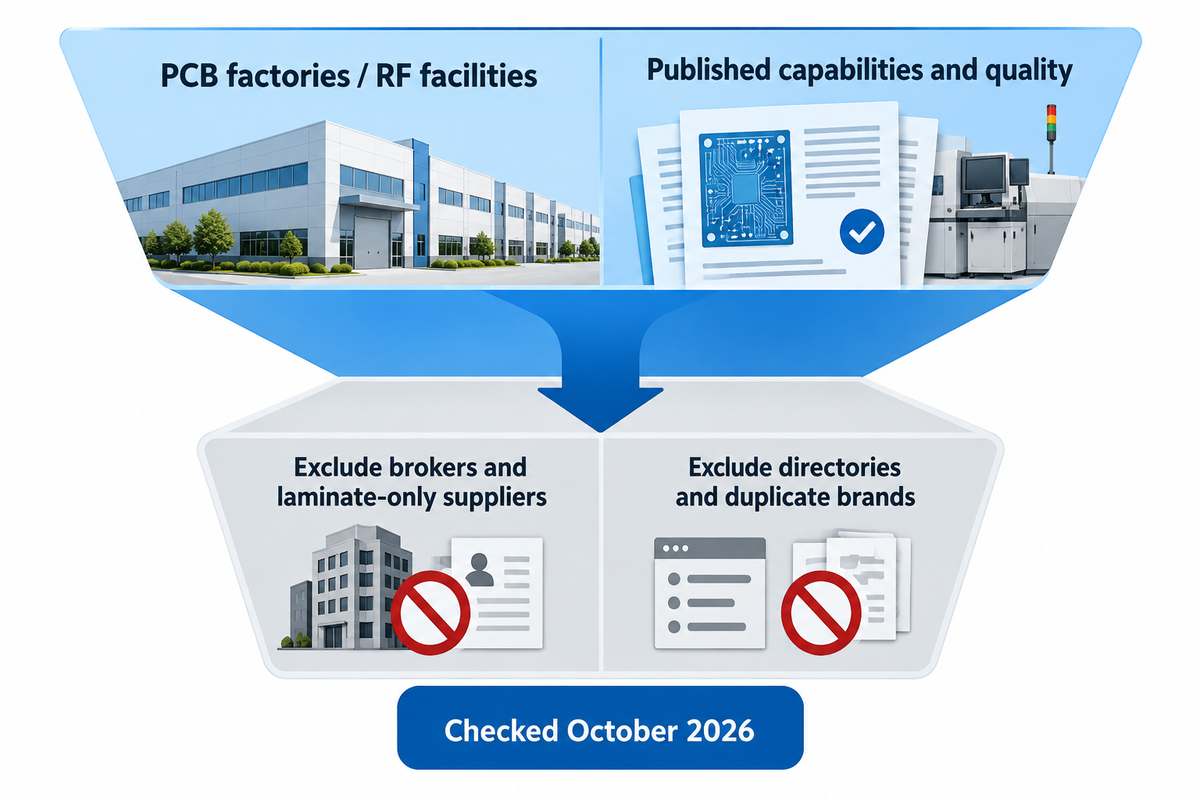
We identified microwave and RF PCB manufacturers that operate PCB factories or RF manufacturing facilities and have quality, capability or product information published. Company information was verified against their official web-sites and/or other public sources in October 2026. Brokers, laminate-only suppliers, directories and duplicate group brands were excluded. This comparison of PCB manufacturers in the world’s major electronics markets examines various purchasing needs through a curated shortlist, not a complete assessment.
RF PCB manufacturers compared
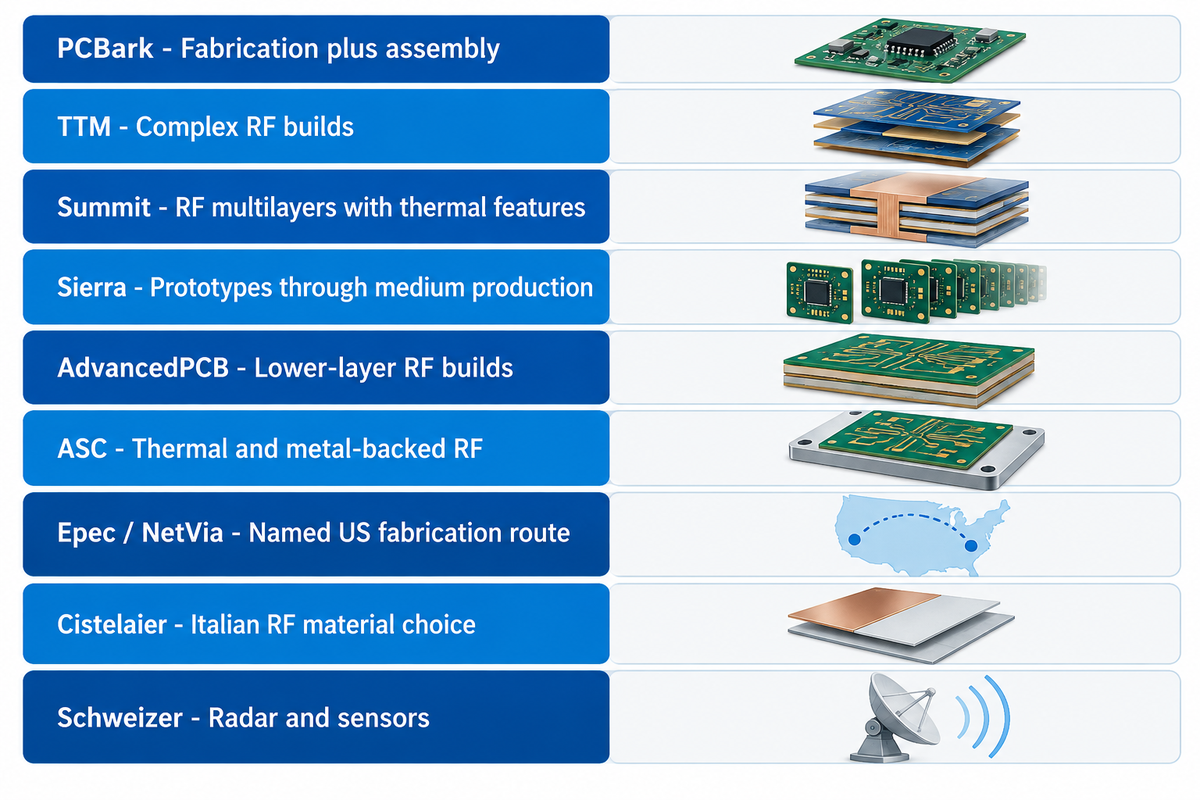
The 9-Company RF Capability Comparison groups suppliers by the location of their headquarters and published manufacturing scope. The headquarters field identifies where the business is based. It doesn’t provide the fabrication location of every order. Current company brands are distinguished from older company roots by the dates shown.
| No. | Company | Headquarters | Founded / roots | Best for | RF materials and construction | Key advantage | Buying limitation | Official website |
|---|---|---|---|---|---|---|---|---|
| 1 | PCBark | Shenzhen, China | 2010 | Fabrication plus assembly | PTFE and hybrid boards | Rogers, Taconic, Isola, Megtron options | China fabrication route | https://pcbark.com/ |
| 2 | TTM Technologies | Santa Ana, USA | 1998 incorporation | Complex RF builds | Hybrids, cavities, thermal coins | PTFE fusion bonding and RF test centers | Specialist work needs suitable site | https://www.ttm.com/ |
| 3 | Summit Interconnect | Irvine, USA | 2016 | RF multilayers with thermal features | PTFE, hydrocarbon, hybrids | Cavities and bonded heat sinks | Qualifications vary by factory | https://summitinterconnect.com/ |
| 4 | Sierra Circuits | Sunnyvale, USA | 1986 | Prototypes through medium production | Hybrid RF multilayers | Sunnyvale fabrication and assembly | No heat-sink option in RF table | https://www.protoexpress.com/ |
| 5 | AdvancedPCB | Aurora, USA | 2024 brand; APCT1977 | Lower-layer RF builds | Rogers, Taconic, FR-4 hybrids | Dedicated RF fabrication offer | RF offer lists up to8layers | https://www.advancedpcb.com/ |
| 6 | American Standard Circuits | West Chicago, USA | 1988 | Thermal and metal-backed RF | Bonded metal-backed PTFE | Carrier machining and wire-bond finishes | Bonding: sheet film adhesive or sweat solder | https://www.asc-i.com/ |
| 7 | Epec / NetVia | New Bedford, USA | 1952 Epec roots | Named US fabrication route | Rogers, Arlon, PTFE/FR-4 | NetVia manufacturing in Irving | Specify domestic route | https://www.epectec.com/ |
| 8 | Cistelaier | Modena, Italy | 1976 roots | Italian RF material choice | Rogers, Taconic, Isola | Precision etching and backdrilling | ESA scope is polyimide-specific | https://www.cistelaier.it/en |
| 9 | Schweizer Electronic | Schramberg, Germany | 1849 roots; PCBs1958 | Radar and sensors | Asymmetric RF/FR-4 hybrids | Dedicated RF77GHz technology | ISO 9001:2015: Schramberg | https://schweizer.ag/ |
China-based RF PCB manufacturing
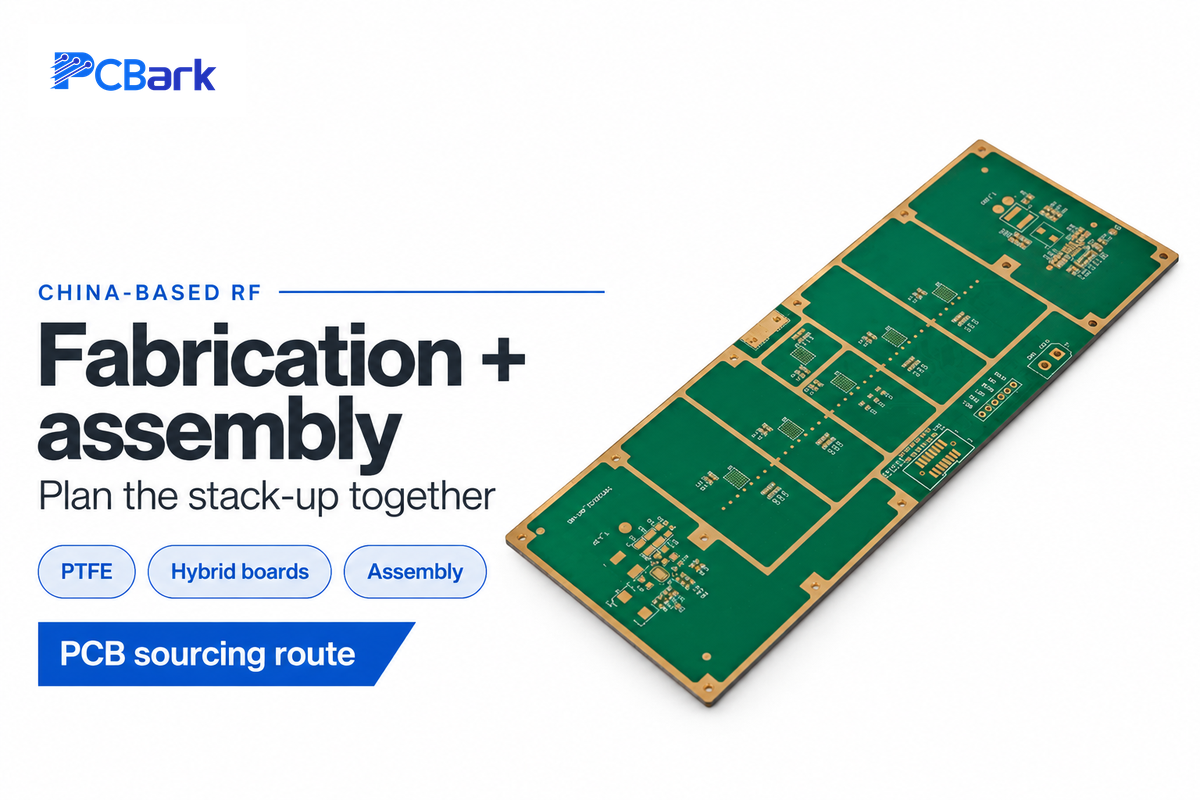
1. PCBark: Best for RF fabrication with assembly
Headquarters: Shenzhen, China · Founded: 2010 · Type: PCB manufacturer and assembler
Official website: https://pcbark.com/
Main products: RF, microwave and hybrid PCBs; PCB assembly.
Certifications: Its website lists ISO 9001, ISO 14001 and UL certification.
Published capabilities: Rogers, Taconic, Isola and Megtron material options; PTFE and hybrid construction.
Among PCB manufacturers in China, PCBark is a PCB manufacturing company combining PTFE and hybrid RF boards with assembly. Coordinating fabrication and assembly services in one sourcing conversation suits buyers developing a board and its populated prototype. The engineering team can discuss the stack-up and assembly requirements together. Buying limitation: China-based fabrication doesn’t satisfy a domestic-US manufacturing requirement.
See PCBark’s RF PCB fabrication service for its material and construction offer.
US RF PCB prototypes and production
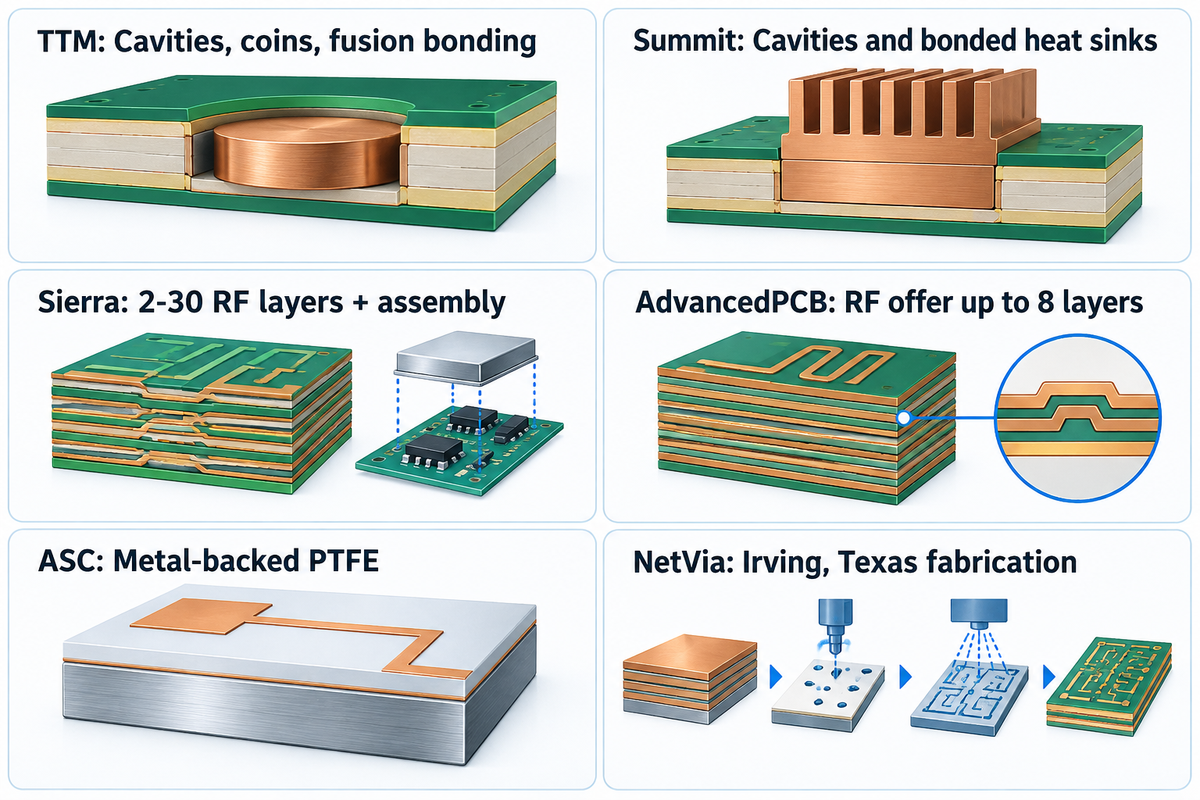
These businesses are headquartered in the USA and publish information about RF manufacturing services and PCB products, but consolidation in the PCB industry means that the named manufacturing site, rather than the US headquarters, identifies the fabrication location.
2. TTM Technologies: Best for Complex RF structures
Headquarters: Santa Ana, California, USA · Founded: 1998 incorporation · Type: PCB and RF component manufacturer
Official website: https://www.ttm.com/
Main products: RF/microwave PCBs, RF components and advanced interconnects.
Certifications: RF webpage lists AS9100 and ISO 9001 among facility-dependent certifications.
Published capabilities: Over 70 resin systems; PTFE fusion bonding, cavities and thermal coins.
RF test centers publish combined network-analyzer sweep coverage up to 110 GHz. That’s test-center equipment coverage, not a blanket board specification. Cavities, coins and fusion bonding make TTM relevant for microwave PCB projects with integrated electrical and mechanical features. Buying limitation: Specialist cavities and RF test-center work require allocation to a suitable manufacturing site.
3. Summit Interconnect: Best for RF multilayers with thermal features
Headquarters: Irvine, California, USA · Founded: 2016 · Type: PCB manufacturer
Official website: https://summitinterconnect.com/
Main products: Rigid, rigid-flex, HDI and RF/microwave PCBs.
Certifications: Official certifications page lists AS9100D and ISO 9001:2015 by facility.
Published capabilities: PTFE, hydrocarbon and hybrid stackups; plated cavities and bonded heat sinks.
RF offer includes plated cavities, controlled-depth milling and bonded heat sinks. Those features make Summit relevant when complex multilayer boards need thermal hardware or recessed component areas. Its published mix extends beyond substituting a low-loss laminate into an ordinary board. Buying limitation: Site-specific qualifications make factory allocation part of sourcing the RF build.
4. Sierra Circuits: Best for US prototypes with assembly
Headquarters: Sunnyvale, California, USA · Founded: 1986 · Type: PCB manufacturer and assembler
Official website: https://www.protoexpress.com/
Main products: RF/microwave boards, prototypes and turnkey assemblies.
Certifications: Its website lists AS9100D, ISO 9001:2015 and ISO 13485:2016.
Published capabilities: Published RF capability table lists 2–30 layers, hybrid boards and ±5% controlled impedance.
Published RF range is 2–30 layers; Sunnyvale fabrication and assembly support quick-turn and medium-production work. Full turnkey PCB assembly also puts component sourcing alongside board manufacture, helping a team move from a bare-board prototype to a populated electronic product. Buying limitation: Its RF capability table lists no heat-sink option.
5. AdvancedPCB: Best for Lower-layer-count RF builds
Headquarters: Aurora, Colorado, USA · Founded: 2024 combined brand; APCT roots in 1977 · Type: PCB manufacturer and design services provider
Official website: https://www.advancedpcb.com/
Main products: Advanced rigid, flex/rigid-flex and RF/microwave PCBs.
Certifications: Company About page lists ISO 9001:2015, MIL-PRF-31032 and ITAR registration.
Published capabilities: Rogers and Taconic materials, FR-4 hybrids; RF page lists up to 8 layers.
Dedicated RF offer lists up to 8 layers and 2.75 mil trace/space on suitable materials. AdvancedPCB unites APCT, Advanced Circuits and San Diego PCB Design under one brand. Its advanced PCB fabrication offer is the relevant comparison for an RF prototype, rather than a general group-wide multilayer maximum. Buying limitation: The dedicated RF offer is capped at 8 layers, below some broader group capabilities.
6. American Standard Circuits: Best for Metal-backed RF boards
Headquarters: West Chicago, Illinois, USA · Founded: 1988 · Type: PCB manufacturer
Official website: https://www.asc-i.com/
Main products: RF/microwave, metal-backed, flex and rigid-flex PCBs.
Certifications: Official quality page lists AS9100 Rev D, ISO 9001:2015 and MIL-PRF-31032.
Published capabilities: Hybrid multilayers; pre/post-bonded metal-backed PTFE; in-house machining and plating.
Bonded metal carriers, wire-bondable finishes and in-house machining suit RF modules with electrical and thermal packaging requirements. Mechanical drawings form part of the definition of this kind of RF build. Buying limitation: ASC’s metal-backed RF construction ties board procurement to carrier machining and specified sheet-film adhesive or sweat-solder bonding.
7. Epec Engineered Technologies / NetVia: Best for A named domestic fabrication route
Headquarters: New Bedford, Massachusetts, USA · Founded: 1952 Epec roots · Type: Electronics manufacturer with NetVia PCB fabrication
Official website: https://www.epectec.com/
Main products: RF/microwave PCBs and engineered electronic products.
Certifications: Approvals page lists separate ISO 9001:2015 certificates for Epec and NetVia.
Published capabilities: Stock Rogers 4003/4350 and Arlon materials; PTFE/FR-4 hybrids, metal-backed boards.
NetVia’s domestic PCB manufacturing facility is in Irving, Texas. NetVia is an Epec company, so both appear here within one group entry. Stock RF material options and a named fabrication route make the group a candidate for buyers matching a board to a domestic production requirement. Buying limitation: US domestic fabrication specifically routes through NetVia in Irving within a wider global supply network.
European RF and microwave specialists
8. Cistelaier: Best for Italian RF material choice
Headquarters: Modena, Italy · Founded: 1976 manufacturing roots · Type: PCB manufacturer within Finmasi Group
Official website: https://www.cistelaier.it/en
Main products: Rigid, flex/rigid-flex and RF/microwave PCBs.
Certifications: Quality page lists EN 9100, ISO 13485:2016 and ESA qualification for polyimide constructions.
Published capabilities: Precision etching, dielectric-thickness control and backdrilling; Rogers, Taconic and Isola HF materials.
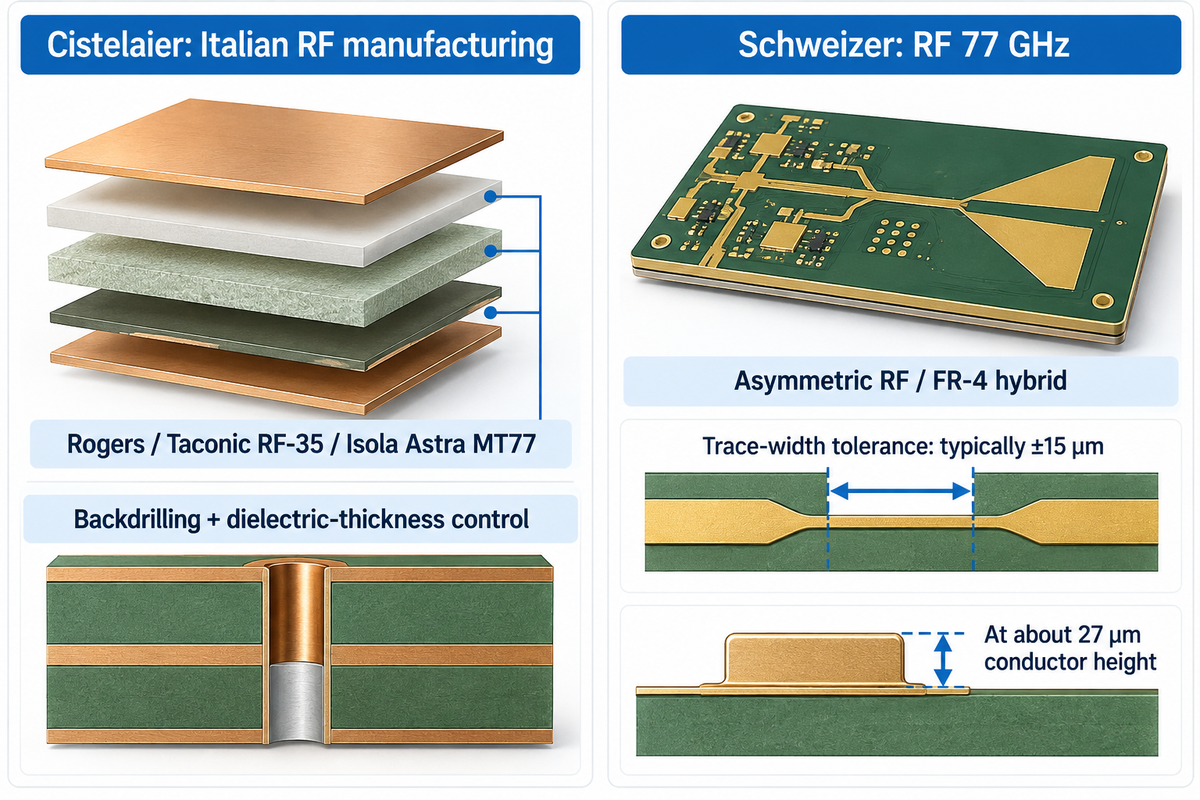
High-frequency material list includes Taconic RF-35 and Isola Astra MT77 alongside Rogers options, giving buyers choices beyond one laminate family. Manufacturing operates through Cistelaier’s Italian plants. Backdrilling and dielectric-thickness control address construction choices that affect the RF path. Buying limitation: Its listed ESA qualification covers polyimide constructions rather than every RF material stackup.
9. Schweizer Electronic: Best for Radar and sensor development
Headquarters: Schramberg, Germany · Founded: 1849 roots; PCB production from 1958 · Type: PCB and embedded solutions manufacturer
Official website: https://schweizer.ag/
Main products: RF/sensor, multilayer and embedded PCBs.
Certifications: Published ISO 9001:2015 certificate covers Schramberg; valid 2024-01-11 to 2027-01-10.
Published capabilities: RF 77 GHz technology uses asymmetric RF/FR-4 hybrid stackups.
RF 77 GHz page lists typical ±15 µm trace-width tolerance at approximately 27 µm conductor height and describes radar and sensing applications. This is a high-frequency PCB option when board construction forms part of sensor development. Buying limitation: Radar performance requires coordination of the board, RF chip and housing; Schramberg’s certificate is site-specific.
How to choose an RF PCB manufacturer
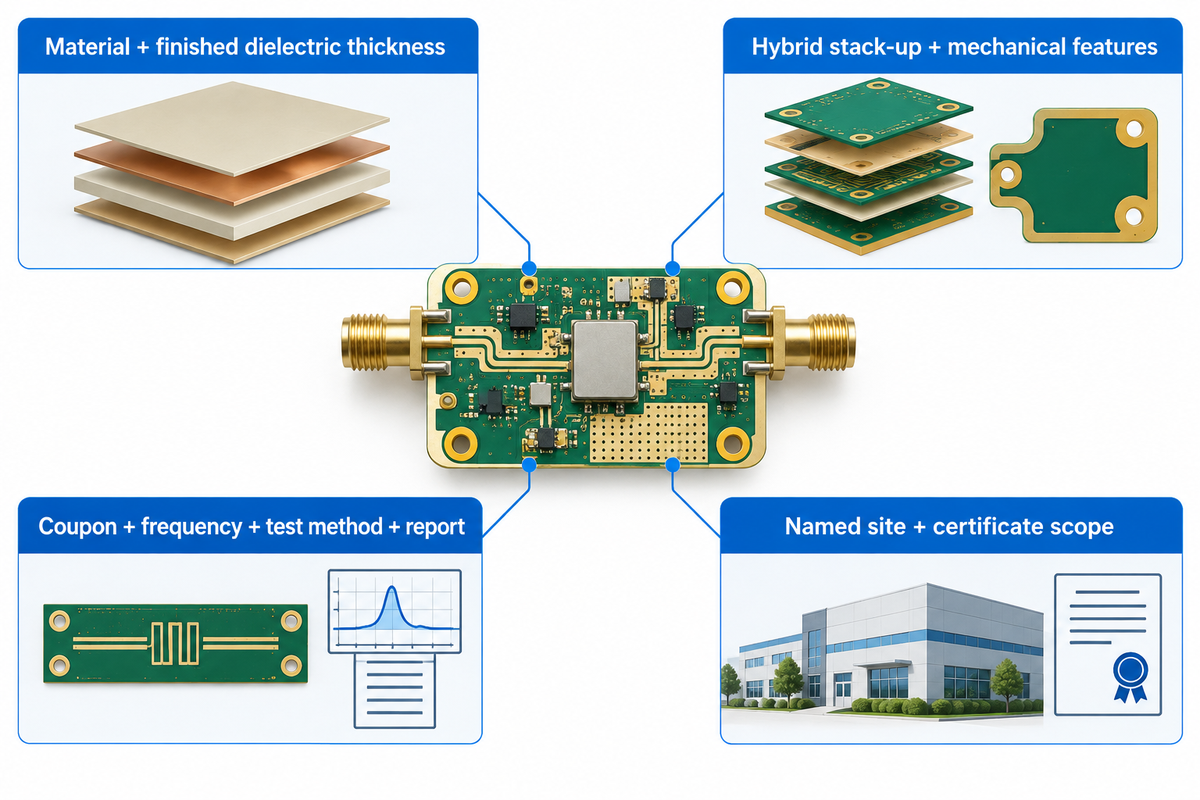
Pick a manufacturer who can work with the material, structure, testing, and production route that best suits your design. A high-precision PCB may need to have very tight feature tolerances. Thermal modules require designs that integrate metal features. Translate a high-performance pcb goal into acceptance criteria and then compare pcb manufacturing services. High-quality printed circuit boards require defined acceptance tests as opposed to a general quality promise.
Does the stack-up fit both RF and digital layers?
A hybrid stack-up can put low-loss material around an RF circuit while using FR-4 elsewhere. Material chemistry affects processing: Rogers describes RO4003C as hydrocarbon/ceramic, with FR-4-like processing. PTFE requires special treatment. In the pcb file and fabrication notes, specify the laminate, bonding material, finished dielectric thickness and blind and buried vias.
What evidence covers impedance and RF loss?
TDR impedance evidence and RF insertion-loss or S-parameter data answer different acceptance questions. IPC’s high-frequency measurement method addresses calibration, fixtures and de-embedding. Board acceptance therefore requires the coupon, frequency range, test method, report and measurement reference plane, in addition to the instrument’s upper frequency.
For printed circuit board manufacturers with multiple plants, source the order against a named fabrication site, certificate holder, scope and validity. IPC validation programs distinguish qualified products and manufacturing sites. Medical-device or aerospace programs may add purchasing requirements beyond a general quality-system certificate.
Define before quoting
- Specify material traceability and permitted substitutions.
- Include carrier machining, finish and assembly drawings.
- Separate prototype and production quantities, testing and turnaround time.
Avoid false equivalence
- Compare the same PCB design revision and build notes.
- Price PCB fabrication and assembly separately from broader electronics manufacturing services.
- Identify the factory and PCB services covered by a PCB supplier’s offer.
For laminate-specific sourcing, see our Rogers PCB manufacturer comparison. Our RF and microwave PCB guide covers the engineering choices in more detail.
RF PCB sourcing FAQ
What makes a custom PCB manufacturer better for RF boards?
A custom RF manufacturer can support a stack-up or test requirement beyond a standard ordering menu.
The advantage is the ability to control specific elements including mixed dielectrics, special vias, cavities, thermal carriers and specified RF test coupons. A basic RF PCB design that fits a published standard process may not require this more elaborate manufacturing route. For a hybrid board, consider the bonding material and the finished dielectric thickness, which should be specified as part of the same build.
How much more does a custom RF PCB cost compared to JLCPCB?
There is no defensible universal price multiplier; JLCPCB advertises an RF starting offer of USD47.
Use JLCPCB’s USD47 advertised RF starting offer (October 2026) as a baseline for its offered configuration. It’s subject to change and isn’t a universal price multiplier for custom RF manufacturing. For layers, special laminates, bonding cycles, machining, test coupons or assembly, request a quotation. When evaluating fabrication quotes for the same board size, quantity and acceptance requirements, subtract the lower quote from the higher quote to determine the premium for your project.
Why choose a PCB manufacturer in the USA?
A US fabricating site can suit projects requiring domestic manufacture or close coordination with a local engineering team.
Choose a US manufacturing site to meet a domestic-fabrication requirement or to tighten control over engineering coordination, shipments and visits. The fabricating site makes the board, not the company headquarters. The relevant differences are site operations, RF construction, documentation and production support for the requirements in your build notes; geography alone does not determine quality.
Can JLCPCB make RF PCBs for 5G applications?
JLCPCB offers RF boards; a 5G design must fit the published process and its electrical requirements.
JLCPCB’s high-frequency PCB offer is a two-layer Rogers RO4350B/PTFE manufacturing route. It can suit a 5G design when its frequency, layer count, stack-up and RF acceptance-data requirements match that route; boards needing more layers, a custom hybrid stack-up or specified RF acceptance data require a matching quotation.
Which RF PCB manufacturer is best?
Shortlist TTM for complex structures, Sierra for prototypes with assembly, ASC for metal-backed construction, and Schweizer for radar work.
PCBark suits buyers sourcing China-based RF fabrication with PCB assembly services. Summit, AdvancedPCB, Epec/NetVia and Cistelaier offer other combinations of manufacturing route, materials and construction. Start with the relevant Best for category, then compare the exact build specification. The best circuit board manufacturer for a prototype may differ from the one that fits sustained PCB production and its documentation requirements.
Find a manufacturing fit for your RF board
At PCBark, we offer RF PCB fabrication and PCB manufacturing and assembly support. Send the stack-up, fabrication files, quantity and required tests so we can review the manufacturing fit. Our design for manufacturing review and prototype PCB assembly service support the next step.
Discuss your RF board with PCBark
References & Sources
- E3 Success Story: American Standard Circuits, Inc. Illinois Sustainable Technology Center, 2014.
- High-frequency electrical measurement guidance, IPC-TM-650 2.5.5.14 IPC.
- Validation Services Global Electronics Association / IPC.