Get in touch with PCBark Company


Last updated: October 2026
The best heavy copper PCB manufacturers for a shortlist depend on the construction: Amitron for selective copper, SCHWEIZER for thick inner power layers, Summit Interconnect for documented multilayer builds, and PCBWay for geometry-led prototypes. PCBark combines fabrication and assembly. Compare the copper required on each layer before comparing the supplier’s headline maximum.
Quick Picks
- Best for turnkey industrial power boards: PCBark
- Best for selective same-layer copper: Amitron
- Best for thick internal power planes: SCHWEIZER
- Best for European bare-board sourcing: KSG
- Best for an all-layer heavy-copper build reference: Summit Interconnect
- Best for weight-specific prototype geometry: PCBWay
Disclosure: This guide is published by PCBark. We list ourselves first because this is our website, not because we claim to be the market leader. The other 19 manufacturers are grouped by what they’re best for, in no particular order within each group.
How We Selected These Heavy Copper PCB Manufacturers
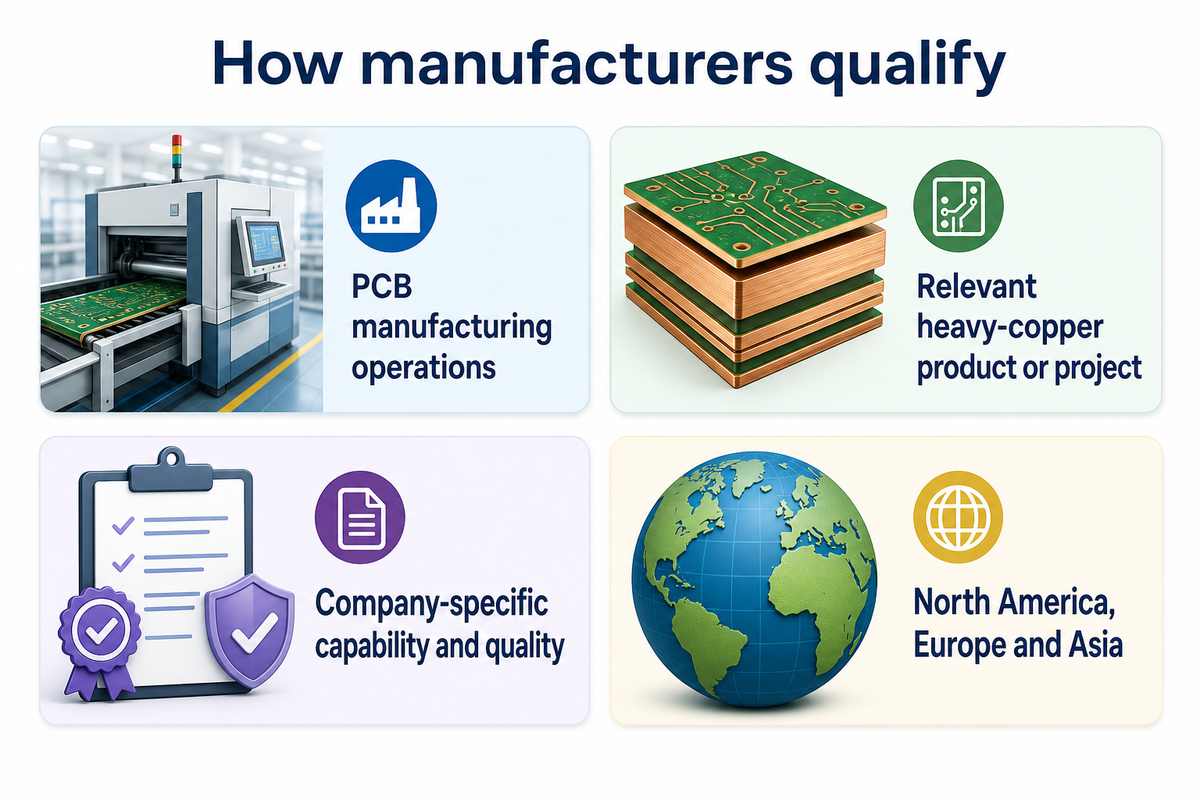
Company information was verified against official websites and public sources in October 2026. Inclusion required evidence of PCB manufacturing operations, a relevant heavy-copper product or documented project, and company-specific capability and quality information. Trading companies, distributors, sourcing platforms, directories, media websites and used-equipment dealers were excluded. The selection covers North America, Europe and Asia; related group brands are counted once.
This is an editorial shortlist, with numbers for navigation rather than revenue or quality ranking. Corporate headquarters identify the business, while named facilities identify the scope of particular production or certification statements. Historical records carry their dates. Suppliers use heavy copper PCBs or thick copper PCBs for related product categories, but those names alone don’t define an equivalent construction.
Heavy Copper PCB Manufacturer Comparison
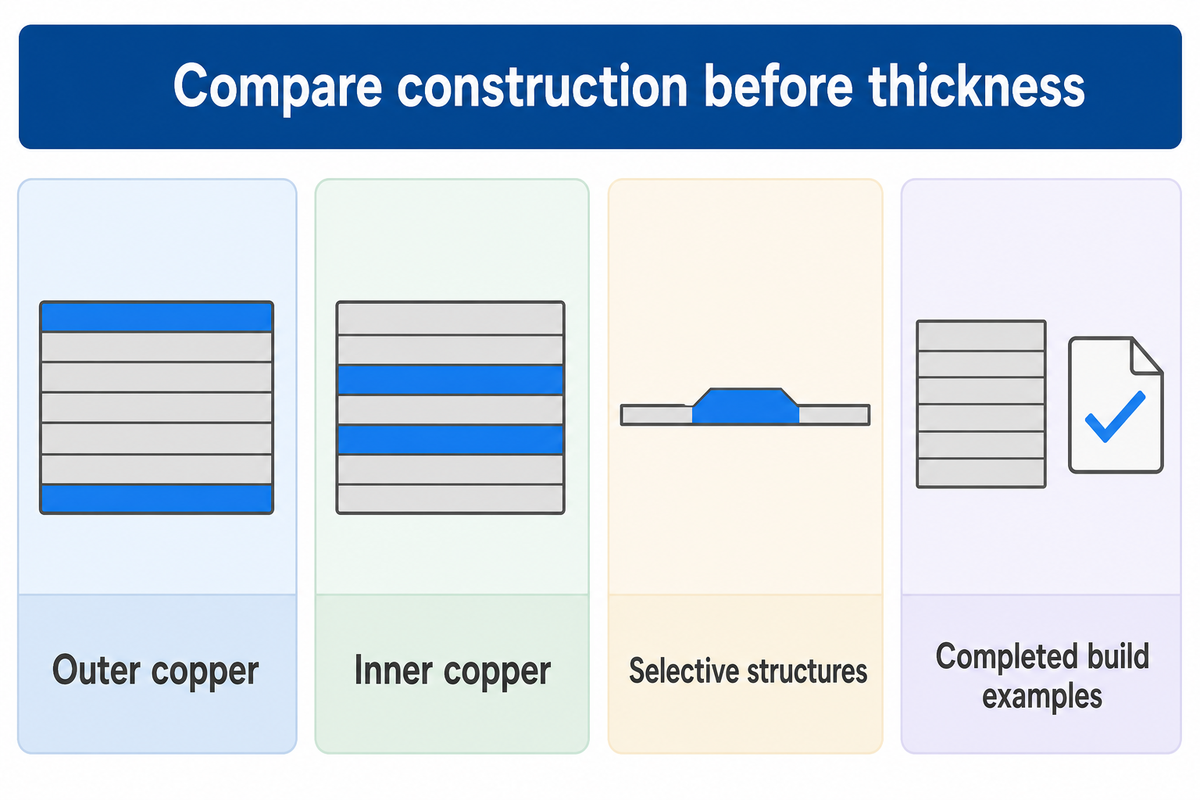
The Copper Construction Fit Grid keeps each manufacturer’s published measurement basis. Outer copper, inner copper, selective structures and completed build examples occupy different design categories. Read the capability and limitation together; copper foil, finished copper and embedded conductors can’t be sorted into a useful supplier ranking by one thickness number.
| No. | Company Name | Headquarters | Founded Year | Best For | Brief Introduction | Published Heavy-Copper Capability | Key Advantages | Potential Disadvantages | Official Website |
|---|---|---|---|---|---|---|---|---|---|
| 1 | PCBark | Shenzhen, China | 2010 | Turnkey power boards | Fabrication plus assembly | 20 oz outer / 12 oz inner | Component-to-test package | Inner copper capped below outer | https://pcbark.com/ |
| 2 | Amitron | Elk Grove Village, Illinois, USA | 1985 | Selective power/control copper | US and Asian fabrication | 20+ oz finished; selective structures | Laminated Deposition | Surface and hole-wall values differ | https://www.amitron.com/ |
| 3 | Saturn Electronics | Romulus, Michigan, USA | 1985 | Explicit approval scope | US bare-board fabricator | 20 oz fabrication; UL 6 oz | Dedicated heavy-copper mask process | UL range narrower than fabrication | https://www.saturnelectronics.com/ |
| 4 | Pro-Tech Interconnect Solutions | Chaska, Minnesota, USA | 1968 | Extreme-copper structures | US specialty fabricator | 3–20 oz; special structures to 120 oz | Selective plating and slugs | 120 oz is not uniform multilayer foil | https://www.protechmn.com/ |
| 5 | Sierra Circuits | Sunnyvale, California, USA | 1986 | US populated prototypes | Fabrication and assembly | Up to 5 oz | Sunnyvale integrated campus | Moderate copper-weight envelope | https://www.protoexpress.com/ |
| 6 | TTM Technologies | Santa Ana, California, USA | 1998 incorporation | Power and signal integration | Multisite PCB group | 10 oz outer / 12 oz inner | High internal-copper allowance | Outer copper limited to 10 oz | https://www.ttm.com/ |
| 7 | Excello Circuits | Anaheim, California, USA | Not publicly disclosed | Heavy external conductors | Anaheim PCB fabricator | 20 oz outer / 4 oz inner | Clear inner/outer table | 4 oz inner limit | https://excello.com/ |
| 8 | Cirexx | Silicon Valley, California, USA (manufacturing base) | 1980 | Rigid-flex power layouts | Layout, fabrication, assembly | 6 oz outer / 4 oz inner | Combined engineering route | Below extreme-copper ranges | https://www.cirexx.com/ |
| 9 | AdvancedPCB | Aurora, Colorado, USA | 1977 manufacturing heritage; current unified brand is later | Custom thermal structures | Unified US PCB group | 20 oz outer / 4 oz inner | Coins, cavities, mixed stackups | 20 oz applies to outer copper | https://www.advancedpcb.com/ |
| 10 | PNC | Nutley, New Jersey, USA | 1969 | Design-to-assembly programs | Single-facility PCB producer | Custom High Copper Weight service | Nutley Total Concept route | Single-facility production concentration | https://www.pnconline.com/ |
| 11 | Sanmina | San Jose, California, USA | 1980 | Power backplanes | Global electronics manufacturer | Heavy copper above 6 oz | Power plus high-speed backplanes | Published PCB production outside Europe | https://www.sanmina.com/ |
| 12 | Summit Interconnect | Irvine, California, USA | 2016 | All-layer heavy copper | North American PCB group | Example: 12 layers, all 4 oz | Documented multilayer build | North American production footprint | https://summitinterconnect.com/ |
| 13 | SCHWEIZER | Schramberg, Germany | 1849 | Thick internal power planes | German PCB manufacturer | 400 µm inner / 240 µm outer | Up to four 400 µm inner layers | Outer and inner limits differ | https://schweizer.ag/ |
| 14 | KSG | Gornsdorf, Germany | 1878 roots; PCB production since 1959 | European bare boards | German/Austrian fabricator | 400 µm inner / 210 µm outer | Etched copper and HSMtec routes | Assembly sourced separately | https://www.ksg-pcb.com/ |
| 15 | Cistelaier | Modena, Italy (PCB division management) | 1998 merger of Cistel and Laier | Power/control integration | Finmasi PCB manufacturer | Heavy copper up to 500 µm | Embedded pills and plates | 500 µm range; embedded copper is separate | https://www.cistelaier.it/ |
| 16 | SOMACIS | Italy; Castelfidardo manufacturing base | 1972 | High-mix power supplies | Global HMLV PCB group | 2008 Dongguan record: up to 20 layers | DFM and reliability services | High-mix focus, not commodity-volume positioning | https://www.somacis.com/ |
| 17 | PCBWay | Hangzhou, China (headquarters stated in company history) | 2014 | Geometry-led prototypes | Chinese PCB fabricator | 15 oz outer / 12 oz inner | Weight-specific line/space table | Thicker copper needs coarser geometry | https://www.pcbway.com/ |
| 18 | Hemeixin | Shenzhen, China | 2003 (assembly-service history) | Specialized copper with assembly | Fabricator with partner support | Overview offers up to 30 oz | Fabrication and assembly coordination | Partner-supported production handoffs | https://www.hemeixinpcb.com/ |
| 19 | Kinwong | Shenzhen, China | 1993 | Volume automotive programs | China/Thailand PCB group | Category starts at 105 µm | Seven bases, thirteen factories | Factory network in China and Thailand | https://www.kinwong.com/ |
| 20 | Suntak | Shenzhen, China | 1995 | Automotive factory programs | Multisite PCB producer | Zhuhai F2 thick/buried copper | Named thick-copper factory | Zhuhai F2 route; transfers need qualification | https://www.suntakpcb.com/ |
Source basis: supplier company, capability and quality pages, plus the dated SOMACIS project report. Copper values retain the source’s units and stated layer basis. Group-level offerings and site certificates have different scopes; maximum layer count, finest geometry and maximum copper are separate specifications unless a completed construction is described.
PCBark: Turnkey Heavy Copper PCB Manufacturing
1. PCBark: Best for turnkey industrial power electronics
Headquarters: Shenzhen, China · Founded: 2010 · Type: PCB manufacturer and turnkey assembly provider
Official website: https://pcbark.com/
Main products: Heavy copper, HDI, rigid-flex PCBs and assembly
Quality, according to its website: ISO 9001, ISO 14001 and UL
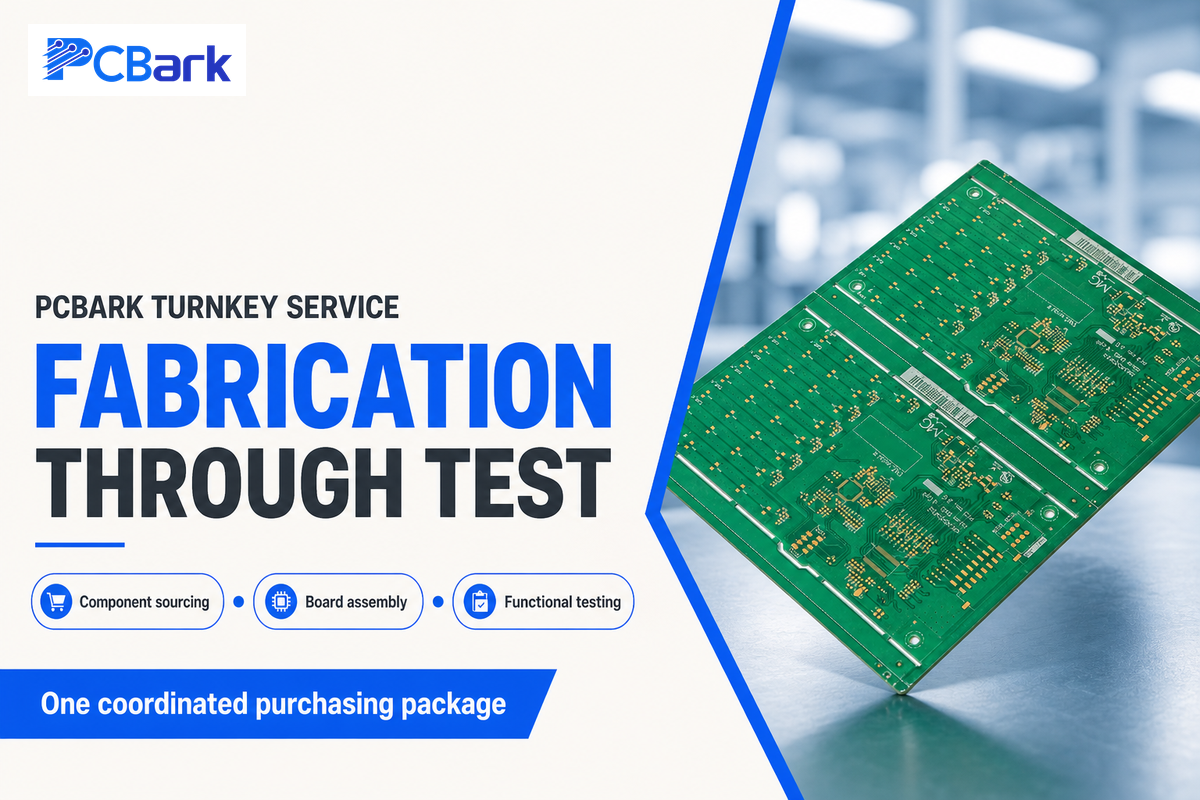
PCBark combines heavy copper PCB fabrication with component procurement, PCB assembly and functional testing for industrial applications. That combination suits a power-conversion project whose board and assembled unit need to move through one service package, while the published 20 oz outer and 12 oz inner limits give the designer an initial copper envelope. An outer-layer maximum doesn’t carry over to an inner power plane; a multilayer heavy copper design must fit the 12 oz inner specification. Its manufacturing history dates to 2010, with later operations in Huizhou and Jiangxi described in the company background.
See PCBark’s manufacturing background and heavy copper PCB manufacturing capabilities for the company’s own service scope.
Heavy Copper PCB Manufacturers in North America
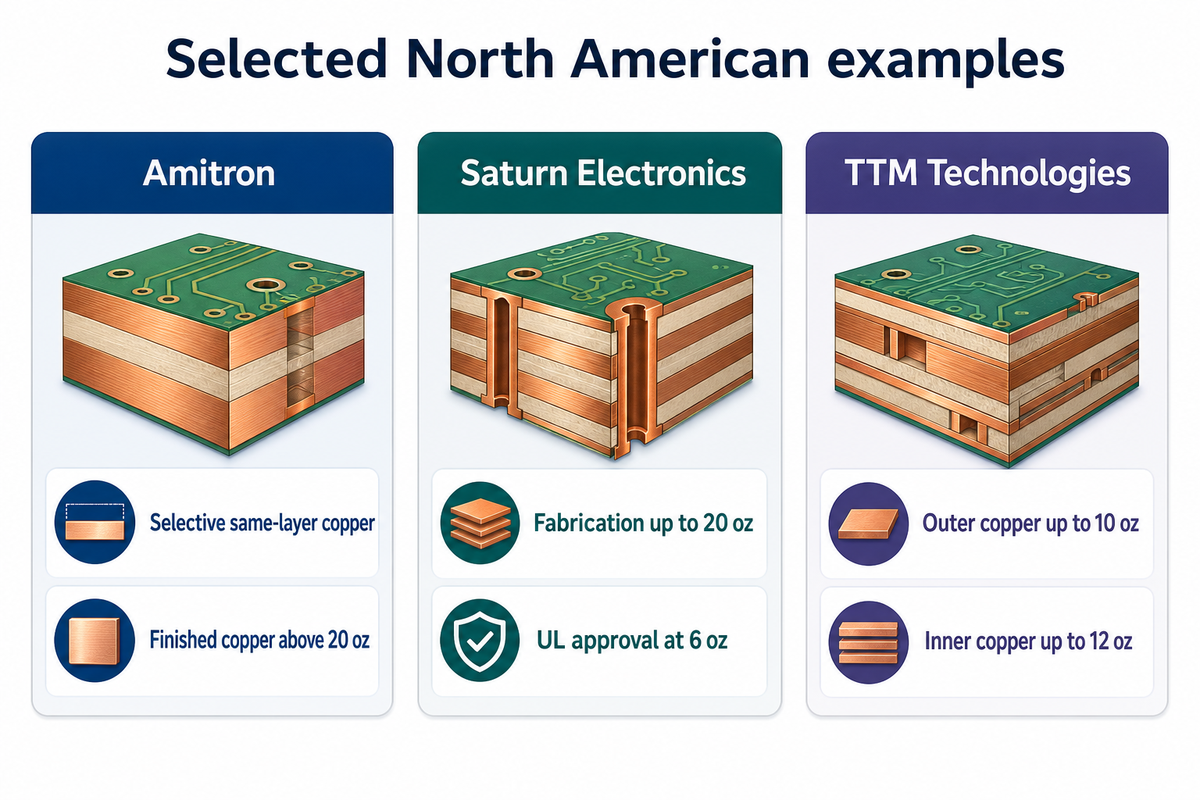
North America’s group includes specialty fabricators and multisite manufacturers. The strongest fit depends on whether the requirement is selective power copper, a populated prototype, internal power planes or a high-reliability multilayer construction.
2. Amitron: Best for selective copper and integrated power/control boards
Headquarters: Elk Grove Village, Illinois, USA · Founded: 1985 · Type: PCB fabricator with US and owned Southeast Asian manufacturing
Official website: https://www.amitron.com/
Main products: Heavy copper, multilayer and specialized PCBs
Quality, according to its website: ISO 9001:2015, AS9100D and UL; ITAR registration
Amitron’s distinguishing process is Laminated Deposition, which places different copper weights on the same layer rather than merely alternating heavy and standard copper layers through a stackup. That’s useful when a board must combine high current paths with finer control circuitry and the design team wants to consider selective copper before adding separate conductors. Amitron describes heavy-copper plating experience since 1994 and finished copper above 20 oz, but its examples distinguish surface copper from hole-wall copper. Treat that specialized construction as its own manufacturing process; a 20 oz surface isn’t a promise of the same thickness inside every plated hole.
3. Saturn Electronics: Best for heavy-copper fabrication with explicit approval boundaries
Headquarters: Romulus, Michigan, USA · Founded: 1985 · Type: US bare-board PCB manufacturer
Official website: https://www.saturnelectronics.com/
Main products: Heavy copper double-sided and multilayer PCBs
Quality, according to its website: ISO 9001, IATF 16949, AS9100D, ISO 14001 and UL
Saturn gives buyers a particularly useful distinction: it describes fabrication up to 20 oz while stating UL approval at 6 oz on inner and outer layers. Those figures answer different questions, so a purchasing team can separate a technically buildable board from the approval scope needed for its product. Dedicated spray solder-mask processing is another relevant detail because thick copper leaves a different surface profile from standard printed circuit boards. Saturn’s concrete limitation is the narrower published UL copper range, which can rule out a proposed construction even when its thickness falls within the fabrication offering.
4. Pro-Tech Interconnect Solutions: Best for selective extreme-copper structures
Headquarters: Chaska, Minnesota, USA · Founded: 1968 · Type: US PCB fabricator
Official website: https://www.protechmn.com/
Main products: Heavy and extreme copper PCBs with selective plating
Quality, according to its website: ISO 9001, ISO 13485, AS9100 and UL
Pro-Tech describes heavy copper in the 3–20 oz range and specialized extreme copper above 20 oz up to 120 oz. Selective plating and copper slugs allow substantial power conductors to share a board with control functions, making this a candidate for a deliberately engineered extreme copper PCB rather than a routine thickness upgrade. Pro-Tech traces its history to 1968 and operates a Chaska manufacturing facility. Its 120 oz figure concerns special structures; it must not be read as a uniform foil weight available on every layer of an ordinary multilayer board, or as a directly comparable maximum against conventional etched copper.
5. Sierra Circuits: Best for US prototypes with fabrication and assembly
Headquarters: Sunnyvale, California, USA · Founded: 1986 · Type: PCB fabrication and assembly manufacturer
Official website: https://www.protoexpress.com/
Main products: Heavy copper, HDI, rigid-flex and assembled PCBs
Quality, according to its website: ISO 9001:2015, AS9100D, ISO 13485:2016 and UL
Sierra Circuits is a practical candidate when a US prototype program needs board fabrication and assembly coordinated through its Sunnyvale operation. Its dedicated heavy-copper page specifies up to 5 oz, a more moderate range than the extreme copper PCBs elsewhere in this list, while its broader manufacturing portfolio includes HDI and rigid-flex work. A designer who needs a populated power-control board can consider that combined production route alongside the copper requirement. A 5 oz published envelope limits this comparison: a project requiring substantially heavier copper would need a different documented offering rather than an assumption based on Sierra’s other advanced manufacturing capabilities.
6. TTM Technologies: Best for complex power and signal boards across a multisite group
Headquarters: Santa Ana, California, USA · Founded: 1998 incorporation · Type: Multisite PCB manufacturer
Official website: https://www.ttm.com/
Main products: Conventional, advanced multilayer and heavy copper PCBs
Quality, according to its website: Santa Ana directory lists AS9100D and ISO 9001; certifications vary by site
TTM’s conventional PCB table is unusual because its published inner copper limit, 12 oz, exceeds its 10 oz outer limit. That split can suit power distribution built into internal layers alongside complex signal routing, and it gives procurement a more useful starting point than a single maximum copper number. Santa Ana’s quality directory lists AS9100D and ISO 9001, while the wider group operates multiple manufacturing locations. The published 10 oz outer-layer ceiling excludes designs needing heavier external conductors from that conventional capability range; plant selection also determines the applicable certification scope.
7. Excello Circuits: Best for high outer-copper weights with moderate inner copper
Headquarters: Anaheim, California, USA · Founded: Not publicly disclosed · Type: PCB design and fabrication manufacturer
Official website: https://excello.com/
Main products: Heavy copper, rigid-flex, HDI, RF and metal-core PCBs
Quality, according to its website: ISO 9001/ISO 13485 quality systems, UL and ITAR registration
Excello’s heavy-copper table puts its strongest numerical offer on the outside of the board: 1–20 oz outer copper, compared with 0.5–4 oz on inner layers. That makes it relevant to high-current designs whose largest conductors are external, while its Anaheim operation also covers rigid-flex, HDI, RF and metal-core products. A purchasing comparison should therefore distinguish an external power path from a design that distributes the same amount of copper across internal planes. Excello’s 4 oz inner ceiling is the specific constraint; the outer maximum can’t support a shortlist decision for a board that needs heavier copper buried inside the stack.
8. Cirexx: Best for heavy copper integrated with rigid-flex layouts
Headquarters: Silicon Valley, California, USA (manufacturing base) · Founded: 1980 · Type: PCB layout, fabrication and assembly manufacturer
Official website: https://www.cirexx.com/
Main products: Heavy copper rigid and rigid-flex PCBs
Quality, according to its website: ISO 9001 and AS9100 Rev D
Cirexx combines layout, fabrication and assembly with a heavy-copper offer covering rigid and rigid-flex boards. Its published envelope of 6 oz outer and 4 oz inner copper gives a starting point for designs that must connect power circuitry across mechanically constrained assemblies, rather than simply maximize copper mass. Cirexx describes fabrication history since 1980 at its Silicon Valley manufacturing base. Projects that require heavier internal power planes fall beyond the listed 4 oz inner range, so Cirexx’s integration services are most relevant when the electrical and mechanical design fits that construction window.
9. AdvancedPCB: Best for US custom thermal-management constructions
Headquarters: Aurora, Colorado, USA · Founded: 1977 manufacturing heritage; current unified brand is later · Type: US multisite PCB manufacturer
Official website: https://www.advancedpcb.com/
Main products: Heavy copper, HDI, rigid-flex and thermal-management PCBs
Quality, according to its website: AS9100D and ISO 9001:2015; site-specific certification directory
AdvancedPCB brings APCT, Advanced Circuits and related US manufacturing operations under one current brand; they’re counted once here. AdvancedPCB’s portfolio combines mixed copper stackups with copper coin technology, insulated metal substrates and controlled-depth cavities, giving thermal designers several distinct ways to route power or remove heat within the PCB. Its custom capability table lists outer copper up to 20 oz but inner copper at 0.5–4 oz. That large difference is the purchasing constraint: the availability of coins or cavities doesn’t turn the 20 oz outside-layer figure into a conventional 20 oz inner-layer option.
10. PNC: Best for one-facility design-to-assembly programs
Headquarters: Nutley, New Jersey, USA · Founded: 1969 · Type: PCB design, fabrication and assembly manufacturer
Official website: https://www.pnconline.com/
Main products: High copper weight, RF, HDI, rigid-flex and assembled PCBs
Quality, according to its website: AS9100D and ISO 9001:2015; ITAR registration
PNC’s Total Concept offering brings design, fabrication and assembly into its Nutley facility, with a company history reaching back to 1969. The capability list explicitly includes High Copper Weight alongside RF, HDI and rigid-flex products, so its value is a coordinated engineering-to-assembly route rather than a headline contest for the largest oz figure. A program combining power electronics with assembly requirements can use that manufacturing structure to narrow its supplier discussions. The single-facility model concentrates production at Nutley. A buyer requiring geographically separate manufacturing backup would need a second qualified production route alongside this integrated service.
11. Sanmina: Best for power backplanes and global production programs
Headquarters: San Jose, California, USA · Founded: 1980 · Type: Global electronics and PCB manufacturer
Official website: https://www.sanmina.com/
Main products: Backplanes, high-speed multilayers and heavy copper PCBs
Quality, according to its website: US aerospace PCB operations described as AS9100; medical fabrication described as ISO 13485
Sanmina connects PCB fabrication with a broader electronics-manufacturing organization and identifies heavy copper above 6 oz in its 2026 PCB portfolio. Backplane experience and high-speed multilayer work make the company relevant where power delivery shares a large, complex board with signal-integrity requirements, including programs that move between development and global production. Its PCB operations span the Americas and Asia, with quality-system claims tied to particular markets and facilities. Sanmina advertises high-volume PCB manufacturing in the Americas and Asia. A procurement requirement for fabrication within Europe therefore falls outside that published production route.
12. Summit Interconnect: Best for heavy copper across every layer of a multilayer board
Headquarters: Irvine, California, USA · Founded: 2016 · Type: North American PCB manufacturer
Official website: https://summitinterconnect.com/
Main products: Advanced multilayer, rigid-flex and heavy copper PCBs
Quality, according to its website: Anaheim directory lists AS9100D, ISO 9001:2015 and Nadcap; site scopes differ
Summit’s published heavy-copper example is a 12-layer PCB with 4 oz on every layer, which shows a more specific construction than a list of unrelated maxima. Its discussion covers the plating and lamination problems involved, including resin fill around thick copper layers, so the example is useful for a designer planning distributed power across a multilayer stack. Summit was established in 2016, and its current headquarters is Irvine; Anaheim is a manufacturing site with its own certification directory. That all-4 oz board is a demonstrated example, not a maximum. Summit’s manufacturing network is North American; buyers requiring fabrication within Europe or Asia need a different production route.
European Manufacturers for Thick Copper and Power Electronics
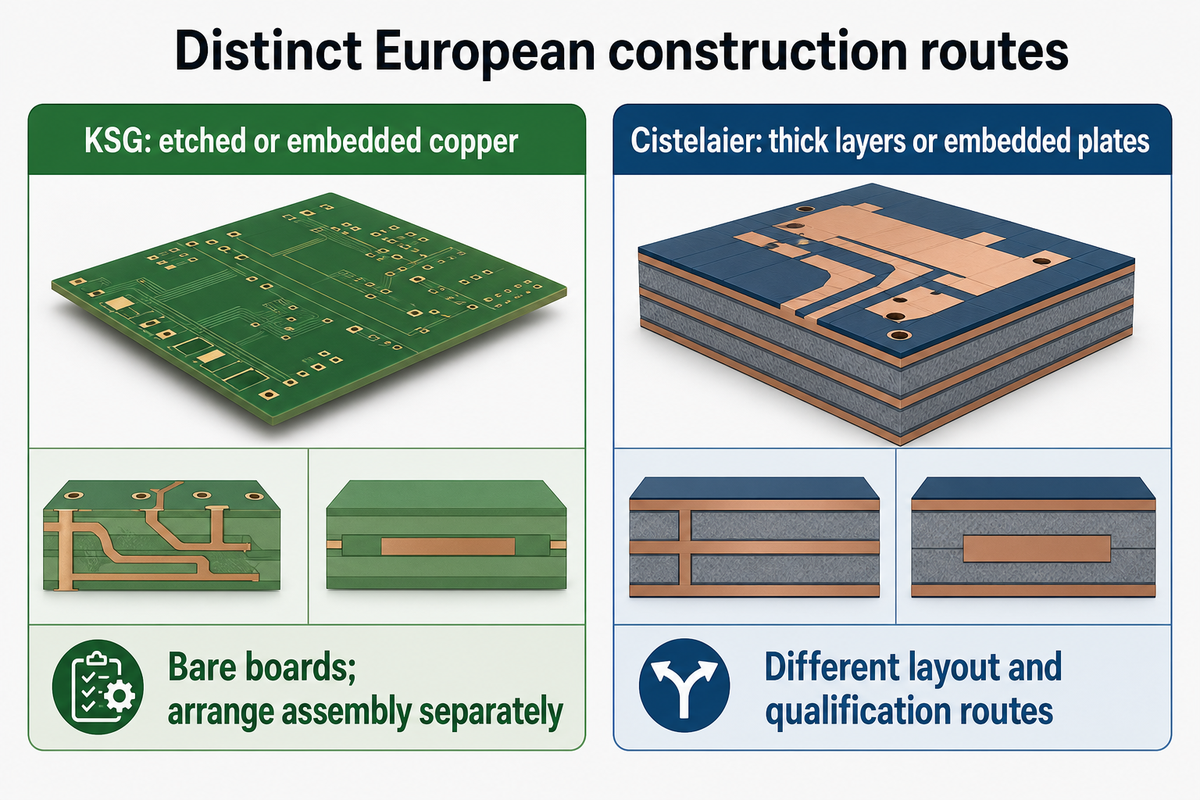
European options distinguish thick etched layers from embedded conductors and custom power-supply work. These are different ways to combine power and control functions, with assembly scope and factory allocation affecting the purchasing route.
13. SCHWEIZER: Best for very thick inner power layers
Headquarters: Schramberg, Germany · Founded: 1849 · Type: PCB manufacturer focused on advanced electronics
Official website: https://schweizer.ag/
Main products: Heavy copper and embedded/advanced power-electronics PCBs
Quality, according to its website: ISO 9001 and IATF 16949 with site-specific downloads
SCHWEIZER’s heavy-copper offer emphasizes internal power layers, including structures with up to four 400 µm inner copper layers. Published outer copper is 50–240 µm, so the construction can be considered where a power-electronics design needs substantial buried conductors without assuming identical copper on the outside. SCHWEIZER traces its Schramberg roots to 1849 and provides site-specific quality documentation. Its useful distinction is the internal 400 µm process; the corresponding limitation is that the outer layer stops at a different thickness, and the separate values don’t describe a single all-layer specification.
14. KSG: Best for European bare boards with distinct high-current construction routes
Headquarters: Gornsdorf, Germany · Founded: 1878 roots; PCB production since 1959 · Type: European bare-board PCB manufacturer
Official website: https://www.ksg-pcb.com/
Main products: Thick copper, HSMtec and other advanced bare PCBs
Quality, according to its website: ISO 9001 and IATF 16949 listed for both production sites
KSG offers several routes that should remain distinct in a technical comparison: etched thick copper, HSMtec embedded copper conductors and selective-thickness approaches. Its thick copper table reaches 400 µm on inner layers and 210 µm finished outer copper, while its manufacturing history includes PCB production since 1959 and earlier roots in 1878. Designers can compare those routes when conventional etched traces become difficult to reconcile with power and fine-signal functions. KSG’s purchasing boundary is clear: it supplies unassembled printed circuit boards, so a buyer needing a complete populated module must arrange an assembly route separately.
15. Cistelaier: Best for European power/control integration
Headquarters: Modena, Italy (PCB division management) · Founded: 1998 merger of Cistel and Laier · Type: PCB manufacturer in the Finmasi PCB division
Official website: https://www.cistelaier.it/
Main products: High-power heavy copper and advanced multilayer PCBs
Quality, according to its website: EN ISO 13485, AS/EN 9100, IATF 16949 and ISO 14001
Cistelaier describes heavy-copper production up to 500 µm and also offers embedded copper pills or plates for localized power and thermal paths. Those options are useful when high-power electronics must share a board with control functions, because a designer can compare a broadly thick copper layer with a conductor placed only where the power path requires it. Cistelaier was formed by the 1998 merger of Cistel and Laier and belongs to the Finmasi PCB division. Conventional heavy-copper designs above 500 µm exceed its published range. Embedded pills or plates offer a separate construction route, with different layout and qualification requirements rather than a direct foil substitution.
16. SOMACIS: Best for high-mix power-supply boards with global engineering support
Headquarters: Italy; Castelfidardo manufacturing base · Founded: 1972 · Type: Global PCB manufacturer focused on high-mix, low-volume programs
Official website: https://www.somacis.com/
Main products: HDI, rigid, rigid-flex, flex and power-supply multilayer PCBs
Quality, according to its website: Dongguan directory lists ISO 9001, AS9100, ISO 13485 and IATF 16949
SOMACIS has a documented heavy-copper power-supply history at Dongguan: Printed Circuit Design & Fab reported approval for multilayer production in January 2008, describing boards up to 20 layers for DC/DC converters. Current group pages still identify Dongguan and list DFM, stackup analysis, microsections and reliability testing among the wider engineering and quality services. That combination supports consideration for high-mix power-supply programs, with the 1972 founding date stated in Bain Capital’s acquisition announcement. SOMACIS focuses on high-mix, low-volume manufacturing, making a standardized commodity-volume order a less direct match to that positioning. The 2008 project remains historical experience, not a current copper ceiling.
Heavy Copper PCB Manufacturers in Asia
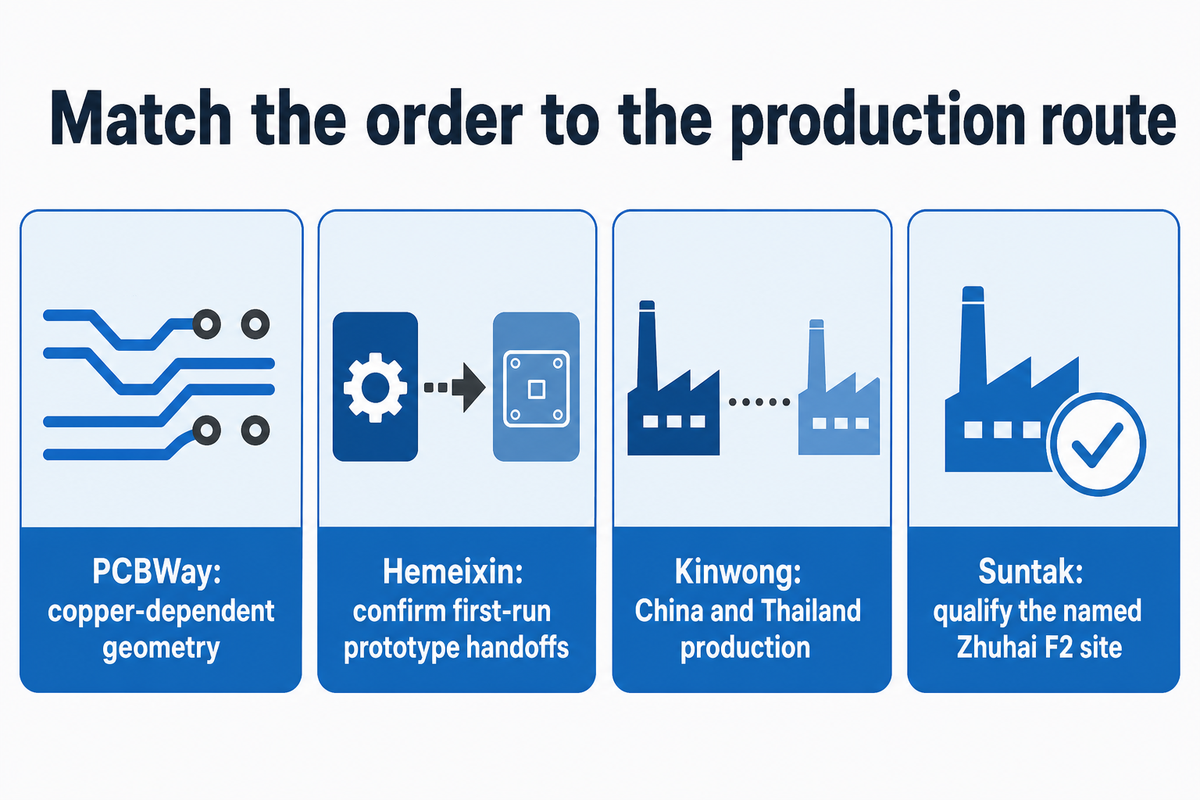
Asian manufacturers in this group span online prototype purchasing, specialized copper construction and automotive production programs. A named factory or an explicit geometry table is more useful than assuming every manufacturer in a country has the same price, lead time or copper range.
17. PCBWay: Best for prototype purchasing with copper-dependent geometry tables
Headquarters: Hangzhou, China (headquarters stated in company history) · Founded: 2014 · Type: PCB fabrication and assembly manufacturer
Official website: https://www.pcbway.com/
Main products: Heavy copper, prototype and assembled PCBs
Quality, according to its website: an ISO 9001 quality system
PCBWay publishes finished outer copper up to 15 oz and inner copper up to 12 oz, together with geometry limits that change as copper weight rises. That detail is useful for prototype purchasing because a layout that fits a standard PCB process may need wider copper traces or spacing when the copper becomes thicker. Its company history identifies a 2014 start and Hangzhou headquarters, with manufacturing operations in Shenzhen. PCBWay’s constraint is the geometry tradeoff: the heavier options can’t be combined automatically with the finest line and space offered elsewhere in its product range.
18. Hemeixin: Best for specialized high-copper boards with assembly coordination
Headquarters: Shenzhen, China · Founded: 2003 (assembly-service history) · Type: PCB fabricator and assembly provider with partner-supported processes
Official website: https://www.hemeixinpcb.com/
Main products: Heavy copper, HDI, rigid-flex and PCB assembly
Quality, according to its website: UL and legacy ISO 9001:2008, ISO 14001:2004 and ISO/TS 16949:2009
Hemeixin’s company overview includes heavy copper up to 30 oz alongside HDI, rigid-flex, fabrication and assembly services. Hemeixin’s assembly page traces that service history to 2003, and the contact page identifies its Shenzhen manufacturing address; the business also describes partner-supported processes within its wider offer. This makes it a candidate for specialized copper boards that need assembly coordination as part of the purchasing package. The 30 oz offer doesn’t apply automatically to every layer. Partner-supported first-run prototype processes create additional production handoffs, so an order requiring every operation at one supplier-owned facility needs its actual production route confirmed.
19. Kinwong: Best for volume automotive power-electronics programs
Headquarters: Shenzhen, China · Founded: 1993 · Type: Multisite PCB manufacturer
Official website: https://www.kinwong.com/
Main products: Rigid, flexible, HDI and thick copper PCBs
Quality, according to its website: Automotive page states IATF 16949 certification
Kinwong’s automotive page identifies thick copper at 105 µm and above, placing it within a portfolio that also includes heat-dissipation structures and other automotive PCB technologies. Its public overview describes seven manufacturing bases and thirteen factories across China and Thailand, which makes the group relevant to volume programs seeking a defined production route for automotive power electronics. Kinwong was founded in 1993 and is headquartered in Shenzhen. The 105 µm figure is a category threshold, not a maximum. Its China-and-Thailand factory network also means buyers requiring domestic US or European fabrication need another manufacturing route.
20. Suntak: Best for automotive power boards with a named production base
Headquarters: Shenzhen, China · Founded: 1995 · Type: Multisite PCB manufacturer
Official website: https://www.suntakpcb.com/
Main products: Multilayer, thick copper and automotive PCBs
Quality, according to its website: Zhuhai F2 page lists IATF 16949, ISO 9001, ISO 14001 and UL
Suntak identifies Zhuhai F2 as a production base for thick-copper and buried-copper boards, providing a specific factory reference within a larger Shenzhen-headquartered group. Its automotive portfolio includes power applications such as onboard charging, while the F2 page lists IATF 16949, ISO 9001, ISO 14001 and UL. A volume buyer can therefore connect the product family to a named manufacturing operation instead of relying solely on a group-wide slogan. The thick- and buried-copper production route described here is tied to Zhuhai F2. Moving the order to another factory would require separate process and site qualification; the group name alone does not make the transfer interchangeable.
How to Choose a Heavy Copper PCB Manufacturer
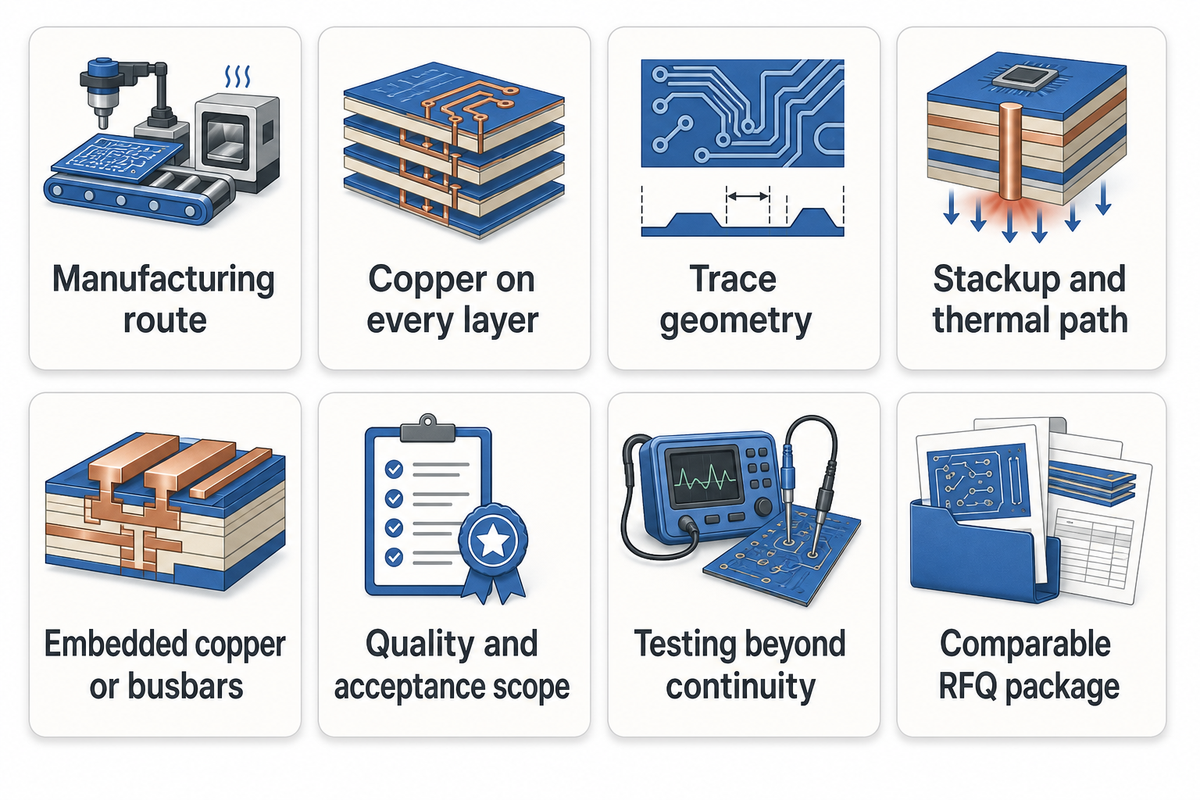
A reliable heavy copper PCB manufacturer is one whose agreed process matches the entire drawing package. The advantages of heavy copper can include lower conductor resistance and greater current-carrying capacity, but the board still needs suitable geometry, insulation and heat removal. Use the following checks to turn a longlist into quotations for the same design.
Match the manufacturing route to the deliverable
Separate bare-board fabrication from PCB assembly, component sourcing and final testing. A PCB supplier may manufacture some processes and coordinate others through partners, while a bare-board specialist such as KSG leaves assembly to a separate provider. Identify the producing facility and which operations it performs; that distinction affects the handoff, traceability and acceptance documents for a heavy copper board.
Specify copper on every layer
Record PCB copper thickness layer by layer, including whether each value describes starting foil or finished copper after copper plating. A request for “20 oz of copper” leaves too much open when a supplier’s outer and inner limits differ. Plated holes and via sidewalls need their own requirements; adding copper to a surface doesn’t automatically establish the same thickness through a hole. Standard PCB and heavy copper constructions should therefore be compared against the same drawing basis.
Connect the copper weight to trace geometry
Thick copper PCB manufacturing changes the space needed to etch a conductor cleanly. PCBWay’s weight-specific table illustrates why a fine-line capability from standard copper work can’t simply be carried into a thicker copper order. Review trace width, spacing, clearances, hole sizes and the transition to fine-pitch control circuitry together. Electrical resistance of the copper traces depends on both their cross-section and length, so the thickest available foil isn’t automatically the most useful layout.
Check the stackup and thermal path
Lamination must fill around thick conductors while maintaining the specified dielectric separation. Resin selection, copper balance, finished board thickness and attachment to the heat-removal path all affect thermal performance and mechanical strength. Designing heavy copper PCBs to handle high current loads therefore needs more than a copper-weight label. Heavy copper printed circuit boards can carry higher current than a thinner otherwise comparable conductor, but heat dissipation capabilities depend on the complete design, ambient conditions and allowed temperature rise. Use the heavy copper PCB design guide for the engineering considerations behind that choice.
When should mixed-weight copper give way to embedded copper or busbars?
Using heavy copper is one option for a power path, and selective copper is another. Amitron’s same-layer process differs from placing different foil weights on separate layers; KSG’s embedded copper bars and Cistelaier’s copper plates introduce still another construction. Consider embedded copper when localized high current requirements or a concentrated heat path make a uniformly thick layer inefficient for the rest of the circuit. There’s no universal amperage crossover: compare routing area, joints, insulation, cooling and the manufacturing capabilities available for that specific layout.
Separate quality systems from product acceptance
ISO 9001 certification describes a quality-management system; it does not state the copper thickness qualified for your PCB board. Match the current certificate to the legal entity, producing site and relevant process. Some supplier pages retain legacy certificate versions, so obtain the applicable document during qualification. Saturn’s 6 oz UL scope alongside 20 oz fabrication shows why the distinction matters. Manufacturers must also agree on the drawing revision, acceptance class, material traceability and any special-process controls that apply to the order.
What does electrical testing miss in a heavy copper board?
Electrical continuity and isolation tests address connectivity. They don’t, by themselves, establish every physical or thermal property that governs the durability of heavy copper under service conditions. Agree on the relevant microsections, copper and hole-wall measurements, insulation checks and thermal or reliability testing for the application. An official IPC Standards Revision Table lists IPC-6012F for rigid-board qualification and performance and IPC-A-600M for acceptability. Select the applicable requirements for the purchase; a standard’s title doesn’t supply a universal thermal-cycle count.
What should a comparable heavy copper PCB RFQ contain?
Send one controlled revision of the Gerber or ODB++ data, fabrication drawing and stackup. State the copper basis on each layer, plated-hole requirements, material, finish, board dimensions, testing package, prototype quantity, expected production volume and delivery needs. Heavy copper PCB boards used for high power should also include the design’s thermal and current acceptance conditions. Separate tooling, fixtures and qualification charges from recurring board prices, and identify whether assembly is included. A quotation for a complete assembly and one for a bare circuit board answer different purchasing questions.
FAQs About Heavy Copper PCB Manufacturers
Q: Who makes heavy copper PCBs?
Heavy copper PCBs are made by specialist PCB fabricators and larger electronics manufacturers with suitable plating, etching and lamination processes.
Companies producing heavy copper PCBs include Amitron, Saturn, TTM, SCHWEIZER, KSG, PCBWay and PCBark, among the other manufacturers in this list. Each has a different construction range and service scope. A useful comparison connects the required copper layers to the factory that will build them, then distinguishes bare fabrication from assembly. A supplier name alone can’t establish that every high-current design fits its process.
Q: Who are the best heavy copper PCB manufacturers in the USA?
The best US candidates depend on whether the project needs selective copper, heavy internal layers, an assembled prototype or a specialized multilayer build.
Amitron describes selective copper processes, Saturn separates fabrication from UL copper scope, and Summit publishes an all-4 oz multilayer example. Sierra Circuits combines fabrication and assembly within a more moderate copper range. Several listed groups also operate outside the United States, so a US headquarters isn’t a manufacturing-origin statement for an individual order. Compare the named production location and the same complete stackup before choosing.
Q: Who are the largest heavy copper PCB manufacturers in the world?
Comparable public heavy-copper-only revenue data is insufficient to identify a largest manufacturer in this article.
Large groups such as TTM, Sanmina, Kinwong and Suntak operate extensive PCB businesses, but their total output covers more than thick copper PCBs. Group revenue or total factory capacity doesn’t reveal capacity allocated to a particular power-board construction. A smaller specialist may offer the process a design needs. The twenty entries here are an editorial procurement shortlist, not a ranking by heavy-copper market share or sales.
Q: How much does a heavy copper PCB cost?
Heavy copper PCB cost depends on the complete construction, quantity and acceptance package, so a universal unit price would be misleading.
Copper weight is only one factor when determining effort for plating and etching, lamination and inspection. Other factors such as layer count, outline, trace geometry, hole requirements, material and finish can also impact the effort required. A thick copper PCB with fine control features, for example, might require a different route from a simpler power distribution board using the same nominal copper weight. Evaluate prototype and production quantities on the same revision, with delivery requirements stated separately. Itemize tooling, test fixtures, coupons and qualification work so one-time costs remain separate from the unit price. Also identify if components and assembly are also included in the offer. Published starting prices for standard printed circuit boards don’t establish the cost of an unreviewed heavy copper circuit. A comparable offer is linked to the agreed drawing and test package.
Q: Is every PCB supplier a manufacturer?
No. Some PCB suppliers fabricate boards, while others source them from independent factories or combine both routes.
A sourcing network can provide some useful services, but it’s a different commercial model from an owned fabrication plant. Both work within the PCB industry. Determine who performs the copper processing, who controls subcontracted work, and which entity takes responsibility for the finished product.
Q: What copper specification should a heavy copper PCB quotation include?
Specify starting or finished copper on each inner and outer layer, with plated-hole requirements listed separately.
For thickness of copper, specify actual board construction (not broad categories like heavy or extreme copper), as that lets the manufacturer assess the appropriate process and the geometry it can produce. For a 3 oz design, as for a much heavier one, identify selective same-layer regions, mixed weights across layers and any embedded conductors.
Send a Heavy Copper PCB RFQ to PCBark
A useful enquiry starts with the copper required on each layer, the intended manufacturing route and the test package. Send PCBark the controlled fabrication files, stackup, quantities and delivery requirements, and identify any assembly or component-sourcing needs. PCBark can review the construction against its published service scope and prepare a quotation tied to that package.
Request a heavy copper PCB quotation
References & Sources
- IPC Standards Revision Table · Global Electronics Association.
- Dongguan Somacis High Layer Copper PCBs Approved for Power Supplies · Printed Circuit Design & Fab, January 7, 2008.