Get in touch with PCBark Company


Updated June 2026 · Reviewed by the Shenzhen Linghangda Technology Co., Ltd. (PCBark) technical team.
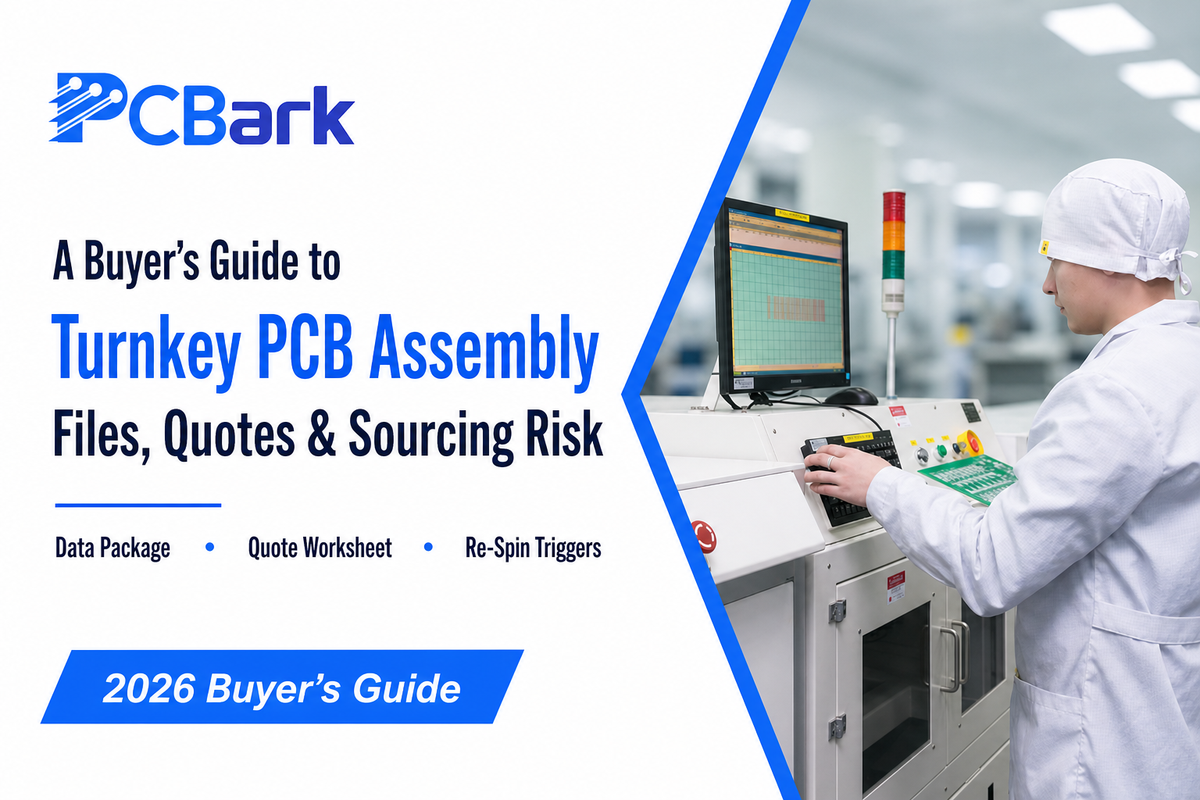
Turnkey PCB assembly is a single-supplier model where one provider sources your components, fabricates the bare board, assembles it, and tests it, so you hand over Gerbers and a bill of materials and get back a finished, tested board instead of running a coordination project across three vendors. Most guides stop at that definition. This one is written for the person who actually has to send the files, read the quotes, and answer for the result when something ships late.
In one paragraph: A turnkey PCB assembly service rolls design review, component sourcing, fabrication, SMT and through-hole assembly, inspection, and final testing into one accountable contract. You provide a complete data package; the supplier carries the sourcing and kitting risk and ships a tested assembly. The buyer’s job isn’t to understand every machine, it’s to send a buildable package, compare quotes on the same terms, and put sourcing risk where it’s cheapest to carry.
Quick Specs: Turnkey PCB Assembly at a Glance
| What it includes | DFM review, component procurement, PCB fabrication, SMT + through-hole assembly, inspection, functional testing, shipping |
| What you provide | Gerber files (RS-274X) or IPC-2581/ODB++, a BOM with manufacturer part numbers, a CPL/centroid file, assembly drawings, class + test spec |
| What you get back | Finished, inspected printed circuit board assemblies |
| Models | Full turnkey · partial turnkey · consignment |
| Quick-turn lead time | 5–15 days for in-stock designs; sourcing, not freight, is the variable |
| Typical board envelope | 0.4–3.2 mm thick, 1–42 layers, down to 0.4 mm component pitch |
| Biggest cost lever | The BOM — commonly 40–70% of total assembly cost |
Five things buyers get wrong
- Consignment isn’t automatically cheaper than full turnkey once you price your own purchasing time, minimum-order overbuys, and the cost of a stalled line.
- “Send Gerbers and a BOM” is the floor, not the goal, an ambiguous BOM line or a missing centroid file is the single most common reason a quote stalls.
- The lowest headline quote is rarely the lowest landed cost; the gap hides in sourcing, test depth, and rework.
- IPC Class 3 is application-based, not aerospace-only, it covers any product that can’t tolerate field failure.
- Search interest in component shortages has cooled, but 2026 lead times on many parts have climbed again. Complacency is the new risk.
If you only have ten minutes, read the data-package section and the quote-comparison worksheet. Those two decisions, what you send and how you compare what comes back, account for most of the difference between a clean build and a re-spin. When you’re ready to price a specific board, you can move to a turnkey PCB assembly service and send your files for a real quote.
What Turnkey PCB Assembly Actually Buys You (and the First Decision It Forces)
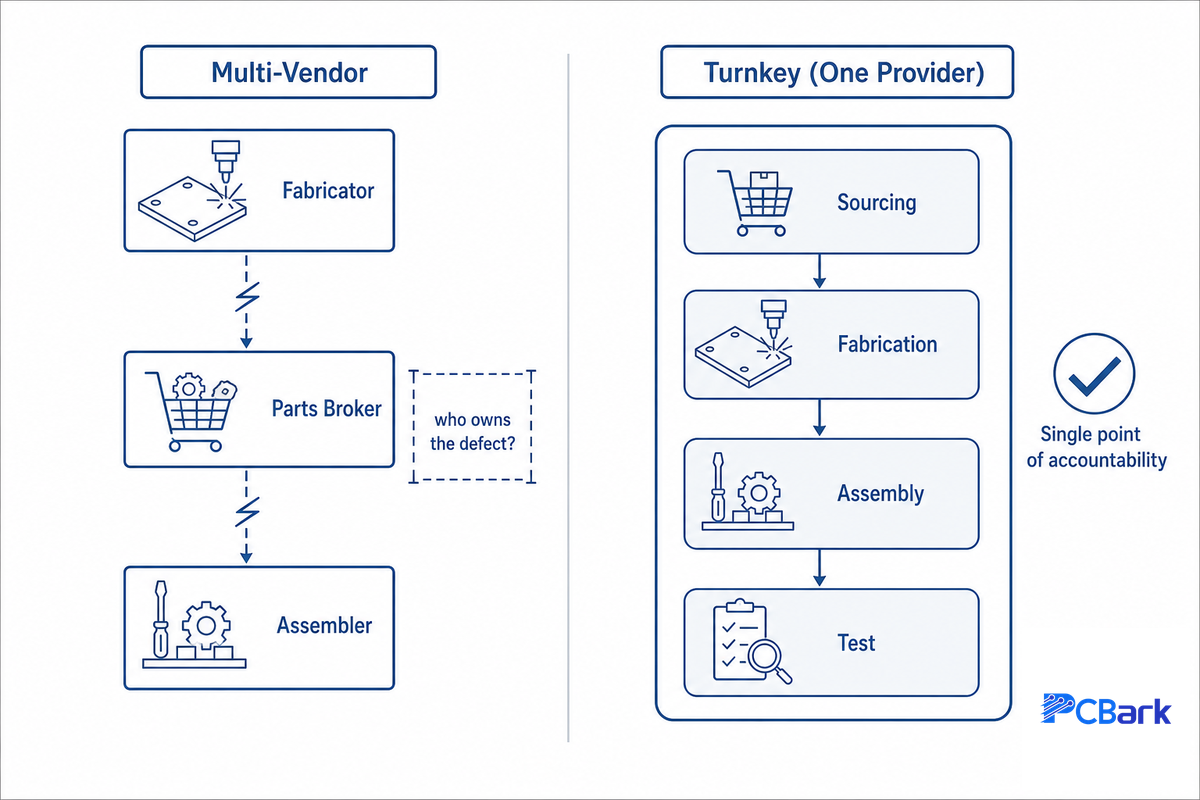
Turnkey PCB assembly buys you one line of accountability. A single supplier owns the chain from design files to a tested board, so when a joint fails, there’s one party to answer for the bare board, the components, the solder, and the test result, not a fabricator blaming a parts broker blaming an assembler. That single point of contact is the whole point: you buy a working assembly, not a coordination problem spread across multiple vendors.
Underneath the label, a turnkey solution is just the full printed circuit board production process under one roof: design-for-manufacturing review, bill-of-materials validation, component sourcing, PCB fabrication, surface-mount and through-hole assembly, inspection, and final testing. A single partner can run a prototype PCB assembly and a high-volume production build on the same line, which is why teams use it to simplify the jump from first article to scale.
Mapped to its stages, the turnkey PCB assembly process repeats the same controlled chain on every build: your design files and bill of materials clear a manufacturability check, then component procurement, PCB fabrication, the assembly process, and final testing before the finished product ships. Integrating PCB fabrication with the assembly process under one turnkey contract keeps PCB manufacturing and assembly aligned, and the benefits of turnkey PCB assembly compound when a single turnkey PCB manufacturing team owns that production process instead of splitting it across multiple suppliers. Whether you need low-volume PCB assembly, PCB prototyping, or a full production run, that one manufacturing solution covers the same assembly and manufacturing capabilities end to end. From your design files to the final product, a single service provider runs the entire PCB production process as one manufacturing process, which is what protects time to market. That manufacturing approach — turnkey PCB services that fold PCB assembly and manufacturing and circuit assembly into one assembly solution — is what keeps the build aligned.
Single-source ownership is also a documented way to cut supply-chain exposure: NIST notes that buying through original manufacturers or their authorized distributors materially reduces information-and-communications supply chain risk (NIST SP 800-161).
Before anything else, turnkey forces one decision: how much sourcing you hand over. That fork, full turnkey, partial turnkey, or consignment, sets who carries shortage risk, and it should be answered against your own inventory position, not the supplier’s marketing. We work through that self-assessment further down. For the broader menu of services that sit under this umbrella, see our PCB assembly services overview.
💡 Key takeaway
Turnkey is an accountability model, not a discount. Its value shows up when a defect spans the fabrication-to-assembly boundary — the exact place a multi-vendor build leaves you holding the bag.
The Data Package That Makes or Breaks Your Turnkey Quote
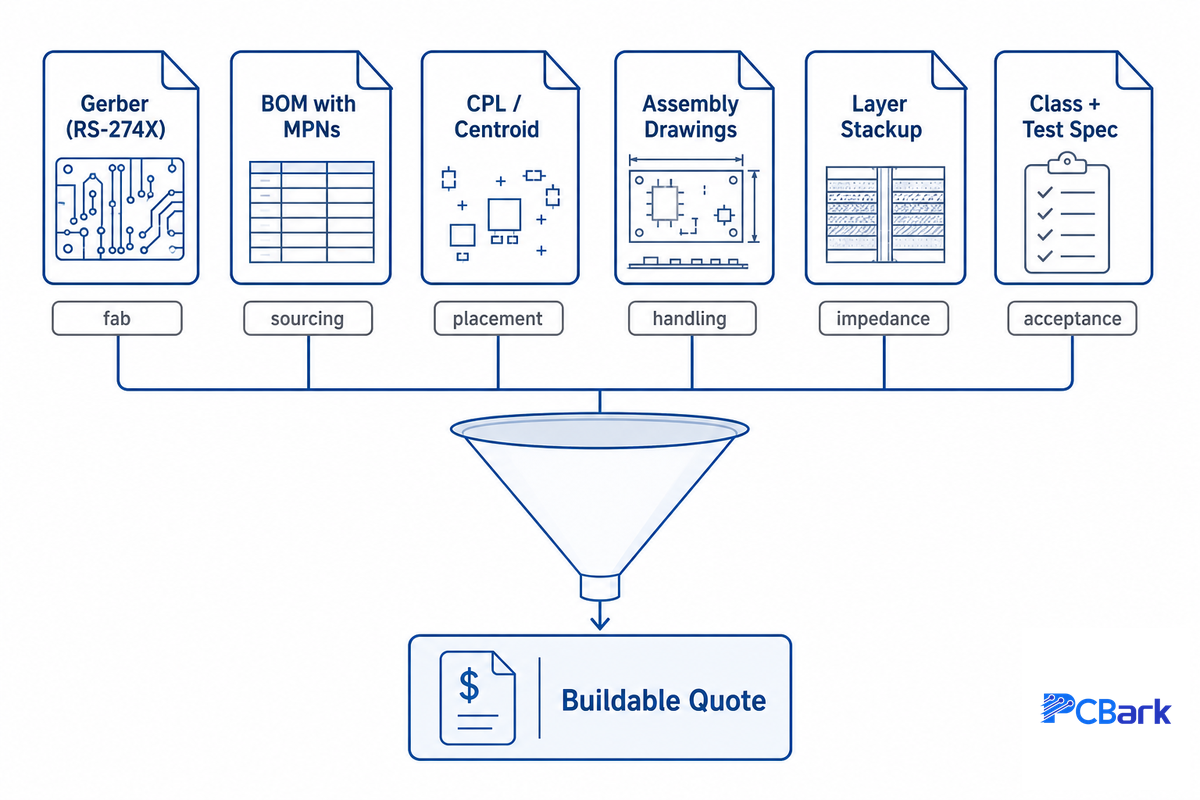
A turnkey quote is only as good as the data package you send. Nothing loses a week faster than an incomplete or ambiguous set of design files: the supplier comes back with questions, the build doesn’t start, and your “5–15 day” quick-turn quietly becomes a month. The buyer controls this entirely, which is why it’s the first place to invest effort.
What data do you need for a turnkey PCB assembly order?
A complete turnkey RFQ package is six files: Gerber files in RS-274X (or a single intelligent file in IPC-2581 or ODB++), a bill of materials with manufacturer part numbers, a component placement list (CPL/centroid) with X-Y positions and rotations, assembly drawings, the layer stackup, and your class and test requirements.
Each one gates a different stage, and each has a signature failure mode when it’s missing or vague. Send those and the supplier can quote your real board instead of a placeholder.
“Send Gerbers” is the floor, not the ceiling. Gerber RS-274X is the de-facto exchange format, and modern Gerber X2/X3 now carries attributes and some assembly metadata, so Gerber is far from obsolete. Even so, a classic Gerber set ships as a stack of layer files, whereas an IPC-2581 or ODB++ file packs the stackup, netlist, and BOM references into a single intelligent file that removes whole categories of handoff ambiguity. Most fabricators accept Gerber; the intelligent formats simply leave less room for a misread, if your tool can export one, do.
Your 8-Point Buildability Audit
| File / item | What it gates | Most common defect |
|---|---|---|
| Gerber RS-274X / IPC-2581 / ODB++ | Fabrication of the bare board | Missing layers; outdated export; format mismatch |
| BOM with manufacturer part numbers | Component sourcing | Part-number/package mismatch; unspecified passives; inconsistent DNP markings |
| CPL / centroid (pick-and-place) | SMT placement and rotation | Missing file or wrong rotation convention — a leading cause of initial SMT programming delays |
| Assembly drawings | Special handling, polarity, mechanicals | Absent — assembler guesses on ambiguous parts |
| Layer stackup | Impedance, copper weight, finish | Unstated — fab defaults may not match your design intent |
| Approved alternates list | Sourcing flexibility | None listed — one out-of-stock part stalls the whole kit |
| IPC class + test spec | Acceptance criteria and inspection rigor | Undefined — default class may be below what your product needs |
| Quantity + delivery target | Pricing tier and scheduling | Vague — setup-dominated pricing makes small quantities look wildly expensive |
Buildability defects compiled from BOM-management and pick-and-place practitioner guidance.
Run that Quote-Ready RFQ Package (8-Point Buildability Audit) before you submit: a yes/no pass on all eight items is the difference between a real quote and a week of email. Tooling is starting to do this for you, one 2023 USPTO filing describes an AI-based system that autonomously extracts and analyzes design data to flag manufacturability issues before a board is built (US20230153512A1), but the responsibility for a complete package still sits with the buyer.
“The board files tell us what to build; the BOM and the centroid tell us whether we can. Nine times out of ten, a stalled quote is not a hard board, it is a BOM line we cannot resolve to a real, in-stock part, or a centroid that does not match the footprints. Fix those two before you hit submit and your lead time is honest.”
📐 Engineering Note
A DFM review reads your package against the rules that actually gate a build: a 0.15 mm minimum component-to-component clearance, 0.4 mm pitch on fine-pitch QFN and 0.5 mm on BGA, 35 µm (1 oz) copper as a common default, and a reflow peak near 245–260 °C under IPC J-STD-001. If your design crosses one of those lines, you want it flagged now, not at first article. Confirm each against your own stackup before you submit.
How to Read and Compare a Turnkey Quote (Without Getting Burned)
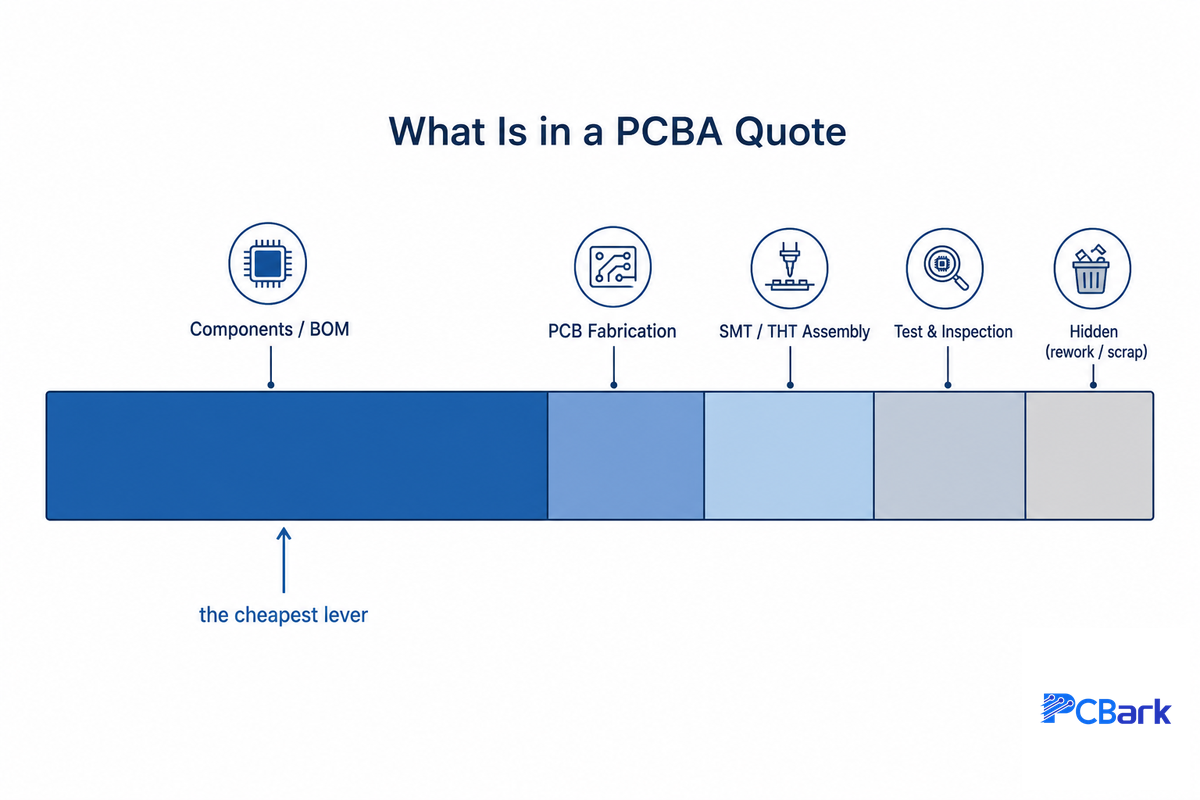
Two suppliers can quote the same board and land two to three times apart, and the headline number tells you almost nothing about why. That gap is structural: the bill of materials is the dominant line item, and every shop sources, marks up, and buffers parts differently. To compare quotes honestly you’ve to normalize them to the same scope, otherwise you’re comparing a thorough quote against an optimistic one.
How much does turnkey PCB assembly cost, and why is my PCB so expensive?
Most of a PCBA quote is components, not labor. Industry estimates commonly put the BOM at 40–70% of total assembly cost, with fabrication and assembly each in the low double digits and test a few percent. At small quantities the picture flips toward setup: practitioners report that the bulk of a low-volume assembly cost is one-time programming, stencil, and feeder setup, which is why a quantity of five feels absurdly expensive per board while five hundred doesn’t.
| Quote line | What it really covers | What to ask — where risk hides |
|---|---|---|
| Components (BOM) | 40–70% of total | Authorized distributors only? Whose alternates? Are out-of-stock lines priced or assumed? |
| PCB fabrication | Bare-board build (~10–15%) | Layer count, finish, panel utilization — in-house or brokered? |
| SMT / THT assembly + setup | Placement, soldering, one-time setup | Is non-recurring setup itemized or buried in unit price? |
| Test & inspection | AOI, X-ray, ICT, functional (~3–5%) | Which methods are included vs. quoted as extras? Class 2 or 3? |
| Hidden / rework | Scrap, re-spin, shortage stoppages | The cheapest quote often skips the DFM step that prevents this |
Here’s the worked example. Say a mid-complexity 4-layer, 1.6 mm board quotes at a relative unit cost of 100. If the BOM is 60% of that, your components are ~60 and everything else is ~40. Trimming unique part numbers by roughly 20% at the design stage can cut assembly setup 10–15%, because every unique part carries its own feeder setup, packaging, and minimum order, so a board that started at 100 can land near 88 without touching its function. That’s why the cheapest lever is almost always your BOM, not your assembler. You can pressure-test your own split with our PCBA cost estimator.
⚠️ Important
The lowest sticker is not the lowest landed cost. The American Society for Quality reports that quality-related costs — rework, scrap, and failure — commonly run 15–20% of revenue, and catching a defect after it ships can cost an order of magnitude more than catching it in production. A quote that skips DFM to look cheap is borrowing that money from your future self.
Component Sourcing: The Risk You’re Actually Handing Over
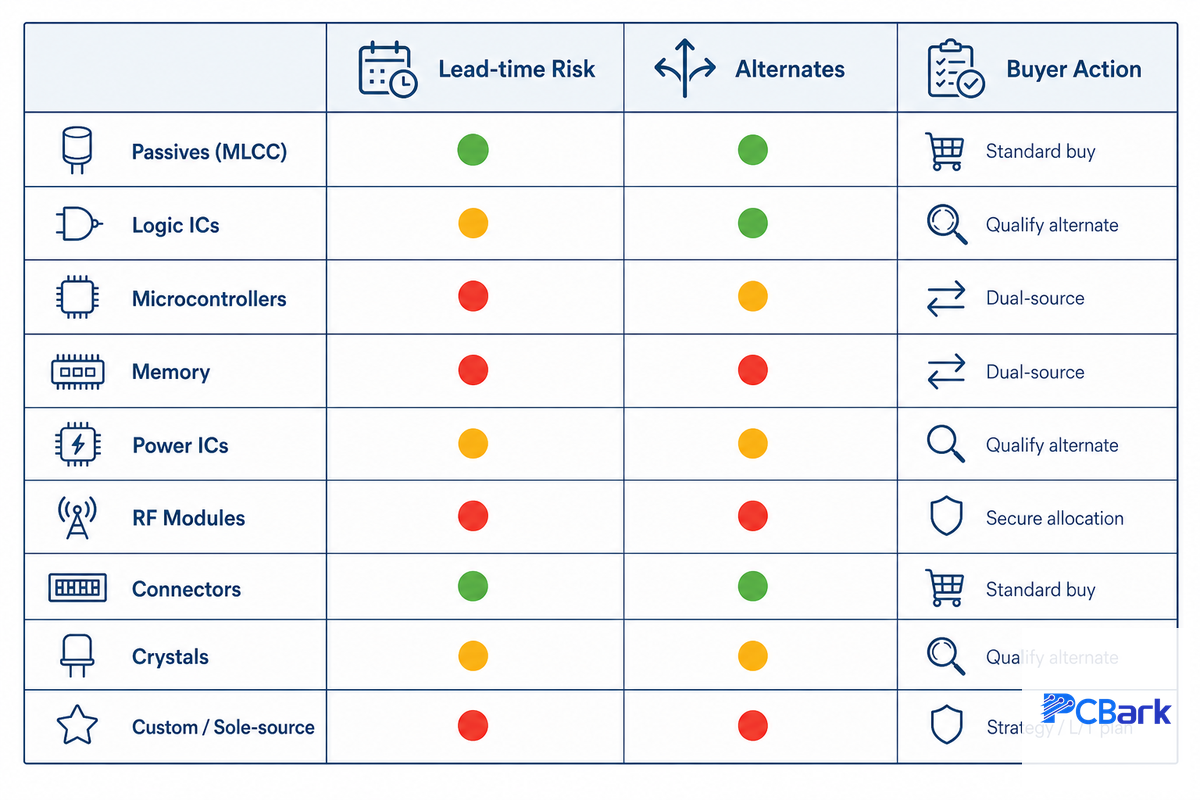
When you choose full turnkey, the real thing you transfer is component sourcing risk, and in 2026 that’s worth more than the convenience. Sourcing, not freight, drives turnkey lead time. The buyer’s job is to specify the sourcing rules so allocation, end-of-life parts, and counterfeits can’t quietly sink the build.
Lead times are long again. Lead times on some logic and microcontroller parts run roughly 20–40 weeks, certain power and memory devices stretch past a year, and distributors are flagging that the easing seen earlier in 2025 has reversed. A turnkey partner that buys early and pools volume across builds buffers exactly that exposure; a single unsourced manufacturer part number can stop an otherwise finished kit cold.
| Part category | Typical 2026 lead-time risk | Alternate availability | Buyer action |
|---|---|---|---|
| MLCC & chip resistors (passives) | Low — often in stock, under 1 month | High — many equivalents | Approve generic alternates by spec |
| Standard logic / jellybean ICs | Low–medium | Good | List one approved alternate |
| Microcontrollers (MCU) | High — 5–10 months on some lines | Limited — family-locked | Pre-buy or pre-approve a pin-compatible part |
| Memory (DRAM / NAND / Flash) | High — 9–12 months, prices climbing | Few | Lock allocation early; freeze the part |
| Power-management ICs (PMIC) | Medium–high — 5–10 months | Some | Qualify a second source at design |
| RF / wireless modules | Medium — certification-locked | Few | Avoid late swaps (re-certification risk) |
| Connectors | Low–medium | Good | Confirm the mating part is also stocked |
| Crystals / oscillators | Medium | Some | Specify frequency and load capacitance exactly |
| Custom / allocated / sole-source | Highest — single source, 12+ months | None by definition | Consign these in a partial-turnkey split |
Lead-time bands reflect 2026 distributor and broker reporting; confirm against a live quote for your specific parts.
Scenario. A small instrumentation team sent a clean board and a tidy BOM, but every line listed a single manufacturer part number with no approved alternate. One 0.1µF MLCC went to allocation the week the build was scheduled. With no pre-approved second source, the line stopped, the team scrambled to qualify a replacement, and a 10-day quick-turn became six weeks, not because the board was hard, but because the BOM left no room to move.
What to write into your RFQ so this doesn’t happen to you:
- ✔ Pre-approve alternates for every commodity passive and any at-risk active part, so the assembler can substitute without a re-spin.
- ✔ Flag lifecycle: mark parts near end-of-life and ask the supplier to confirm availability before the build starts, not at first article.
- ✔ Require authorized or franchised distributors only, never gray-market brokers, which NIST identifies as a primary way to cut supply chain risk (NIST SP 800-161).
- ✔ Ask for incoming screening and lot/date-code traceability on high-value or suspect parts. Certificates of conformance can be forged, so paper isn’t the control, the U.S. Government Accountability Office documents counterfeit parts reaching even defense supply chains (GAO).
💡 Pro Tip
Treat your BOM as a sourcing contract, not a parts list. Columns that matter most to a turnkey build — manufacturer part number, approved alternate, lifecycle status — are exactly the ones hobby BOMs leave blank.
Full, Partial, or Consignment: Choosing From Your Own Risk Position
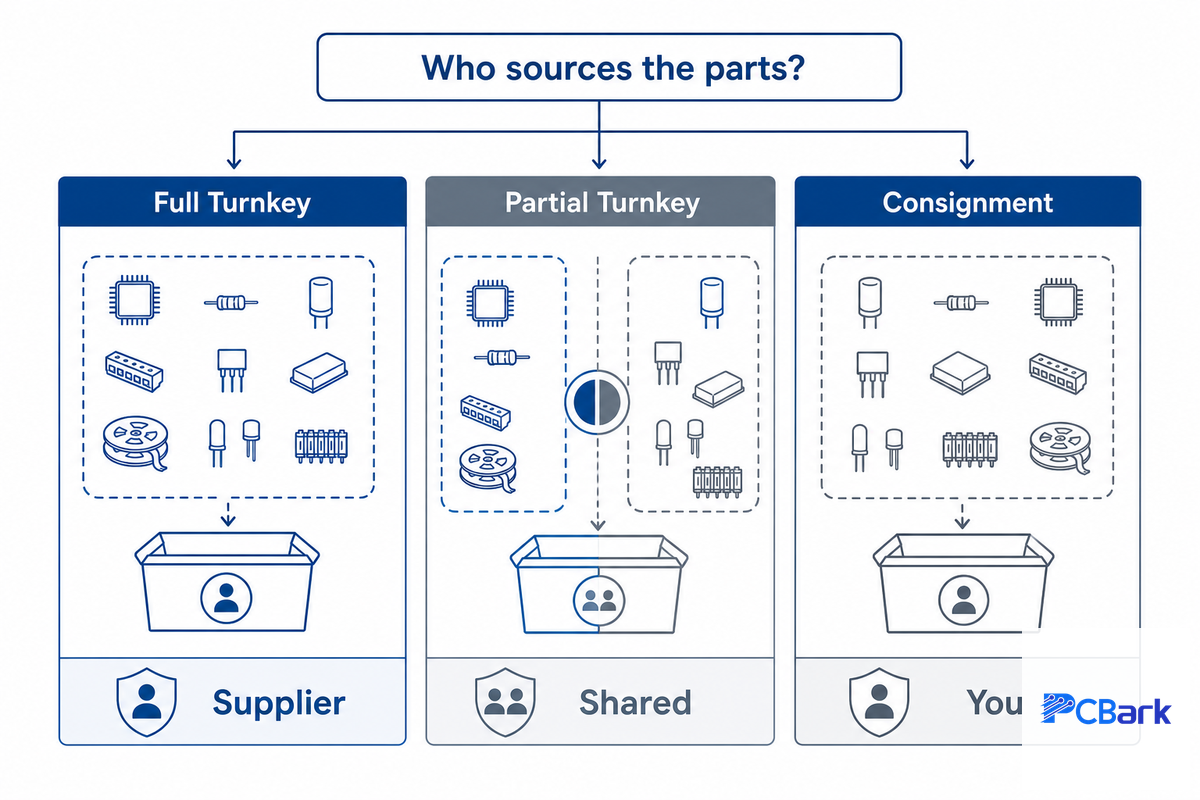
These three turnkey models, full or partial turnkey versus consignment, aren’t better or worse, they put sourcing risk in different places. Pick the one that carries risk where it’s cheapest for you, given the inventory you already hold. Here’s the honest part most vendors won’t say first: a full turnkey quote often looks more expensive than consignment, and it sometimes is on paper. The cost you don’t see on a consignment quote is your own purchasing time, your minimum-order overbuys, and the stoppages when a kit comes up short.
Framed as partial turnkey vs full turnkey, the turnkey vs partial turnkey decision only moves the sourcing split: full turnkey and partial turnkey share the same assembly line, and a partial turnkey PCB assembly run simply leaves the long-lead parts in your hands. Run this self-diagnostic before you ask anyone for a price:
Buyer model self-diagnostic
- Do you already hold allocated or long-lead parts (custom MCUs, pre-bought modules)? If yes → partial turnkey: you supply those, the assembler sources the commodity BOM.
- Do you have a complete, verified, kitted inventory and the staff to manage it, and can you accept a re-spin if the kit is short or mislabeled? If yes → consignment: the shop assembles only.
- Neither? → full turnkey: one accountable partner, fastest path to a tested board, no inventory for you to carry.
Notice that the consignment branch has two conditions, not one. Consignment isn’t automatically cheaper than turnkey, the savings on component markup get eaten by your purchasing labor and the risk that lands back on you when a part is missing. If you can’t honestly check both consignment boxes, you’re choosing a discount you’ll pay back later. When you want to map your specific project to a model, the turnkey model selector walks through the same logic, and teams moving from a first build often start with prototype PCB assembly on the same line they’ll scale on.
⚠️ The consignment trap
Quality systems still apply across all three models — an ISO 9001 supplier should hold sourcing and supplier controls to the same standard whether you consigned the parts or they bought them (ISO 9001). Consigning parts does not let you off the hook for a clean, traceable kit.
How to Vet a Turnkey Partner (and the Quality Bar to Require)
Vetting a turnkey assembly partner, a turnkey PCB manufacturer offering full turnkey services, or a wider electronics manufacturing services provider, isn’t about who has the glossiest capability page, it’s about what you can verify and what you require in writing. For a first order with an offshore supplier, this is the section that actually decides it, so when you compare turnkey PCB assembly manufacturers, score them on evidence, not promises. Look for real PCB assembly capabilities, not a brochure: full turnkey assembly, turnkey assembly services, and consignment under one service provider, with PCB assembly solutions documented enough to ensure assembly quality on your PCB project.
Turnkey Partner Red-Flag Scorecard
- Certifications you can verifyISO 9001 quality management at minimum; IATF 16949, ISO 13485, or AS9100 if your product needs them. Ask for certificate numbers, not logos.
- Named acceptance standardsa credible shop quotes both IPC J-STD-001 (the soldering process) and IPC-A-610 (visual acceptance), not one. They reference each other.
- An in-house test stack, AOI for placement, X-ray inspection for joints hidden under 0.5 mm-pitch BGA and QFN packages, ICT or flying probe for nets, functional test for behavior. No single method sees everything.
- Lot- and date-code traceability that contains a suspect part to one build rather than a recall.
- Registered-entity transparencywill they give business-license and registered-name details for a supplier registry check? Reluctance here’s the loudest red flag.
On what to require: set the IPC class up front, at the bare-board stage. A Class 2 board can’t be “upgraded” to Class 3 because the assembly came out clean, class is a build decision, not an inspection outcome. And drop the assumption that Class 3 is aerospace-only. Class 3 is application-based; it covers medical devices and industrial controls that can’t tolerate downtime just as much as avionics. If your product fails badly in the field, you can and should ask for Class 3 acceptance and a cross-section to prove it.
Counterfeit control is the other non-negotiable. Paper alone doesn’t prove a part is genuine, even authentic-looking certificates of conformance get forged, so require authorized-distributor sourcing plus physical incoming screening, with X-ray verification on suspect or high-value parts. Automated inspection is maturing here: one filing describes a PCBA detection system built on 3D AOI and X-ray to catch defects a single method misses (CN106777756A). For the SMT assembly and fabrication capability behind that test stack, see our PCB manufacturing overview, or pin down your build class with the IPC Class 2 vs 3 selector. Remember that an IPC class is necessary but not sufficient: it doesn’t by itself cover component authenticity, obsolescence (PCN/EOL) management, or test coverage, so treat those as separate line items in your requirements.
⚠️ Scope note for regulated buyers
This guide is written for commercial buyers. If you build for defense or government-adjacent programs, you carry obligations beyond commercial ISO/IPC quality — for example, DFARS 252.246-7007 requires a counterfeit-electronic-part detection and avoidance system with GIDEP reporting and subcontractor flowdown (eCFR DFARS 252.246-7007). PCBark serves commercial electronics manufacturing and scopes out ITAR and export-controlled defense work, so confirm any regulated requirement against the controlling regulation, not a supplier’s marketing.
Where Turnkey Projects Go Wrong: A Re-Spin Failure Catalog
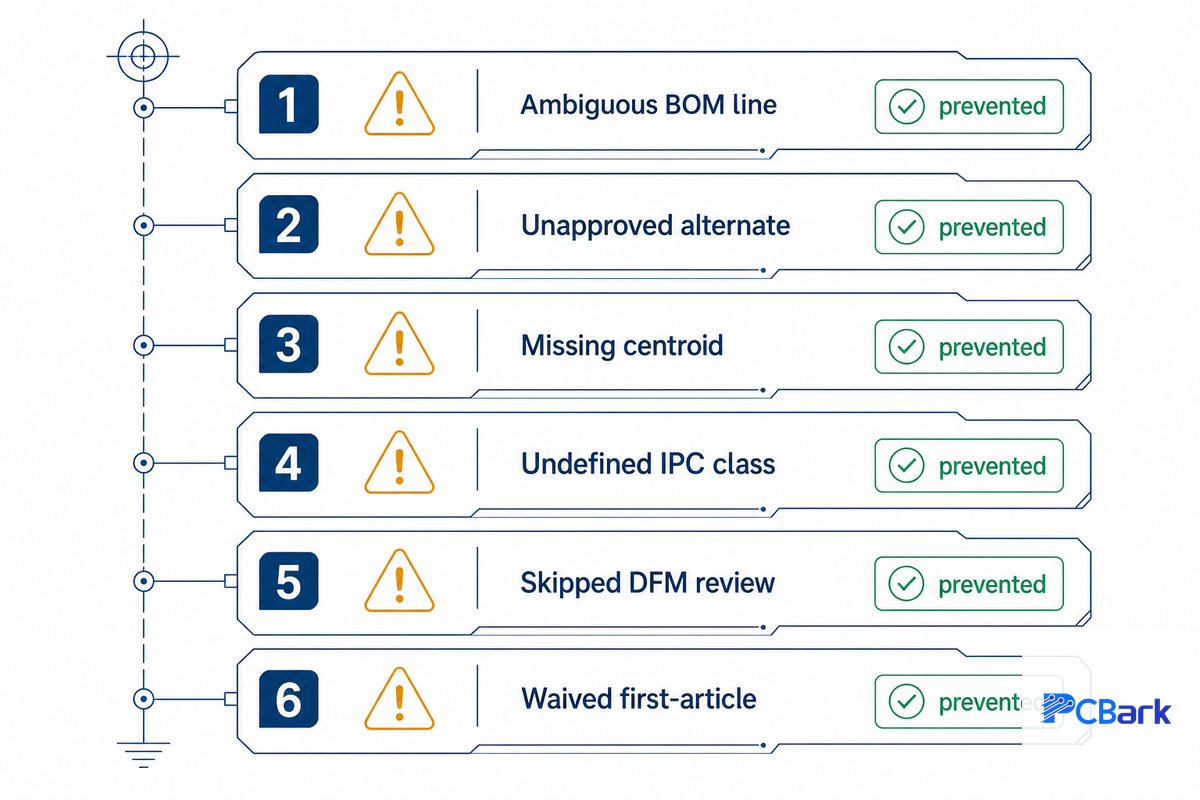
Most turnkey re-spins don’t come from exotic engineering, they trace to a small set of buyer-controlled gaps in the handoff. Here’s the catalog, drawn from what practitioners actually report going wrong, with the prevention for each. Call it the 6 Turnkey Re-Spin Triggers: six failures that turn a tested-board project into a do-over.
6 Turnkey Re-Spin Triggers
| Trigger | Symptom | Prevention |
|---|---|---|
| 1. Ambiguous BOM line | Part number/package mismatch; passive with no exact part | One unambiguous manufacturer part number per line; resolve every “TBD” |
| 2. Unapproved alternate substituted | Shop swaps a part to keep moving; it behaves differently | Pre-approve alternates; mark “no substitution” parts explicitly |
| 3. Missing or mis-scaled centroid | SMT programming stalls; parts rotated 90°/180° | Supply a CPL/centroid; confirm units and rotation convention |
| 4. Undefined IPC class | Board built to a lower acceptance bar than the product needs | State Class 2 or 3 at the bare-board stage, in writing |
| 5. Skipped DFM review | Footprint, clearance, or thermal issue surfaces at first article | Insist on a DFM/DFA pass before fabrication, not after |
| 6. Waived first-article approval | A systemic error replicates across the full run | Approve a first article before volume; never skip to save a day |
One thread runs through all six: a turnkey supplier can only build what your package unambiguously specifies. Industry practitioners frequently report that unclear DNP markings and a mismatch between the BOM and the pick-and-place file are the substitution traps that bite hardest, and that a missing centroid is a top cause of early SMT delays. None of these is an assembly problem; all of them, down to a 0.1 mm footprint slip, are package problems you can close before you submit. Modern DFM tooling, including AI-driven design-inspection systems, exists precisely to catch them earlier (US20230153512A1), but the cheapest fix is still a clean package.
What’s Changing for Turnkey Buyers in 2026
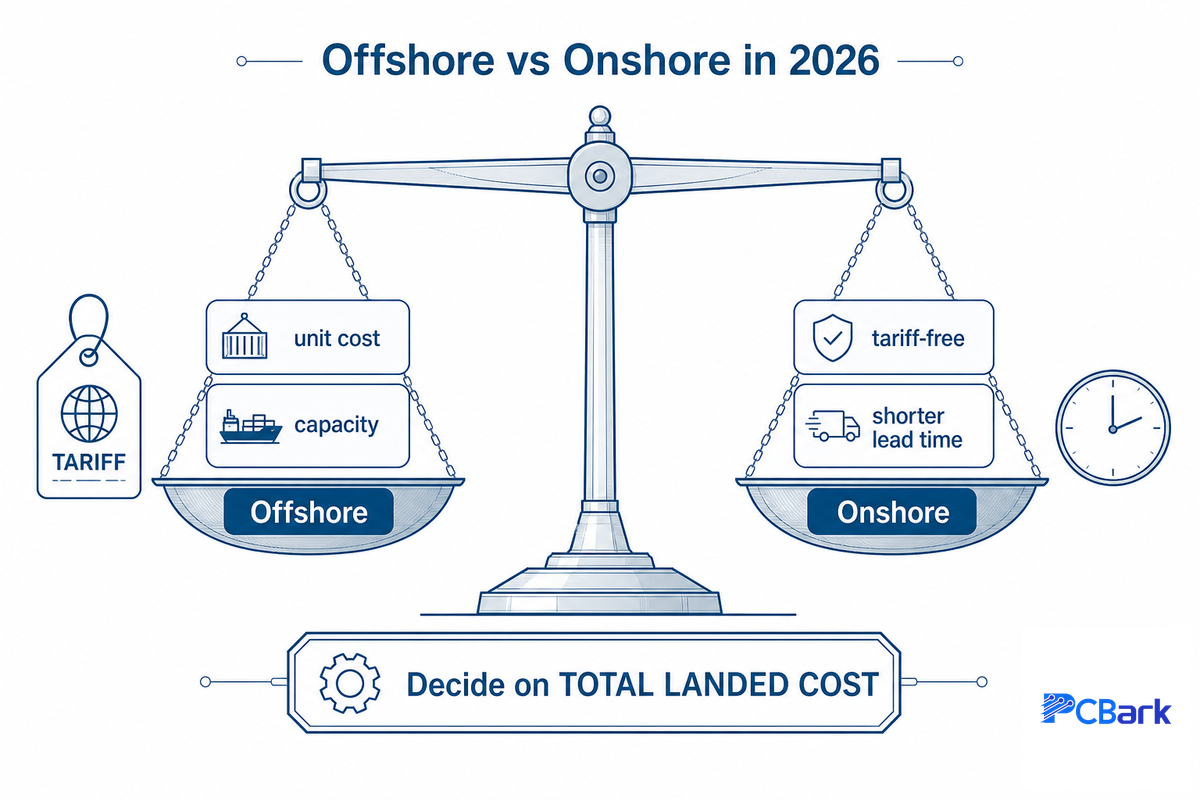
You should revisit your turnkey strategy in 2026 not because the market is growing, but because the basis of the decision has shifted. Tariffs and reshoring have turned “where do I assemble” from a pure cost question into a landed-cost-and-risk question, and component pricing has moved from a predictable, volume-driven model to one that’s segmented and structurally constrained.
For a buyer, that means turnkey’s value is migrating from “convenience” toward “sourcing-risk transfer and tariff navigation” — the thing you’re really buying is a partner who can absorb volatility you can’t.
Two concrete signals. First, U.S. Section 301 actions explicitly cover printed circuit boards among tariffed goods, and 2025–2026 reviews have maintained tariffs on covered China-origin products, so the offshore-versus-onshore turnkey choice now has to be priced as total landed cost, not unit cost (USTR). Second, and counter to the headlines: search interest in component shortages has cooled even as 2026 lead times on many logic and memory parts have climbed again. Buyers most exposed in 2026 are the ones who relaxed their sourcing discipline because the panic faded.
If you’re planning a 2026 build, the action is simple: lock approved alternates now, ask your turnkey partner to confirm landed cost including duty, and don’t let a calm news cycle talk you out of buffering long-lead parts. For context, the broader PCB assembly market is projected to pass $100 billion by 2030, directional background, not a reason to assume parts will be easy to get.
💡 2026 action item
Re-quote your turnkey work on a total-landed-cost basis — components, duty, freight, and the cost of a stalled line — not on the unit price alone. A cheap unit can be the most expensive board.
Frequently Asked Questions
Q: What is the difference between full turnkey, partial turnkey, and consignment?
View Answer
In full turnkey PCB assembly the supplier sources every component and builds the board, so you hand over files and get a tested assembly. In partial turnkey you supply the hard-to-get or long-lead parts while the assembler buys the rest, which suits teams that already hold allocated components. In consignment, a consigned assembly run, you provide all parts and the shop only assembles, giving you maximum control over the bill of materials but leaving sourcing, kitting, and shortage risk entirely with you.
Q: What files do I need to provide for a turnkey PCB assembly quote?
View Answer
Send Gerber files in RS-274X (or a single IPC-2581 or ODB++ file), a bill of materials with manufacturer part numbers, a component placement list (CPL/centroid) with positions and rotations, assembly drawings, your layer stackup, and any class or test requirements. The two that most often stall a quote are the BOM and the centroid, so resolve every ambiguous BOM line and confirm your rotation convention before you submit. With those in hand a supplier can quote your real board rather than a placeholder.
Q: How long does turnkey PCB assembly take?
View Answer
Quick-turn assembly of an in-stock design runs about 5–15 days. What varies is almost never the build — it is component sourcing, since some semiconductors carry lead times of 20–40 weeks or more in 2026. A turnkey partner that buys early and pools volume buffers that risk, and a good one quotes a realistic lead time with every RFQ instead of a best-case headline. Pre-approving alternates is the single fastest way to protect your schedule.
Q: Is turnkey always more expensive than consignment?
View Answer
No. A turnkey quote can look higher because it is all-inclusive, but consignment shifts purchasing time, minimum-order overbuys, and shortage risk back onto you. Price the full picture before deciding.
Q: Can I move from prototype to production with the same turnkey provider?
View Answer
Yes — building a prototype and a production run on the same line avoids re-qualifying a new shop, which is the main reason teams stay with one turnkey partner from first article to volume.
Q: How do I protect my design and IP with an offshore turnkey provider?
View Answer
Use an NNN agreement (non-disclosure, non-use, non-circumvention) under the supplier’s local law, name the registered entity, and source only through authorized distributors. That agreement is the gate; the manufacturing relationship and tooling control are the system.
Ready to price a specific board?
Send your Gerbers and BOM and get an itemized turnkey PCB assembly quote you can compare line by line, full, partial, or consignment.
About This Guide
This guide is written from the assembler’s side of the table: the file gaps that stall our quotes, the BOM lines that can’t be sourced, and the centroid problems that delay first article are things we resolve on real turnkey PCB assembly orders. We’ve kept cost figures as industry ranges rather than fixed numbers, because a quote depends on your specific board, class, and quantity. Reviewed by the Shenzhen Linghangda Technology Co., Ltd. (PCBark) technical team.
References & Sources
- SP 800-161: Supply Chain Risk Management Practices — National Institute of Standards and Technology
- Counterfeit Electronic Parts (GAO-10-389) — U.S. Government Accountability Office
- SP 1278: Hardware Supply Chain Security — National Institute of Standards and Technology
- Section 301 Tariff Actions (Printed Circuit Boards) — Office of the U.S. Trade Representative
- Cost of Quality (COQ) — American Society for Quality
- ISO 9001:2015 Quality Management Systems — International Organization for Standardization
- DFARS 252.246-7007: Contractor Counterfeit Electronic Part Detection — Electronic Code of Federal Regulations
- US20230153512A1: Electrical Circuit Design Inspection System — USPTO
- CN106777756A: PCBA Detection via 3D AOI and X-ray — USPTO / Google Patents