Get in touch with PCBark Company


Last updated: October 2026
The best automotive PCB manufacturers for your shortlist include PCBark for combined fabrication and assembly, TTM for prototype-to-volume automotive boards, MEKTEC for battery-management flex circuits, and AT&S for radar interconnects, alongside leading PCB makers and largest automotive PCB assembly suppliers. Start with the board construction and manufacturing location: those choices narrow the field faster than a supplier’s overall size.
A radar board, an inverter board, and a flexible circuit can be manufactured using different processes. This guide compares 20 actual manufacturers because of that purchasing challenge. The PCB market includes global conglomerates and best service providers serving several markets as well as specialty shops focused on particular PCB constructions. The numbers identify the manufacturers, and don’t express any comment on product quality, delivery, or fitness for a given vehicle program.
Quick Picks: Start with Your Automotive Build
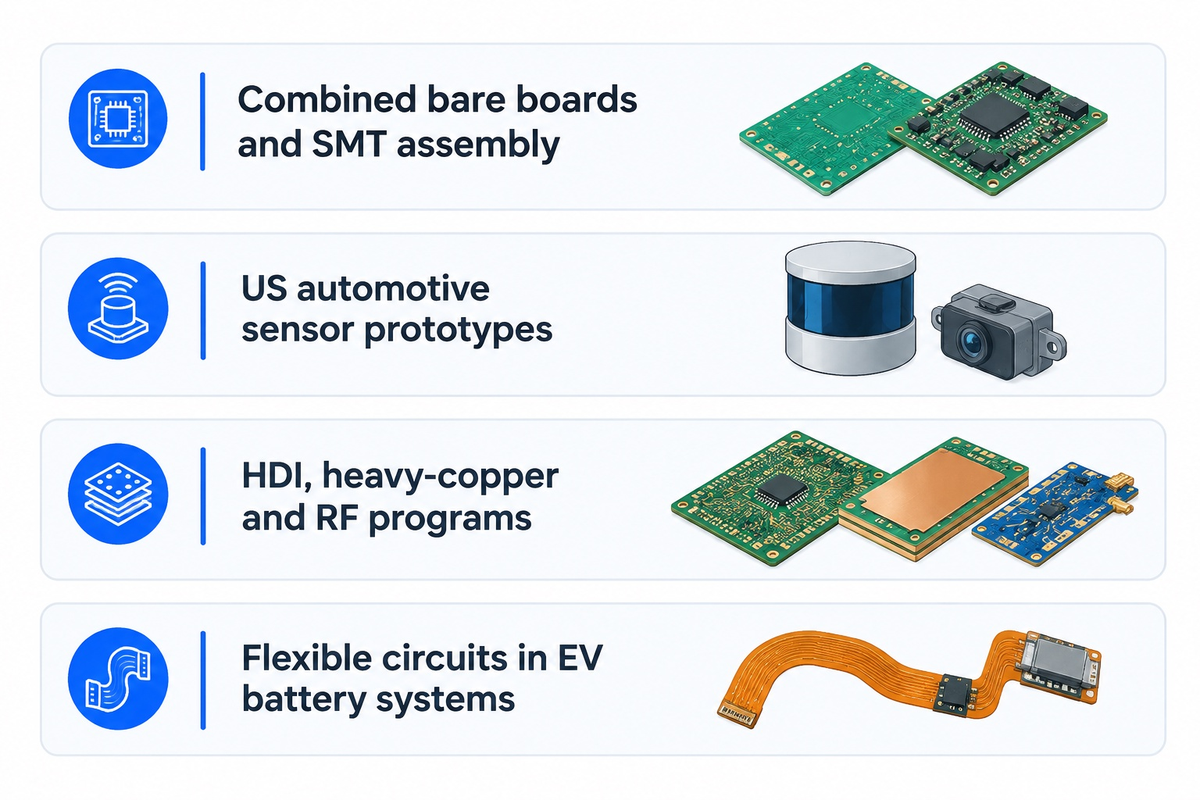
- Best for PCB fabrication and assembly through one supplier: PCBark. A starting point for buyers combining bare boards, component sourcing, SMT assembly and functional testing.
- Best for US automotive sensor prototypes: Sierra Circuits. Its automotive offering includes LiDAR-related fabrication work and prototype PCB assembly services.
- Best for prototype-to-volume automotive board programs: TTM. Consider its HDI, heavy-copper and RF/mmWave product families when the program spans development and production.
- Best for EV battery-management flexible circuits: MEKTEC. Its FPC business connects materials development with component mounting and battery interconnection applications.
- Best for radar and dense interconnects: AT&S. Its published radar antenna range and HDI portfolio address signal-density requirements.
- Best for European high-current PCB manufacture: KSG. Its German and Austrian operations combine PCB fabrication with HSMtec thermal and current-management technology.
Disclosure: This guide is published by PCBark. We list ourselves first because this is our website, not because we claim to be the market leader. The other 19 manufacturers are grouped by what they’re best for, in no particular order within each group.
How We Selected These Manufacturers
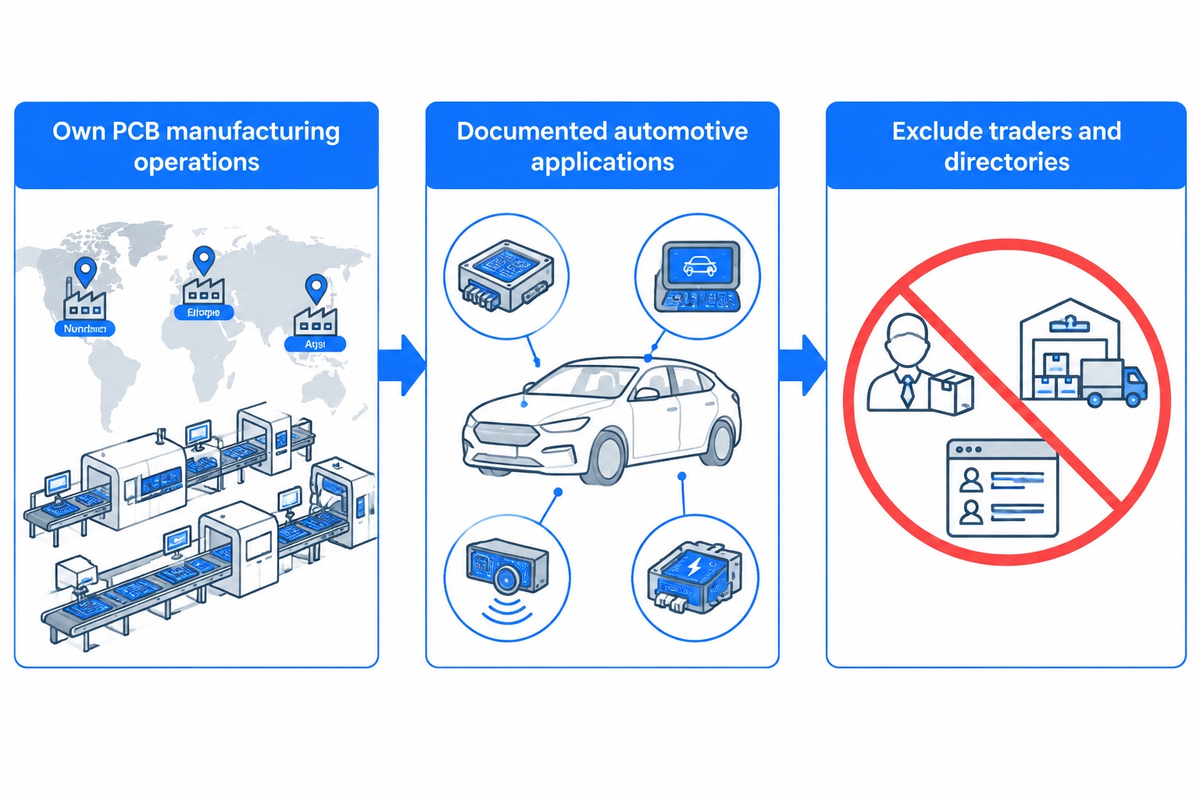
We chose companies with their own PCB manufacturing operations in North America, Europe, and Asia, and with documented automotive products or applications, and excluded trading companies, distributors, sourcing platforms, directories, media websites, and used equipment dealers. We also excluded companies for which there was insufficient evidence to support their operations. Company information was verified with official websites, and other public sources, in October 2026. The companies are categorized by buying fit.
Product features and certification references are from the companies’ publications. Other references are identified. A corporate headquarters or factory and a certification location may be different. The headquarters represents the company base; the profile describes exceptions. Founding / Brand Launch / Historical Milestones are for the company, brand or stated predecessor, as described in the profile.
Automotive PCB Manufacturers Compared
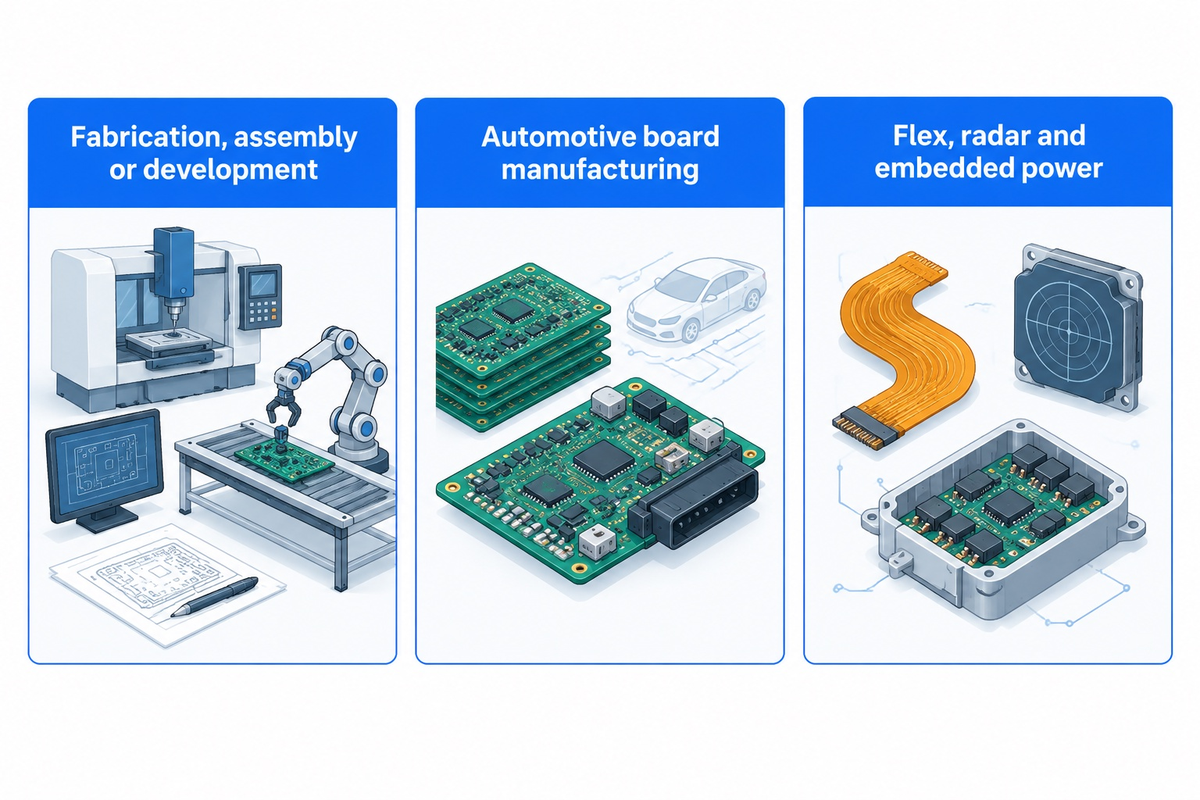
The 20-Supplier Automotive Board Map is the first thing to study to compare offers. The first group covers fabrication, assembly or development support; the second covers automotive board manufacturing; the third covers flexible circuits, radar, embedded power and regional manufacturing.
| No. | Company Name | Headquarters | Founded Year | Best For | Brief Introduction | Automotive Board Focus | Key Advantages | Potential Disadvantages | Official Website |
|---|---|---|---|---|---|---|---|---|---|
| 1 | PCBark | Shenzhen, China | 2010 | Automotive builds combining PCB fabrication and assembly through one supplier | PCB fabricator and electronic manufacturing services provider with Chinese manufacturing operations. | High-Tg, heavy copper, HDI, RF, flex and rigid-flex | DFM, sourcing, fabrication, SMT and functional test | China manufacturing footprint | pcbark.com |
| 2 | Meiko | Ayase, Japan | 1975 | High-current and heat-dissipation boards | Japanese PCB group offering board manufacturing and separate EMS operations. | Thermal, high-current, HDI and embedded-device boards | Multiple automotive-certified operations | Fabrication and EMS scope varies by operation | meiko-elec.com |
| 3 | Sanmina | San Jose, USA | 1980 | Complex boards with broader manufacturing integration | Global electronics manufacturing group producing PCBs, flex circuits and backplane products. | High-layer-count, HDI and heavy-copper boards | Bare-board engineering plus wider manufacturing services | Board capabilities differ from complete-module qualification | sanmina.com |
| 4 | AdvancedPCB | Aurora, USA | 2024 | US prototypes with a managed global-volume route | PCB brand combining US fabrication resources with a partner-based overseas production route. | Rigid, flex, rigid-flex, HDI and high-Tg | Quick-turn prototypes and NPI assembly services | Higher-volume route can use overseas partner factories | advancedpcb.com |
| 5 | Sierra Circuits | Sunnyvale, USA | 1986 | US automotive sensor prototypes | PCB manufacturer and assembler with documented automotive LiDAR project experience. | HDI, high-speed multilayer and sensor boards | Impedance control and wire bondable gold experience | Turnkey assembly needs its own defined scope | protoexpress.com |
| 6 | TTM | Santa Ana, USA | 1998 | Prototype-to-volume automotive PCB programs | Multisite printed circuit board manufacturer serving automotive and other electronics markets. | HDI, heavy copper, RF/mmWave and rigid-flex | Broad process portfolio and automotive manufacturing history | Different technologies are assigned to different facilities | ttm.com |
| 7 | CMK | Tokyo, Japan | 1961 | Automotive thermal and current-management constructions | Japanese manufacturer offering automotive printed circuit boards and specialized copper constructions. | HDI, copper-core, copper-base and thick-copper | CMK-COMP thermal construction options | Bare-board offer requires a separate module assembly route | cmk-corp.com |
| 8 | KCE | Bangkok, Thailand | 1982 | Thailand-based custom multilayer PCB production | Thai PCB group with distinct fabrication operations and an upstream laminate subsidiary. | Custom multilayer automotive boards | Manufacturing locations differentiated by layer-count offering | Layer-count capability is site dependent | kce.co.th |
| 9 | CHIN POON | Taoyuan, Taiwan | 1979 | ECU, ADAS and automotive power boards | PCB manufacturer with automotive product families spanning control electronics and power conversion. | Multilayer, heavy copper, HDI and metal-base | Published construction ranges and application mapping | Maximum specifications belong to separate product families | chinpoon.com |
| 10 | Kinwong | Shenzhen, China | 1993 | Thick-copper and Anylayer HDI electrification projects | PCB manufacturer offering automotive high-current, high-voltage and dense-interconnect technologies. | Thick copper, high-order HDI and high-frequency boards | Power and signal constructions within one portfolio | Specialized constructions require distinct production processes | kinwong.com |
| 11 | WUS Kunshan | Kunshan, China | 1992 | Automotive boards within a complex multilayer portfolio | PCB research, design and manufacturing company serving automotive, telecom and computing applications. | Automotive multilayer boards | Complex board engineering across several markets | Telecom layer-count limits do not define automotive products | wustec.com |
| 12 | Dynamic | Huangshi, China | 2015 | Automotive HDI, semi-flex and heavy-copper programs | PCB manufacturer listing production bases in China and Thailand. | HDI, semi-flex, high-frequency and copper-inlay boards | Inlay, backdrilling and via-in-pad options | Multiple sites require site-specific production assignment | dynamicpcb.com |
| 13 | HannStar Board | Taoyuan, Taiwan | 1989 | Multilayer and thick-copper automotive boards | PCB manufacturer whose production portfolio includes automotive applications. | Multilayer, thick copper, HDI and SLC multilayer PCB | IATF 16949 at Guanyin and Jiangyin | Cross-market technology list spans different product lines | tw.hannstarboard.com |
| 14 | Shennan Circuits | Shenzhen, China | 1984 | Automotive collision-avoidance radar RF boards | PCB manufacturer publishing specific automotive radar, camera and battery-board examples. | 77 GHz RF, BMS flexible circuits and rigid-flex | Detailed radar construction example | General high-layer capability is a different product scope | scc.com.cn |
| 15 | COMPEQ | Taoyuan, Taiwan | 1973 | HDI, high-layer-count and rigid-flex fabrication | PCB group with HDI development, fabrication sites and optional SMT services. | HDI, multilayer, flexible and rigid-flex boards | Thailand automotive applications and named plant capabilities | SMT is a separate service from board fabrication | compeq.com.tw |
| 16 | MEKTEC | Tokyo, Japan | 1969 | EV battery-management flexible circuits | Flexible printed circuit specialist with materials and component-mounting capabilities. | BMS, lighting, sensors and other FPC applications | Volkswagen BMS FPC order | Flex specialization differs from rigid ECU board supply | mektec.nokgrp.com |
| 17 | AT&S | Leoben, Austria | 1987 | Radar boards and dense automotive interconnects | Advanced circuit board and interconnect producer with automotive radar and ADAS offerings. | High-frequency radar, HDI, Anylayer and mSAP | Published 24–90 GHz radar antenna range | Development-stage modules differ from production offerings | ats.net |
| 18 | Schweizer | Schramberg, Germany | 1849 | Embedded power and thermal-management boards | German PCB technology company combining its Schramberg operation with manufacturing partnerships. | Power embedding and thermal-management PCBs | Automotive-focused business and embedding technology | High-volume route includes partner production | schweizer.ag |
| 19 | KSG | Gornsdorf, Germany | 1959 | European high-current PCB manufacture | European PCB manufacturer with German and Austrian production sites. | HSMtec, IMS, thick copper and multilayer | European production and thermal-current construction options | European footprint does not provide local Asian manufacture | ksg-pcb.com |
| 20 | Zhen Ding | Taoyuan, Taiwan | 2006 | Broad rigid, flexible and advanced-interconnect sourcing | PCB holding group combining multiple fabrication businesses and technology families. | FPC, HDI, rigid boards and high-frequency products | Group portfolio includes BoardTek specialist processes | Group-wide products span different factories and maturity stages | zdtco.com |
The table uses 2024 for the AdvancedPCB brand launch, 1849 for Schweizer’s company roots and 1959 for the start of PCB production at KSG’s Gornsdorf operation. COMPEQ’s Taoyuan headquarters identification comes from its 2020 sustainability report. Dynamic’s entry refers to the current Huangshi-based company established in 2015.
Fabrication, Assembly and Prototype Support
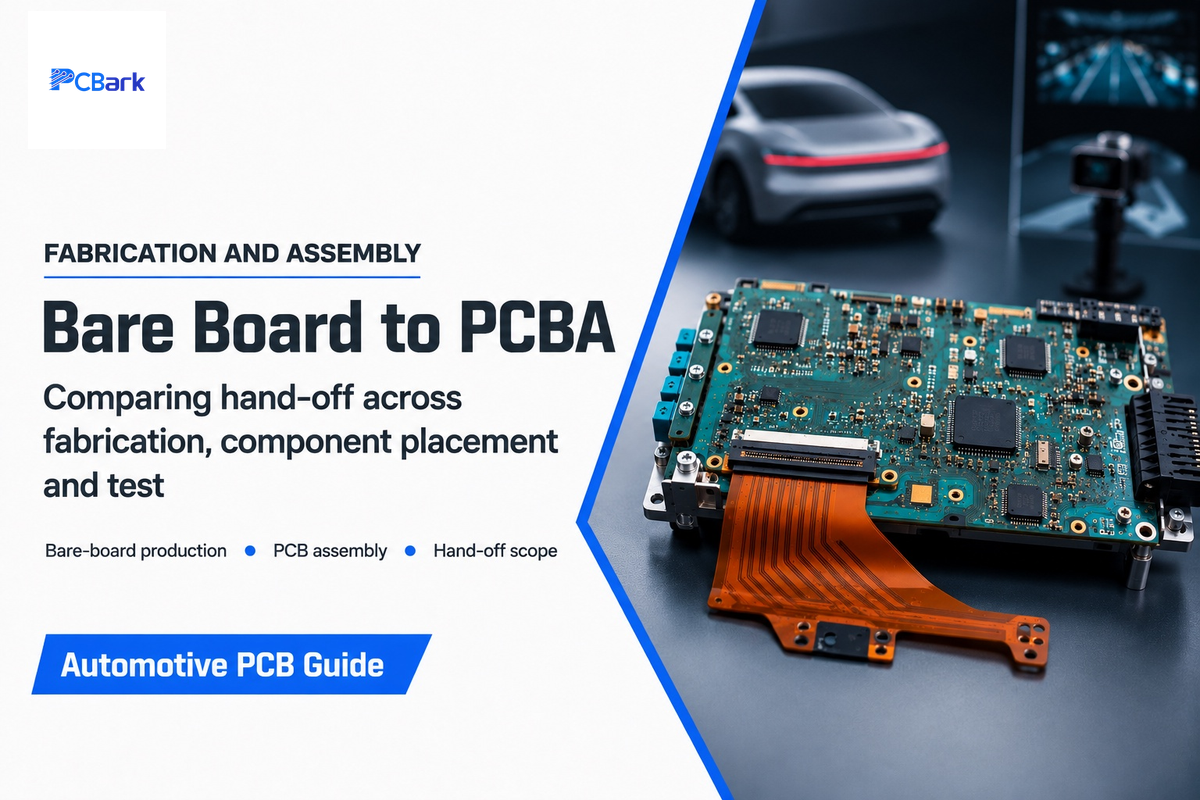
These companies combine bare-board production capacities with PCB assembly services, development assistance or broader electronic manufacturing resources. The main distinction is hand-off: one supplier may take charge of the entire quotation while different factories perform board fabrication, component placement and test. The profiles identify areas where such combinations are more relevant.
1. PCBark: Best for automotive builds combining PCB fabrication and assembly through one supplier
Headquarters: Shenzhen, Guangdong, China.
Official website: https://pcbark.com/
Founded: 2010, company-stated origin. Type: PCB fabricator and electronic manufacturing services provider.
Main products and technologies: High-Tg rigid boards, heavy copper PCB constructions, HDI PCB manufacturing, aluminum metal-core, RF, flex, rigid-flex and ceramic boards; DFM review, component sourcing, SMT assembly and functional testing.
Certification scope: The published IATF 16949:2016 certificate names Huizhou Linghangda Technology Co., Ltd. for PCB manufacturing, with product design excluded, with printed dates from June 2024 to June 2027.
PCBark’s automotive PCB manufacturing capabilities suit a buyer who wants fabrication and assembly coordinated within one supplier relationship. Its history traces a Shenzhen factory start in 2010 and a move to Huizhou in 2018, while the automotive offering connects board construction, sourcing and test rather than stopping at a bare-board shipment. That combination can simplify responsibility for the transition from PCB design files to an assembled circuit board; the manufacturing footprint is in China, so a requirement for domestic US or European fabrication calls for another option.
2. Meiko: Best for automotive high-current and heat-dissipation boards
Headquarters: Ayase, Kanagawa, Japan.
Official website: https://www.meiko-elec.com/english/
Founded: November 25, 1975. Type: PCB design, manufacturing and sales company with group EMS operations.
Main products and technologies: Double-sided and multilayer through-hole boards, HDI, flexible and flex-rigid circuits, high-electric-current boards, heat-dissipation boards and embedded-device PCBs.
Certifications: Meiko lists IATF 16949:2016 for named operations including Miyagi/Ishinomaki, Guangzhou Nansha, Wuhan and Vietnam locations.
Meiko connects its high-current and heat-dissipation products with demanding automotive environments, including applications inside of car engines. Embedded-device boards add another construction route for buyers working on packaging density, while the group’s fabrication and electronic manufacturing resources create options beyond a single board family. The distinction matters in purchasing: Meiko’s PCB factories, EMS companies and sales entities have different roles, so a fabrication relationship and an assembly engagement belong to the relevant operation. Its AnyLayer HDI examples for mobile devices should be read as a separate product application.
3. Sanmina: Best for complex high-layer-count PCBs with broader manufacturing integration
Headquarters: San Jose, California, USA.
Official website: https://www.sanmina.com/
Founded: 1980. Type: Electronics manufacturing services group that produces PCBs, flex circuits and backplane products.
Main products and technologies: Complex multilayer boards, AnyLayer HDI, multiple sequential lamination, heavy-copper layers and flex products; its general PCB portfolio advertises over 70 layers.
Listed qualifications: The PCB business page identifies AS 9100, TL 9000 and MIL-PRF-55110/31032 qualifications, each relevant to its stated manufacturing scope.
Sanmina is a useful candidate when the board purchase sits within a larger electronics manufacturing engagement that may also involve systems assembly. The combination of complex bare-board processes and wider manufacturing services gives an engineering team more than a catalog of standard stackups to discuss. Sanmina’s general PCB portfolio includes the published over-70-layer capability; the automotive project has its own construction and assembly scope. Automotive buyers seeking manufacturing integration should separate the bare-board deliverable from the assembly, enclosure and test work included in the project.
4. AdvancedPCB: Best for US automotive prototypes with a managed global-volume route
Headquarters: Aurora, Colorado, USA.
Official website: https://www.advancedpcb.com/
Founded: AdvancedPCB brand launched in 2024; its predecessor history includes APCT, founded in 1977. Type: Automotive PCB manufacturer with prototype and NPI assembly support.
Main products and technologies: Rigid, flex, rigid-flex, HDI, high-Tg and heavy-copper boards; US quick-turn prototype fabrication and prototype/NPI PCB assembly.
Certifications: The company website lists ISO 9001:2015; aerospace qualifications belong to the corresponding aerospace offer.
AdvancedPCB addresses the transition between development builds and larger production orders rather than treating those as unrelated purchases. Its automotive page pairs US-based quick-turn prototypes with assembly support, which is useful when a design team wants feedback on fabrication and component placement during the same development cycle. The volume route can involve vetted overseas partner factories, so the later production location isn’t necessarily the US factory that supplied the prototype. The 2024 date identifies the combined brand, not the beginning of all its underlying PCB manufacturing experience.
5. Sierra Circuits: Best for US automotive sensor prototypes with fabrication and assembly support
Headquarters: Sunnyvale, California, USA.
Official website: https://www.protoexpress.com/
Founded: 1986. Type: US company that manufactures and assembles printed circuit boards.
Main products and technologies: Automotive sensor boards, high-speed multilayer and HDI constructions, blind and buried microvias; published complex-HDI impedance control of ±5%.
Certifications: ISO 9001:2015 and AS9100D are listed alongside separate UL listings for rigid and flexible circuit products.
Sierra’s automotive material includes a specific LiDAR example: high-speed multilayer boards and work on wire bondable gold issues for an unnamed 3D-sensing customer. That gives its sensor-prototype positioning a concrete basis, supported by fabrication processes for fine interconnects and controlled impedance. A design team developing collision-avoidance or connected-vehicle electronics can discuss both the bare board and assembly services with the company. Turnkey assembly remains a separately defined scope, with component supply and test requirements beyond the manufacturing instructions needed for a bare PCB.
Automotive Board Manufacturing for Production Programs
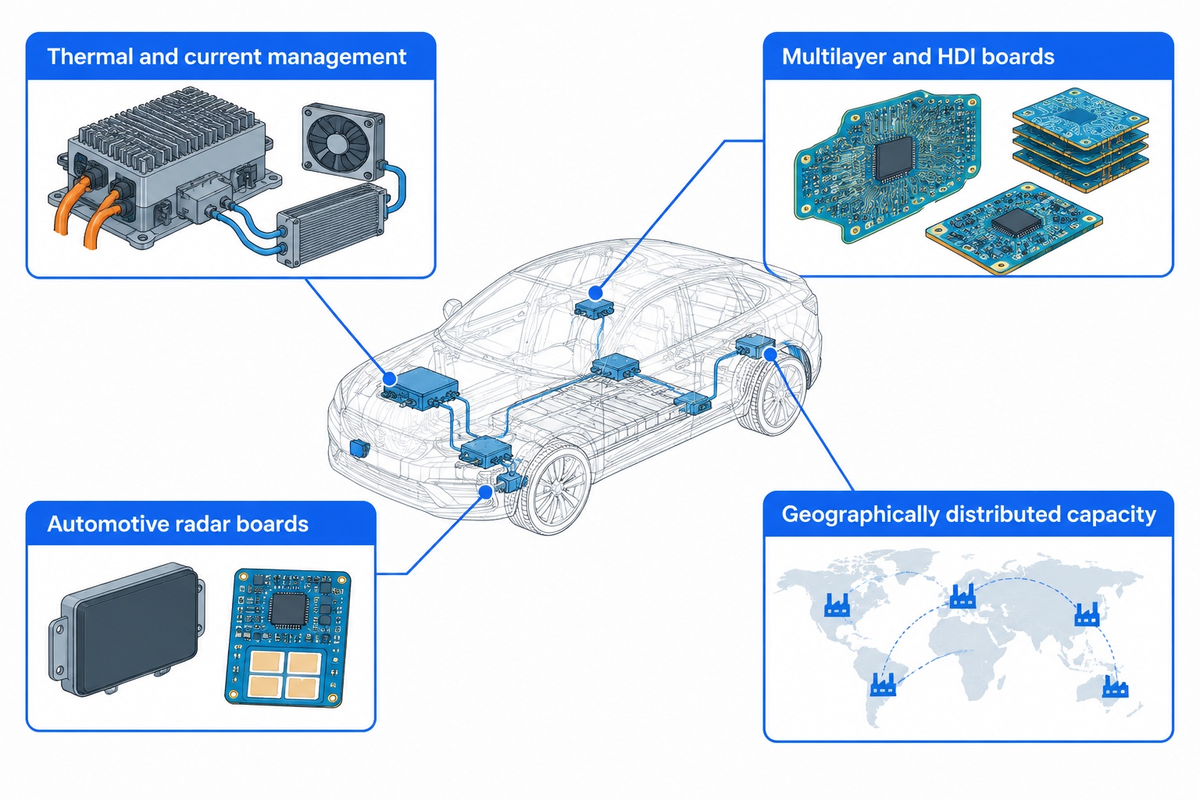
Within the PCB industry, this group comprises manufacturers whose automotive offer is part of an established board-production portfolio. Some focus on thermal and current management; others add multilayer, HDI, radar or geographically distributed capacity. The automotive industry uses several of these circuit board products within the same vehicle, hence compare the construction relevant to your circuit.
6. TTM: Best for prototype-to-volume automotive HDI, heavy-copper and RF boards
Headquarters: Santa Ana, California, USA.
Official website: https://www.ttm.com/
Founded: Incorporated in 1998. Type: Multisite manufacturer of printed circuit boards and related electronic products.
Main products and technologies: Automotive HDI, heavy-copper, RF/mmWave, rigid-flex and semi-flex boards, with prototype and high-volume manufacturing capabilities.
Certifications and history: Published quality information includes ISO 9001 and AS9100 in their stated scopes; the 2015 acquisition of Viasystems expanded TTM’s automotive PCB business.
TTM offers several paths through a vehicle electronics program, from dense control boards to high-current constructions and high-frequency sensing. Its Viasystems acquisition provides a dated automotive-business milestone, while the breadth of board technologies supports a shortlist covering more than one electronic subsystem. The practical constraint is its multisite manufacturing structure: a process available within the group doesn’t make every plant an interchangeable production source. TTM is therefore most useful as a prototype-to-volume candidate when the proposed process and manufacturing facility travel together through the sourcing decision.
7. CMK: Best for automotive HDI with heat-dissipation and high-current options
Headquarters: Shinjuku, Tokyo, Japan.
Official website: https://www.cmk-corp.com/
Founded: February 1961. Type: Manufacturer of printed circuit boards.
Main products and technologies: Automotive HDI, high-voltage insulation constructions, heat-dissipation boards, and CMK-COMP options using Cu base, Cu core and inner thick copper.
Certifications: Published ISO 9001 scope includes designated head-office departments and Niigata operations; ISO 14001 is identified for Niigata.
CMK’s attraction is the range of copper constructions available for managing current and heat within the board itself. CMK-COMP gives buyers a more specific starting point than simply asking a supplier for a thicker copper layer, while HDI addresses a different need for interconnection density. For an automotive design containing both control electronics and a concentrated thermal load, those options make CMK a relevant fabrication discussion. The offer described here’s the bare printed circuit board; an assembled and tested module still requires an assembly route beyond that fabrication scope.
8. KCE: Best for Thailand-based custom automotive multilayer PCB production
Company base: Lat Krabang, Bangkok, Thailand.
Official website: https://www.kce.co.th/
Founded: 1982; operations began in 1983. Type: Manufacturer of custom Printed Circuit Boards.
Main products and technologies: Custom multilayer PCBs, with higher-layer-count products associated with KCE’s Lat Krabang operation and lower-layer-count products with KCE International at Bangpoo.
Manufacturing history: The company’s business dossier records historical TS 16949 and QS 9000 references and identifies TLM as a producer of prepreg and Copper Clad Laminate.
KCE offers a Thailand-based manufacturing option with a group structure extending upstream into board materials. The TLM subsidiary is a useful distinction for understanding the business, while the separate Lat Krabang and Bangpoo product descriptions explain why the company should be considered by site as well as by brand. A buyer comparing multilayer automotive boards can use those production roles to frame the initial inquiry. The limitation is site-dependent layer-count capability: the published higher- and lower-layer offerings are assigned to different operations, rather than one universal manufacturing line.
9. CHIN POON: Best for ECU, ADAS and automotive power boards across varied constructions
Headquarters: Luzhu, Taoyuan, Taiwan, registered company location.
Official website: https://www.chinpoon.com/
Founded: September 26, 1979. Type: Company manufacturing printed circuit boards.
Main products and technologies: Multilayer, Heavy Copper, HDI, IVH, metal-base, high-frequency and flexible products, plus copper inlay and busbar constructions.
Published ranges and certifications: Product families include multilayer boards around 26 layers and heavy copper around 14 oz, separately; the quality page lists ISO 9001, IATF 16949 and TL 9000.
CHIN POON maps its technologies to recognizable automotive functions, including ECUs, ADAS, electric braking and car onboard chargers (Car OBC). Its heavy-copper applications also include junction boxes, high-power inverters and converters, giving power-electronics buyers a direct connection between construction and end use. That variety is useful when a purchasing team handles several board types across a vehicle platform. The published maximum layer count and copper weight belong to different product families, so they shouldn’t be combined into an assumed single 26-layer, 14-oz production specification.
10. Kinwong: Best for thick-copper and Anylayer HDI automotive electrification boards
Headquarters: Shenzhen, China.
Official website: https://www.kinwong.com/
Founded: 1993. Type: Automotive PCB manufacturer with multiple board product families.
Main products and technologies: Thick-copper boards at 105 μm or above, high-order HDI/Anylayer, high-voltage, high-frequency and high-speed constructions.
Certifications: The company’s automotive material references IATF 16949; its manufacturing portfolio includes both signal-density and power-handling technologies.
Kinwong’s automotive technology list brings two different design pressures into the same supplier conversation: denser interconnection and greater electrical loading. High-order HDI/Anylayer suits the first, while thick copper and high-voltage constructions address other parts of an electrified vehicle’s electronics. That breadth makes it relevant to buyers managing separate control and power boards within one program, with the copper threshold providing a concrete starting point for a technical discussion. These remain distinct constructions and production processes; a high-density design and a thick-copper power board aren’t interchangeable products simply because they share a manufacturer.
11. WUS Kunshan: Best for automotive boards within a complex multilayer portfolio
Company base: Kunshan, Jiangsu, China.
Official website: https://www.wustec.com/
Founded: 1992. Type: PCB research, design and manufacturing company.
Main products and technologies: Automotive boards alongside telecommunications, industrial and data-center PCB products; the wider portfolio describes 64-layer backplanes and 40-layer line cards.
Company identity: WUS Printed Circuit (Kunshan) Co., Ltd., based in Kunshan, Jiangsu, China.
WUS Kunshan explicitly places automotive within its core application markets and combines board design work with manufacturing. Its complex multilayer portfolio makes the company relevant when buyers need to discuss demanding interconnect structures as part of an automotive sourcing exercise. Backplanes and line cards account for the published 64-layer and 40-layer examples in its broader business. A control-board inquiry should therefore start from the automotive construction being purchased, not from the largest layer count shown elsewhere in the company’s catalog.
12. Dynamic: Best for automotive HDI, semi-flex and heavy-copper programs
Company base: Huangshi, Hubei, China, for the current named entity.
Official website: https://www.dynamicpcb.com/
Founded: 2015, current company. Type: PCB manufacturer with production bases in Kunshan, Huangshi and Prachinburi.
Main products and technologies: HDI, Semi-Flex, high-frequency and heavy-copper boards; Copper & Substrate Inlay, backdrilling and via-in-pad plated-over processes.
Manufacturing footprint: The published company profile names Chinese and Thai bases, giving the group a regional footprint beyond a single domestic factory.
Dynamic offers a useful combination of board-construction options for buyers comparing interconnect density, packaging and thermal needs. Inlay and backdrilling add specific technical discussion points to its broader automotive product categories, while the Prachinburi base introduces a Thailand production location alongside China. Those features support its place on a shortlist for programs spanning more than one construction family. The manufacturing bases remain separate operations with their own production assignments, so the geographic choice and the technical route need to be defined together within the project scope.
13. HannStar Board: Best for multilayer and thick-copper PCBs with automotive applications
Company address: Guanyin, Taoyuan, Taiwan, as listed by the industry association.
Official website: https://tw.hannstarboard.com/
Founded: March 1989; its timeline records 1989.03 under the former Pacific Technology Industrial name. Type: PCB manufacturer including Automotive PCBs.
Main products and technologies: Double-sided and multilayer boards, Thick copper PCB, HDI and SLC multilayer PCB within its Mass Production Technology portfolio.
Certifications: Guanyin and Jiangyin have separately displayed IATF 16949:2016 and ISO 9001:2015 listings.
HannStar’s production information combines automotive applications with several established board technologies, making it a candidate for multilayer and power-related purchasing. Separately named Guanyin and Jiangyin quality listings help connect the group identity to individual operating locations rather than treating the entire brand as one factory. The product list also spans applications outside automotive electronics, so its HDI, SLC multilayer and thick-copper offerings represent multiple product lines. Buyers selecting a conventional automotive multilayer board can use that range as context without treating every listed technology as part of one production configuration.
14. Shennan Circuits: Best for RF boards in automotive collision-avoidance radar
Headquarters: Shenzhen, China.
Official website: https://www.scc.com.cn/
Founded: 1984. Type: Manufacturer of printed circuit boards and related interconnect products.
Main products and technologies: Automotive collision avoidance radar boards, BMS flexible circuits and rigid-flex camera boards; a published 77GHz example uses eight layers with Ro3000 and IT180A materials.
Named sites and certification scope: Manufacturing facilities include Shenzhen, Wuxi and Nantong. Historical disclosures include ISO 50001 energy management and Nantong ISO 14067:2018 carbon-footprint work, separate from automotive quality certification.
Shennan provides a specific radar construction example rather than leaving its automotive offer at the word “RF.” That material-and-layer description gives radar designers a concrete starting point, while the BMS and camera examples show other vehicle-electronics applications. The value lies in matching one of these constructions to the actual circuit board design. The automotive offer centers on application-specific constructions; its separate general-purpose portfolio includes a 120-layer sample capability.
15. COMPEQ: Best for HDI, high-layer-count and rigid-flex PCB fabrication
Headquarters: Taoyuan, Taiwan, identified in the company’s 2020 sustainability report.
Official website: https://www.compeq.com.tw/
Founded: August 1973, corporate founding. Type: PCB manufacturer with optional SMT services.
Main products and technologies: HDI, high-layer-count, flexible and rigid-flex boards; Luzhu development includes substrate-like PCB, high-end HDI and rigid PCB products.
Certifications and sites: Named Luzhu and Huizhou operations list IATF 16949 and ISO 9001. The Thailand plant description includes automotive electronics among applications for HDI and high-layer-count production.
COMPEQ’s published plant descriptions help connect product families to manufacturing locations, which is useful when evaluating a group with several regional operations. The combination of HDI development and a Thailand automotive application focus supports a shortlist for dense multilayer designs, while flexible and rigid-flex products broaden the construction choices. Optional SMT gives a potential assembly route alongside fabrication. That service remains a separate deliverable, so a bare-board order and printed circuit board assembly should be compared with their respective component, process and test scopes.
Flexible Circuits, Radar and Specialized Power Constructions
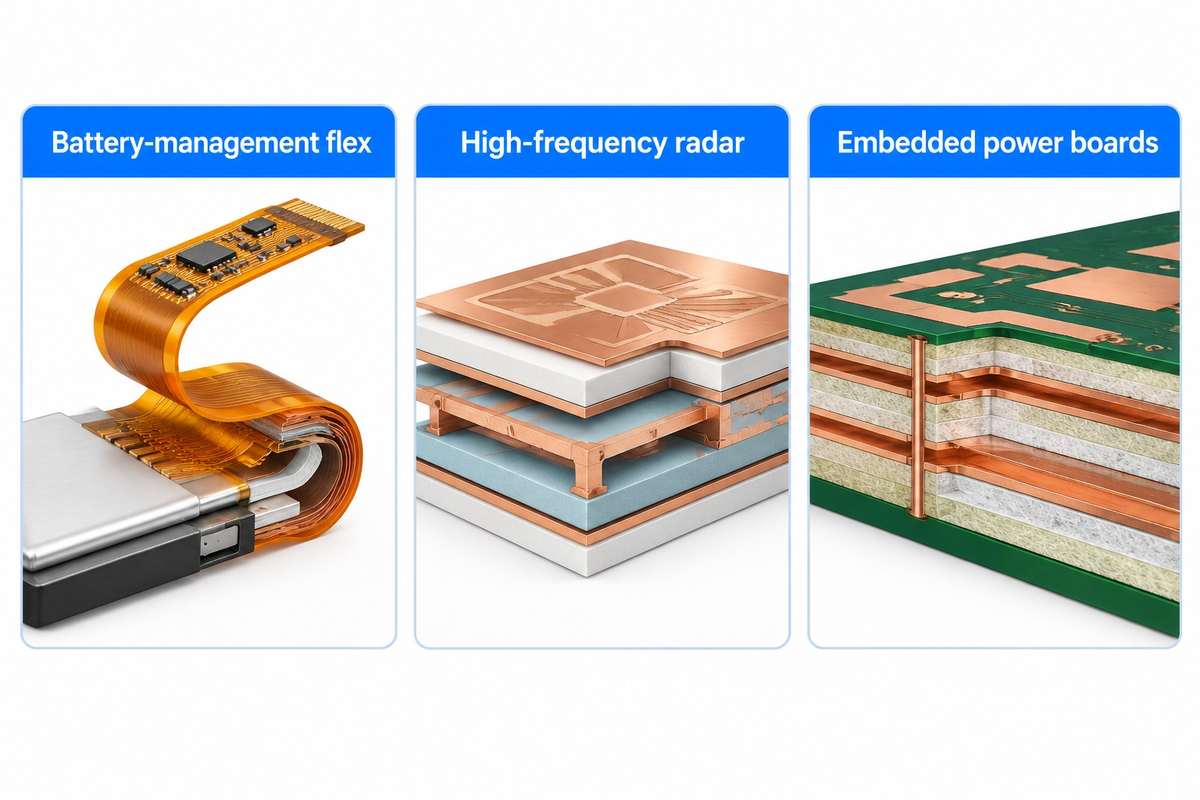
This group is most useful when a buying requirement identifies a specific construction or region. Battery-management flex, high-frequency radar and embedded power boards address different packaging and electrical challenges. Their suppliers should be compared within those applications rather than placed in a single universal ranking of automotive PCB quality.
16. MEKTEC: Best for flexible circuits in EV battery-management systems
Headquarters: Shibadaimon, Minato-ku, Tokyo, Japan.
Official website: https://mektec.nokgrp.com/en/
Founded: 1969 as Nippon Mektron; renamed MEKTEC in 2024. Type: Flexible printed circuit specialist.
Main products and technologies: BMS FPC, lighting, sensor, heater and infotainment flexible circuits, with capabilities from materials development through component mounting.
Certifications and notable work: A 2024 announcement identifies IATF certification for MEKTEC Europe HU Kft in Hungary and a VDA 6.3 audit. A March 2024 announcement names Volkswagen ID.2 BMS FPC orders with production then scheduled for 2026.
MEKTEC is a focused candidate for battery interconnection because flexible circuits are central to its business, not simply another item in a rigid-board catalog. The named Volkswagen order gives that BMS positioning a specific project reference, while materials and mounting capabilities connect the flex structure with its assembled use. The announcement scheduled production for 2026. Its specialization fits flexible interconnects; conventional rigid ECU board sourcing belongs to a different purchasing brief.
17. AT&S: Best for high-frequency radar boards and dense automotive interconnects
Headquarters: Leoben, Austria.
Official website: https://ats.net/
Founded: 1987 through a merger; earlier automotive roots date to 1961. Type: Advanced circuit board and interconnect manufacturer.
Main products and technologies: Radar antenna PCBs for 24–90 GHz, HDI, Anylayer, mSAP, substrate-like PCB and interposer technologies.
Certifications and applications: The company states that relevant plants hold IATF 16949 and describes high-volume ADAS Level III applications in its automotive material.
AT&S offers a radar-specific frequency range alongside dense-interconnect processes, making it useful for a buyer whose signal and packaging requirements are already well defined. Its product descriptions connect advanced board construction with automotive sensing rather than relying solely on general electronics credentials. There’s also a clear maturity boundary in its published offer: 140 GHz modules are described as under development. A project using the production radar antenna range and one seeking a development-stage module therefore involve different engineering and sourcing conversations.
18. Schweizer: Best for embedded power and thermal-management boards from a German technology site
Headquarters: Schramberg, Germany.
Official website: https://schweizer.ag/
Founded: 1849 company roots, not the start of PCB manufacturing. Type: PCB technology and production company.
Main products and technologies: Embedding technology, power and thermal-management PCBs for automotive and industrial applications.
Certifications and business mix: Company quality pages list IATF 16949: 2016, ISO 9001, ISO 14001 and ISO 50001 with site-specific downloads. Automotive represented 84% of 2025 turnover, compared with 81% in 2024, according to its strategy page.
Schweizer’s concentration in the automotive sector and embedding technology make it a relevant candidate for power electronics where the board construction forms part of the thermal design. The Schramberg operation provides a German technology and manufacturing base, with small- and medium-volume production forming part of the published operating model. Higher-volume supply also uses manufacturing partnerships, including cooperation with Meiko. That production model is the main purchasing constraint: sourcing through Schweizer doesn’t mean every volume order will be fabricated at Schramberg.
19. KSG: Best for European PCB manufacture with high-current thermal-management options
Company seat: 09390 Gornsdorf, Germany.
Official website: https://www.ksg-pcb.com/
Founded: PCB production at Gornsdorf began in 1959; company roots extend to 1878. Type: European PCB manufacturer.
Main products and technologies: HSMtec current and thermal management, IMS, thick copper, multilayer power planes and HDI for applications including ECUs, BMS, ADAS and inverters.
Certifications: Company quality pages list IATF 16949: 2016, ISO 9001, ISO 14001 and ISO 50001 with site-specific downloads.
KSG combines an explicitly European manufacturing footprint with specialized constructions for current and heat management. HSMtec, introduced in 2007, gives its power-board offer a named technology beyond a general heavy-copper claim. The German and Austrian sites make it relevant for buyers whose regional production requirement is as important as the stackup. That same footprint sets its boundary: it suits European manufacture, while a requirement for a locally fabricated Asian board calls for a different production option.
20. Zhen Ding Technology Holding Limited: Best for a broad group portfolio of rigid, flexible and advanced interconnect boards
Corporate contact base: Taoyuan, Taiwan; this is distinct from the holding company’s legal domicile.
Official website: https://www.zdtco.com/
Founded: 2006, holding group. Type: Global manufacturer of printed circuit boards and advanced interconnect products.
Main products and technologies: FPC, substrate-like PCB, HDI, rigid boards, IC substrates, RF products and modules across a published five-campus group footprint.
Notable acquisition: Zhen Ding acquired BoardTek through a November 2020 share swap. BoardTek adds high-speed, high-frequency microwave and high-power PCB processes; Avary, BoardTek and Garuda are counted within this single group entry.
Zhen Ding offers breadth for buyers comparing several interconnect technologies under one corporate group. BoardTek supplies a concrete specialist connection to that portfolio, while the group’s flexible and rigid products address different electronic packaging needs. The range also includes facilities and projects at different stages: Garuda automotive FPC material describes planning and construction, rather than an interchangeable mature production line. A buyer choosing from this group therefore selects a business, factory and construction within the portfolio, not a universal product available across every campus.
How to Choose an Automotive PCB Manufacturer
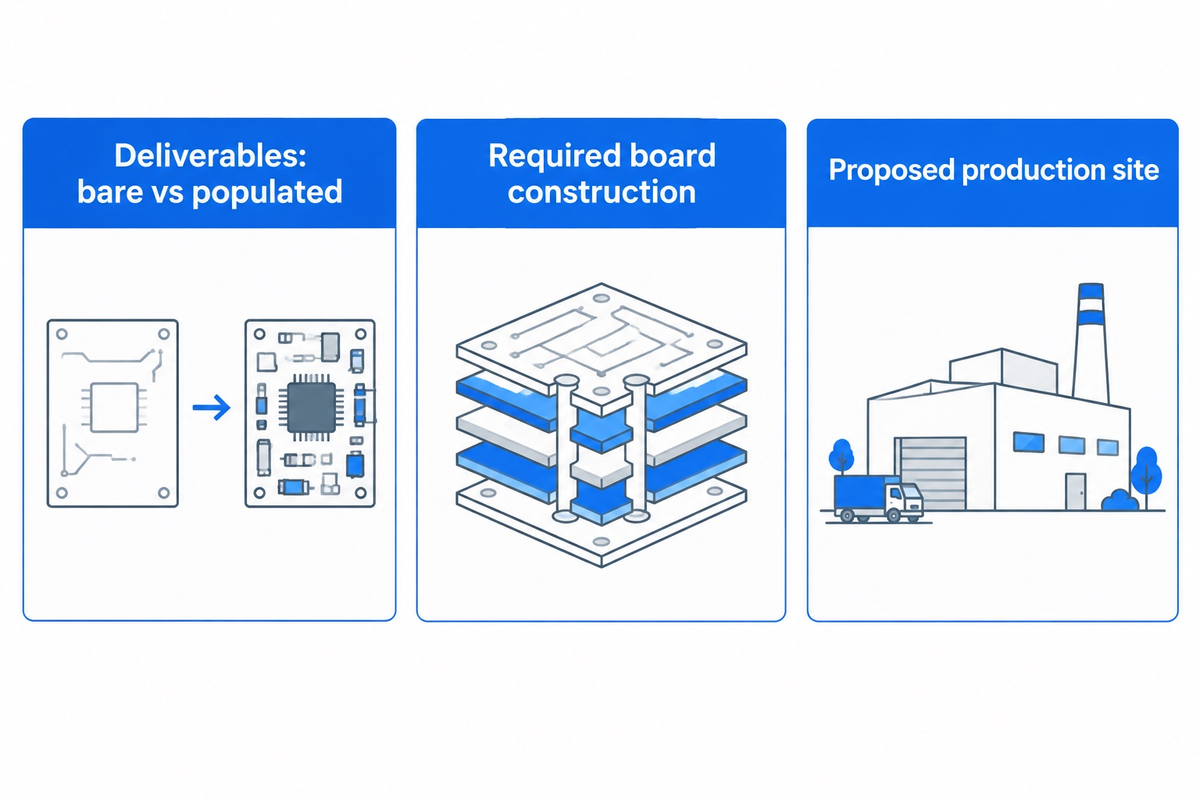
Draw up a shortlist based on the deliverables, construction and production site. Automotive fabrication adds program-specific material, reliability, traceability and change-control requirements, while a general-purpose fabrication capability alone doesn’t define that program scope. A supplier with the right automotive board family may still be the wrong choice, if the quotation includes bare boards, but your team needs populated and tested boards. The following eight checks point to areas that should be considered when comparing offers for PCB fabrication.
- Briefly describe the delivered product. Is it a bare PCB, a populated board, or a tested electronic module? For automotive PCB assembly, name the party that purchases electronic components, handles part substitutions, provides programming files, and owns the test fixture. “Fabrication and assembly” or assembly and fabrication can be used to describe one business relationship involving many operational handoffs. Clear ownership prevents two suppliers from assuming the other will resolve a component footprint or assembly test issue. An assembly-only supplier can populate boards; the combined offer includes circuit board fabrication and assembly.
- Match the construction to the actual circuit. Include the layer stack, material family, finished thickness, copper distribution, hole and via requirements, impedance targets and surface finish. For precision PCB work, identify the part of the design driving the process: dense interconnection, RF performance, current, heat or mechanical flexing. Avoid combining unrelated maximum figures from a supplier’s catalog into one assumed capability. If a manufacturer designs the stackup, assign approval of that design before release. PCBark’s guide to automotive board requirements provides context for organizing that technical discussion.
- Identify the location and route of production. Which facility performs the quoted construction? What are the subcontracted steps? Is there any movement of production after the prototype stage? The location of a fabricator’s sales office doesn’t establish its fabrication location, just as a group certificate doesn’t identify the factory used for an order. Communication, site access, freight and permitted manufacturing route are the main concerns with regional sourcing. Place the selected location in the commercial and technical records.
- Identify separate development and production builds. Note prototype volumes, expected revisions, ramp stages, and recurring demand. How are tooling and stackup changes and production transfers managed during these stages? A prototype supplier can be an excellent development partner without being the final volume source; a volume factory may require a more settled design package. Consider price for the first batch, especially if production transfers to another location.
- Check the certificate and the program requirements. Start with the certificate holder, address, scope and validity dates rather than relying on a logo. IATF 16949 concerns a quality-management system; it doesn’t independently approve your board design or replace customer-specific requirements. Define quality standards for high-quality printed circuit boards through agreed workmanship criteria, qualification evidence, change approvals and documentation with the responsible customer and supplier. Consider industry certifications as part of this determination. Maintain a distinction between bare board reliability, and assembly, component and complete module verification, so that each deliverable has defined acceptance criteria.
- Compare quoted prices in their entirety. Separate recurring costs from tooling, setup, inspection, electrical test, assembly programming, fixtures, and freight. For populated boards, assess the same bill of materials and sourcing assumptions. Alternative components and a change in test scope could alter the offer. There’s no meaningful general price range for simple bare boards versus complex assembled automotive modules. Comparable quotes contain the same production scope and acceptance standards for each competitor.
- Ask for a breakdown of lead times. For a promised quick turn around on fabrication, determine what, if any, components are missing and what controls the delivery clock. Engineering should approve released data before procurement treats the schedule as a committed production schedule. Quality should identify the first-article or qualification measures that must be completed before routine delivery.
- Agree traceability and change control. Identify which records are maintained for materials, lots, inspection and tests, and how nonconforming product is handled. Name the persons who approve laminates, surface finishes, components and manufacturing sites. A high-quality PCB supply requires repeatable documentation and an acceptable first delivery. A reliable circuit board supply relationship requires the appointment of a single owner for an approved technical package. This prevents changes requested by engineering, purchasing and the assembly contractor from becoming competing requirements.
Why Choose a PCB Manufacturer in the USA?
A U.S. PCB manufacturer based in the United States can fit a project needing domestic fabrication and nearby engineering discussions. US PCB sourcing is especially pertinent with repeated prototype revisions where the design team values a short communication path and identified local manufacturing operation.
AdvancedPCB and Sierra Circuits are starting points for US prototype work in this list. TTM and Sanmina offer broader manufacturing portfolios, with the actual board-production location determined by the proposed facility. Compare the quoted manufacturing address and later volume route, rather than assuming a US headquarters makes every board domestic. Domestic sourcing alone doesn’t establish the product’s automotive qualification or the total delivered cost.
What causes delays in the PCB prototyping process?
PCB prototype delays are generally caused by an incomplete fabrication package, unavailable specified materials, unanswered engineering questions or design changes. Assembly adds component availability and test-fixture readiness to the schedule. Thus a fabrication lead time can’t represent the complete populated-board delivery.
Send one released package containing board data, stackup, and fabrication notes, with the bill of materials, and assembly files, if any. Identify approved material or component alternatives and provide the supplier an engineering contact to resolve questions. A prototype schedule is more useful when approval milestones and readiness of material are also included.
Turn the Shortlist into a Comparable Request for Quotation
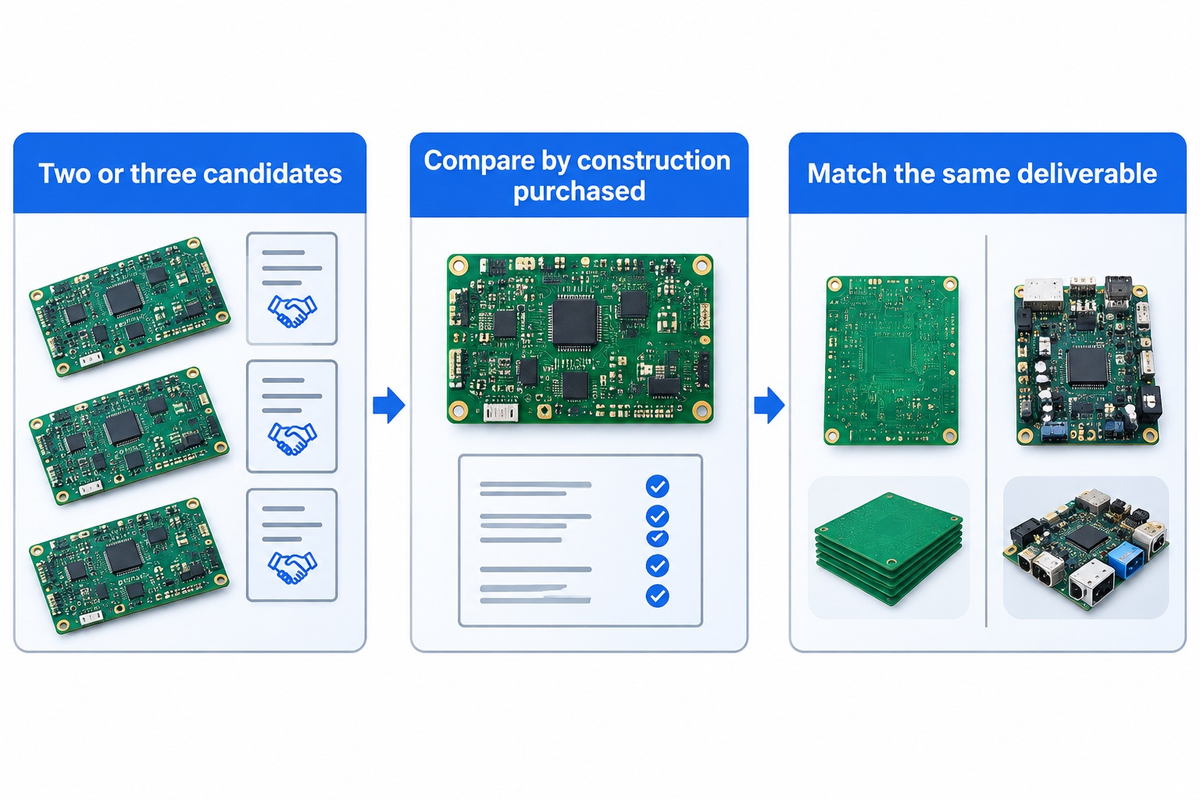
Shortlisting top printed circuit board manufacturers starts with two or three candidates offering the same deliverable. Compare PCB solutions by the construction being purchased, rather than by the total number of services on a company website. For a battery flex project, start with a flex-focused candidate such as MEKTEC and other suppliers offering the required FPC construction. For a radar board, compare AT&S, Shennan or another RF-capable manufacturer against the actual material and interconnect requirements. Shennan’s published examples separate a 0.28mm single-layer BMS flex board from a 1.2mm eight-layer 77GHz radar board. For a combined fabrication-and-assembly order, request both scopes explicitly from the outset.
Your request should include a controlled file set, a drawing or stackup, quantity breaks, delivery location, expected production ramp, required inspection and test records. Also include the bill of materials and assembly instructions only when those services are part of the order. Mark an engineering assumption as open instead of leaving different suppliers to price different solutions. Specify IPC-6012EA or J-STD-001JA/IPC-A-610JA automotive addenda on drawings when those fabrication or assembly rules apply.
Organize the responses around three commercial decisions. Which suppliers can make the specified construction? Which can deliver it through an acceptable production route? Which offer the best overall scope for the price? A low bare-board quotation and a higher populated-board quotation are not competing prices for the same purchase. This provides purchasing a defensible comparison and engineering a prioritized set of questions to answer.
Frequently Asked Questions
Which automotive PCB manufacturer is best for my project?
PCBark suits combined fabrication and assembly, MEKTEC suits battery-management flex, and AT&S suits radar interconnects; Sierra Circuits is a starting point for US sensor prototypes.
Select the best PCB candidate for the required construction, the proposed factory, and a delivery scope covering bare boards, populated boards, or tested electronic modules. Use the comparison to short list the candidates, then compare the same technical package and production requirements. For a board that requires both fabrication and assembly, include component sourcing and functional test in that comparison; for a bare board purchase, keep those services outside the comparison.
Who is the largest automotive PCB manufacturer?
In its 2024 results announcement, Zhen Ding claimed to be the world’s largest PCB manufacturer; this is a general PCB market position and not specific to automotive.
For an automotive-only comparison, use automotive PCB revenue and the same reporting year. Total PCB sales for Zhen Ding include other market segments, such as servers and optical interconnect. An electronics manufacturing group may also include assembly and systems work in its revenue. The revenue segment announced in March 2025 by Zhen Ding combines servers and automotive as well as optical interconnects, and as such wouldn’t provide an automotive only league table.
What is the difference between an automotive PCB manufacturer and a supplier?
A supplier of printed circuit board product can perform its own fabrication processes; a PCB supplier can also be a distributor, sourcing company or commercial intermediary that purchases boards from factories.
This listing only selects companies that provide their own manufacturing services. So an electronic manufacturing services provider can also add component sourcing and testing, and therefore quote more than a bare-board manufacturer. An assembly-only operation purchases its bare boards from another fabricator and performs component placement; a sourcing intermediary manages procurement without itself fabricating the board.
How much do automotive PCBs cost?
Automotive PCBs are custom-quoted products: a bare board and a populated and tested assembly each require a separate quote.
Ask for quotes that itemize materials, fabrication, tooling, test and freight, and components and assembly as applicable. Layer count, copper distribution, via structure, finish, and production quantity impact quotes. Using released files is more effective than using an online price range.
Which manufacturers are best for radar, battery and high-current boards?
AT&S and Shennan offer radar-specific examples; MEKTEC focuses on battery-management flex; CMK, CHIN POON, Kinwong and KSG offer constructions relevant to current and thermal management.
These are starting points for the board family, not interchangeable designs. The best fit follows the actual materials, path, packaging and location for manufacture.
Does IATF 16949 certification approve an automotive PCB design?
No. IATF 16949 certification concerns the named organization’s quality-management system within its certificate scope; it isn’t approval of every PCB design that organization can manufacture.
A board or an assembled module retains its own specifications, qualification work, and acceptance by the end customer. Keep those product requirements separate from the supplier’s quality-system certificate when defining the purchasing and validation plan.
Choose the Supplier That Matches the Board
The best shortlist starts with the board you need: rigid control, radar RF, high-current power or battery flex. Match that construction to a factory and a clear fabrication or assembly scope, then compare equivalent quotations. For a project combining PCB fabrication, component sourcing and assembly, send PCBark your automotive PCB project requirements with the design files, quantities and test needs so the manufacturing scope can be defined.
References & Sources
Company product, history and quality publications consulted in October 2026:
- PCBark: https://pcbark.com/contact-us/
- Meiko Electronics Co., Ltd.: https://www.meiko-elec.com/english/corporate/outline/
- Sanmina Corporation: https://www.sanmina.com/company-profile/
- AdvancedPCB: https://www.advancedpcb.com/en-us/company/about/
- Sierra Circuits: https://www.protoexpress.com/about-sierra-circuits/
- TTM Technologies, Inc.: https://www.ttm.com/en/about-ttm/global-locations
- CMK Corporation: https://www.cmk-corp.com/en/company/office/location/
- KCE Electronics Public Company Limited: https://www.kce.co.th/Eng/aboutKCE.aspx
- CHIN POON Industrial Co., Ltd.: https://www.chinpoon.com/en/about/31
- Kinwong: https://www.kinwong.com/en/contact/
- WUS Printed Circuit (Kunshan) Co., Ltd.: https://www.wustec.com/wus_en/index.php
- Dynamic Electronics Co., Ltd.: https://www.dynamicpcb.com/en/contact.html
- HannStar Board Corporation: https://en.icaa.org.tw/data-64112
- Shennan Circuits Co., Ltd.: https://www.scc.com.cn/scc/en/gysn/index.html
- COMPEQ Manufacturing Co., Ltd.: https://www.compeq.com.tw/about01_1.php
- MEKTEC CORPORATION: https://mektec.nokgrp.com/en/news/2024/032601.html
- AT&S: https://ats.net/en/company/history/
- Schweizer Electronic AG: https://schweizer.ag/en/the-company
- KSG GmbH: https://www.ksg-pcb.com/en/imprint/
- Zhen Ding Technology Holding Limited: https://www.zdtco.com/en/about/group