Get in touch with PCBark Company


Last updated: October 2026 · By GW
The best prototype PCB manufacturers include PCBark for a broad prototype-to-production fabrication offer, Eurocircuits for European pooling, JLCPCB for digital ordering, and Sierra Circuits for CAM-supported US builds. Choose by the board’s material, stack-up and validation needs. A fast bare-board order and a populated PCB assembly package cover different work.
Quick Picks
- Best for a broad fabrication transfer path: PCBark
- Best for European pooled engineering prototypes: Eurocircuits
- Best for advanced interconnect development: Würth Elektronik Circuit Board Technology
- Best for design-to-order integration: JLCPCB
- Best for Silicon Valley CAM support: Sierra Circuits
- Best for engineered ramp-to-volume programs: TTM Technologies
Disclosure: This guide is published by PCBark. We list ourselves first because this is our website, not because we claim to be the market leader. The other 9 manufacturers are grouped by what they’re best for, in no particular order within each group.
How We Selected These Prototype PCB Manufacturers
Information about companies was verified against official websites and publicly available information in October 2026. The companies considered had known fabrication and prototype operations and publicly stated technical capabilities. This study excluded stand-alone trading companies, distributors, sourcing companies, directories, media companies and used-equipment dealers. Best-for labels denote editorial service fit, rather than measured quality and delivery rankings. Manufacturers who partner with other companies for production are identified.
This shortlist focuses on bare-board engineering validation. For a wider industry list, see our broader PCB manufacturer comparison.
Prototype PCB Manufacturers Compared
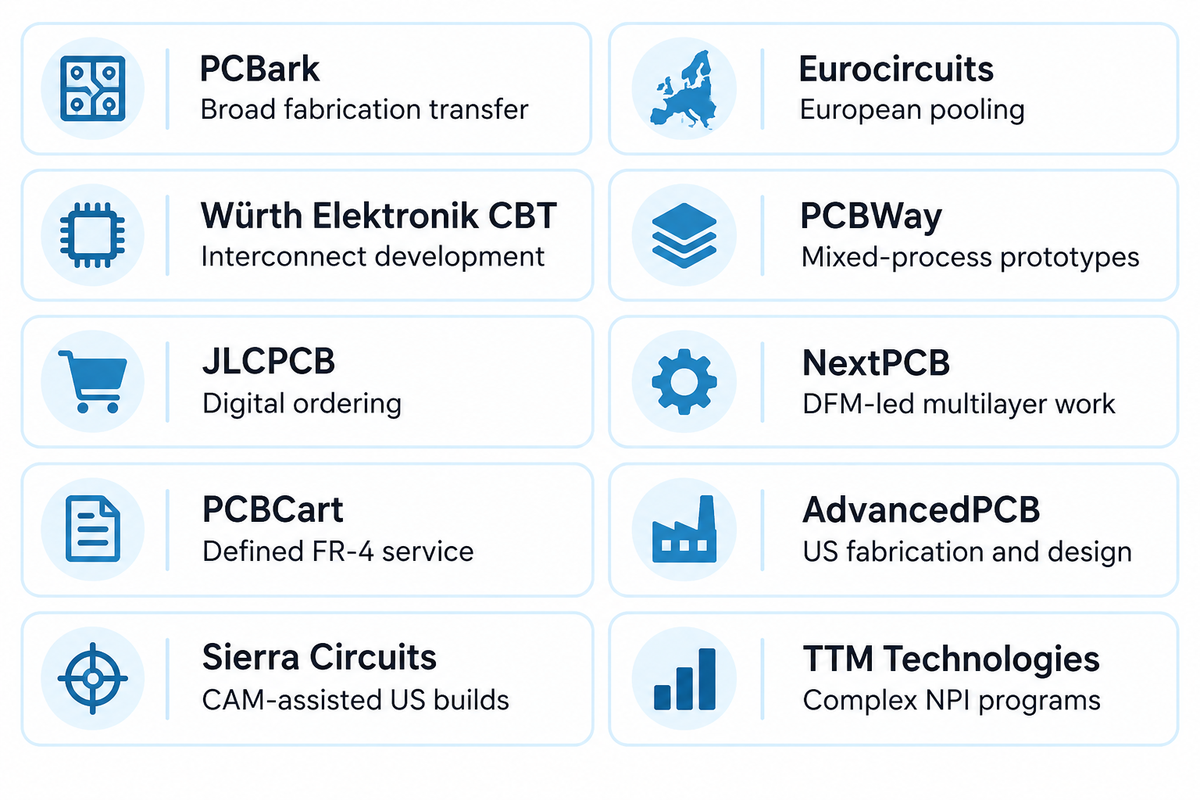
Prototype-to-Production Fit Map
Compare manufacturing location, advanced options and terms of sale at the selected-service level; each company lists the capabilities for that service below.
| No. | Company Name | Headquarters | Founded Year | Best For | Brief Introduction | Prototype offer | Key Advantages | Potential Disadvantages | Official Website |
|---|---|---|---|---|---|---|---|---|---|
| 1 | PCBark | Shenzhen, China | 2010 | Broad fabrication transfer | Fabrication and EMS | Single-piece boards | CAM/DFM support | 3/3 mil published floor | pcbark.com |
| 2 | Eurocircuits | Mechelen, Belgium | 1991 | European pooling | Own European production | Defined service pools | Visualizer checks | Pool-specific design rules | eurocircuits.com |
| 3 | Würth Elektronik CBT | Niedernhall, Germany | 1971 roots | Interconnect development | German plants and partner network | WEdirekt and custom services | HDI through embedding | Production-route selection | we-online.com |
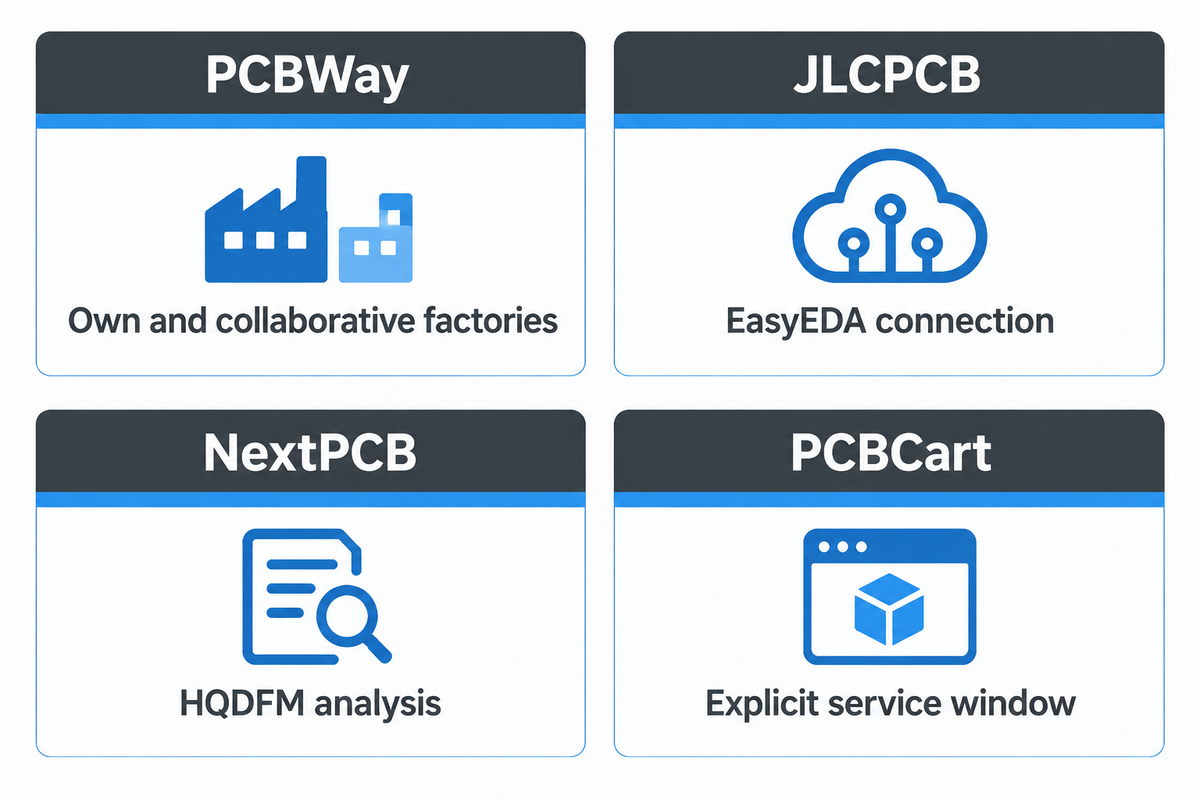
| 4 | PCBWay | Hangzhou, China | 2014 | Mixed-process prototypes | Own and collaborative factories | PCB plus mechanical services | Cross-process ordering | Factory route can differ | pcbway.com |
| 5 | JLCPCB | Not found | 2006 | Digital ordering | Integrated manufacturer | Online PCB workflow | EasyEDA connection | Design-rule review queries | jlcpcb.com |
| 6 | NextPCB | Shenzhen, China | 2011 | DFM-led multilayer work | Digital manufacturing platform | Published multilayer rules | HQDFM analysis | Copper-dependent spacing | nextpcb.com |
| 7 | PCBCart | Singapore | 2005 | Defined FR-4 service | Thailand/China manufacture | 1–8-layer prototypes | Explicit service window | Prototype IPC 1 grade | pcbcart.com |
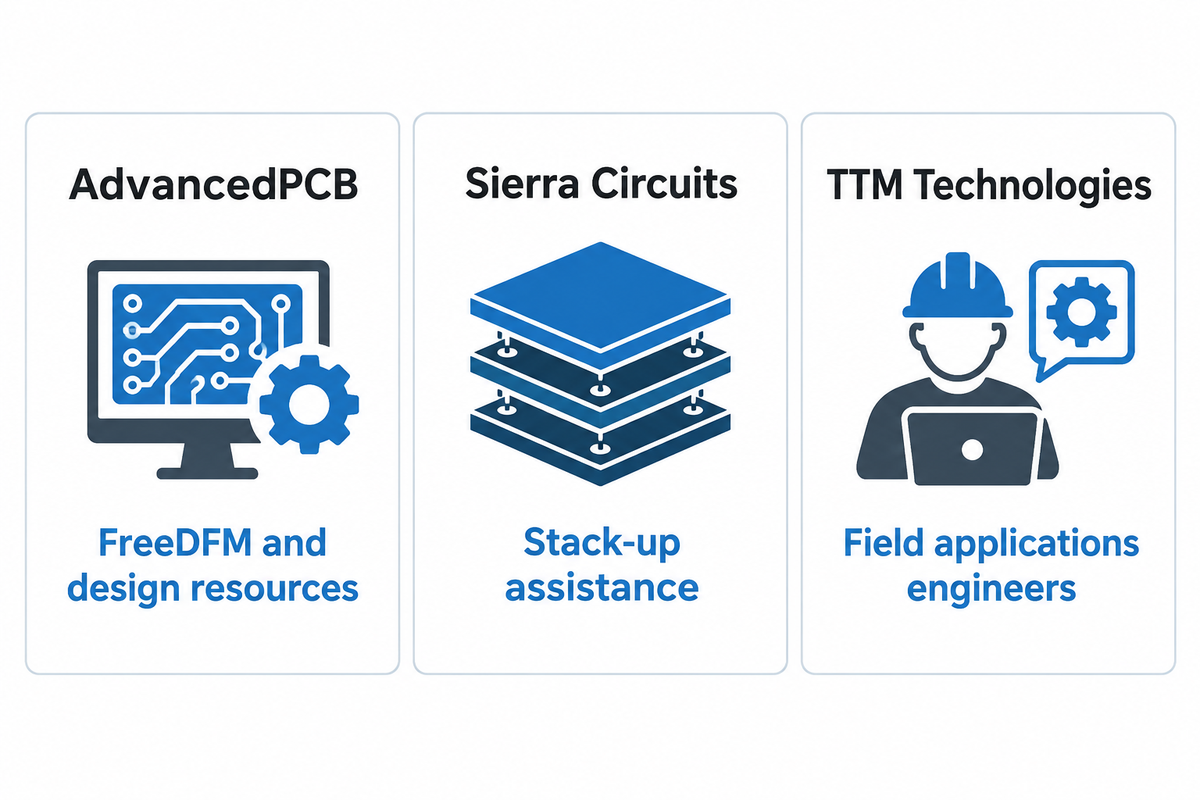
| 8 | AdvancedPCB | Aurora, Colorado, USA | 1977 roots; 2024 brand | US fabrication and design | Unified APCT/ACI network | US prototype fabrication | FreeDFM and design resources | Domestic/partner routes differ | advancedpcb.com |
| 9 | Sierra Circuits | Sunnyvale, California, USA | 1986 | CAM-assisted US builds | Owned fabrication/assembly | Standard and advanced services | Stack-up assistance | Rush schedule is service-specific | protoexpress.com |
| 10 | TTM Technologies | Santa Ana, California, USA | 1998 | Complex NPI programs | Global interconnect manufacturer | Quick-turn and volume ramp | Field applications engineers | Site-specialized capabilities | ttm.com |
Prototype-to-Production Engineering Partners
1. PCBark: Best for a broad fabrication transfer path
Headquarters: Shenzhen, China · Founded: 2010 · Type: Circuit board manufacturer and electronics manufacturing services provider
Official website: https://pcbark.com/
Main products: Rigid, multilayer, HDI, RF, aluminum and rigid-flex PCBs; PCB assembly is available separately.
Quality / notable work: According to PCBark’s manufacturing page, its factory holds ISO 9001 and IATF 16949; the company also lists ISO 14001 and UL credentials.
PCBark’s prototype PCB manufacturing services cover single-piece supply with CAM/DFM support, followed by low-volume and full-scale production. Its published PCB manufacturing capabilities span 1–42 layers, with 3/3 mil trace/space and ±10% impedance control. That combination suits prototype PCB manufacturing that may expand into customized PCB builds and repeat orders. Buying limitation: Sub-2-mil routing or ±5% impedance work falls outside this published standard window.
2. Eurocircuits: Best for European pooled engineering prototypes
Headquarters: Mechelen, Belgium · Founded: 1991 · Type: PCB prototype and small-series manufacturer
Official website: https://www.eurocircuits.com/
Main products: PCB Proto, STANDARD pool, HDI pool, DEFINED IMPEDANCE pool, RF and semi-flex services.
Quality / notable work: The company describes own European fabrication and IPC-A-600 Class 2 bare-board manufacture.
Eurocircuits combines order pooling with interactive Visualizer checks before purchase. Pooling extends beyond basic double-sided boards: its DEFINED IMPEDANCE service covers 4/6/8 layers, while HDI pool covers 6/8 layers with microvias. These defined combinations make its prototyping service useful for design teams seeking a known fabrication process and visible DFM feedback. Buying limitation: Each pool has fixed technology rules, and the company’s stated focus is standard technologies for prototypes and small series.
3. Würth Elektronik Circuit Board Technology: Best for advanced interconnect development
Headquarters: Niedernhall, Germany · Founded: 1971 PCB business roots · Type: PCB manufacturer with partner-production services
Official website: https://www.we-online.com/
Main products: BASIC boards, HDI Microvia, RIGID.flex, component embedding and thermal-management PCBs.
Quality / notable work: WEdirekt lists manufacture according to DIN EN ISO 9001:2015.
Würth’s PCB specialists support advanced technologies through prototypes, medium series and large-scale production. WEdirekt supplies an online route for standard boards, while its wider portfolio covers manufacturing processes beyond conventional multi-layer fabrication. Embedding and rigid-flex PCBs give electronics developers options when interconnect packaging changes during development. Buying limitation: Production can run at German plants or qualified Asian partners; technology and quantity influence that route, so a later volume order may require a planned manufacturing transfer.
Online PCB Prototype Services
4. PCBWay: Best for PCB prototypes alongside mechanical parts
Headquarters: Hangzhou, China, as listed for its OEM head office · Founded: 2014 · Type: Manufacturer with own and collaborative factories
Official website: https://www.pcbway.com/
Main products: PCB manufacturing services and assembly, CNC machining, 3D printing, injection molding and related prototype parts.
Quality / notable work: Its OEM site lists ISO9001:2015 factory credentials; its About page declares RoHS-compliant PCB processes.
PCBWay’s prototype manufacturing offer can suit a project that needs circuit boards and enclosure or fixture parts through related services. Its factory information distinguishes PCB fabrication from assembly operations, while its anniversary history describes prototype and small-to-medium manufacturing. The broader manufacturing and assembly menu is useful when mechanical fit must be checked alongside electronics. Buying limitation: The OEM network uses self-operated and collaborative factories, so recurring production needs an agreed factory route rather than an assumption that every process shares one line.
5. JLCPCB: Best for digital design-to-order integration
Headquarters: Not publicly disclosed on the cited corporate page · Founded: 2006 · Type: Integrated PCB and PCBA manufacturer
Official website: https://jlcpcb.com/
Main products: Bare PCB fabrication and assembly, connected with EasyEDA and component sourcing.
Quality / notable work: The company’s certification page lists ISO 9001:2015 and UL recognition file E479892.
JLCPCB links electronic design tools to online manufacturing services and automated production lines. Its quality-control page describes engineer review of Gerber files, followed by optical inspection and flying-probe electrical testing. That workflow suits engineers who want a digital route for prototype printed circuit boards and repeated small-batch orders. Buying limitation: Files outside board-edge, drill, pad or trace-spacing restrictions trigger an engineering query before production; an instant order still needs to pass the selected design rules.
6. NextPCB: Best for DFM-led multilayer prototypes
Headquarters: Shenzhen, China · Founded: 2011 · Type: PCB manufacturer and digital engineering platform
Official website: https://www.nextpcb.com/
Main products: Rigid, HDI, high-speed, RF, heavy-copper, flex and rigid-flex boards; assembly offered separately.
Quality / notable work: Its quality page lists ISO 9001 and IATF 16949, plus UL recognition resources; credentials have entity and site scopes.
NextPCB combines HQDFM design analysis with detailed prototype PCB manufacturing capabilities. Its standard capability table lists 1–32 layers and ±10% impedance control with default or customer stack-ups, giving engineers concrete inputs for a manufacturability review. Copper weight is a useful screening variable here. Buying limitation: Published outer-layer minimum trace/spacing changes from 3 mil at 1 oz copper to 5.5 mil at 2 oz, so the finer rule can’t be carried into every heavy-copper layout.
7. PCBCart: Best for FR-4 prototypes with an explicit service window
Headquarters: Singapore; manufacturing in Thailand and China · Founded: 2005 · Type: PCB manufacturer and turnkey services provider
Official website: https://www.pcbcart.com/
Main products: A range of PCB services covering rigid, flex, metal-core and Rogers boards; manufacturing and assembly.
Quality / notable work: Its company page lists ISO 9001 and UL; its dedicated PCB Prototype page labels the service IPC 1.
PCBCart’s rapid PCB prototyping services produce prototype circuit boards within explicit fabrication boundaries: 1–8 layers, 5–100 boards and standard FR-4 material. Those details help a buyer choose a PCB prototype manufacturer for an early functional build without treating the entire product catalogue as one service. Its Standard PCB offer covers a different manufacturing window and a wider variety of PCB materials. Buying limitation: The prototype page specifies IPC 1 versus IPC 2 for Standard PCB service, so that dedicated prototype route may not match the planned production board’s acceptance grade.
US Prototype PCB Fabrication
8. AdvancedPCB: Best for US fabrication with design resources
Headquarters: Aurora, Colorado, USA · Founded: 1977 APCT roots; current brand unified in 2024 · Type: US PCB manufacturer
Official website: https://www.advancedpcb.com/
Main products: Standard boards, advanced HDI, RF, flex and rigid-flex circuits, plus design and assembly services.
Quality / notable work: Its corporate page lists ISO 9001:2015; credentials and production capabilities vary by facility.
AdvancedPCB combines APCT, Advanced Circuits and San Diego PCB Design under one brand. FreeDFM and its design resources provide an engineering route alongside US prototype PCB fabrication. Separate standard, advanced and flex service categories help a developer match the board to a manufacturing process before moving into higher volumes. Buying limitation: Its domestic fabrication and offshore partner service are different routes; the partner offer targets high-volume production, so it should be compared separately from a domestic prototype quote.
9. Sierra Circuits: Best for Silicon Valley CAM and stack-up support
Headquarters: Sunnyvale, California, USA · Founded: 1986 · Type: PCB manufacturer and assembler with owned facilities
Official website: https://www.protoexpress.com/
Main products: Rigid, HDI, RF, flex and rigid-flex boards, with separate assembly services.
Quality / notable work: Its official page links AS9100D, ISO 9001:2015, ISO 13485:2016 and UL documents.
Sierra’s advanced PCB service combines quick turnaround with dedicated CAM engineering and stack-up assistance. The standard PCB offer lists 2 mil trace/space, giving engineers a specific feature benchmark rather than a generic high-technology label. Owned fabrication and assembly facilities support a connected development route for sectors such as aerospace and medical electronics. Buying limitation: Fast turnaround times, including published 24-hour options, apply to selected services; advanced materials follow separate schedules.
10. TTM Technologies: Best for complex prototypes with an engineered volume ramp
Headquarters: Santa Ana, California, USA · Founded: 1998 · Type: Global PCB manufacturing company and advanced interconnect manufacturer
Official website: https://www.ttm.com/
Main products: Conventional, HDI, flex, rigid-flex, RF and microwave printed circuits.
Quality / notable work: Its certification categories include ISO 9001, AS 9100 and IPC 1791, with applicability tied to the product and site.
TTM’s industrial capabilities explicitly connect quick-turn prototypes and new product introduction (NPI) with medium- and high-volume manufacturing. Field applications and production engineers help original equipment manufacturers plan PCB production and shorten time to market through that transition. Its Santa Ana operation specializes in high-layer-count and advanced HDI work. Buying limitation: Capabilities are site-specific; the selected prototype facility and the later production route need to fit the same program requirements.
How to Choose a Prototype PCB Manufacturer
Choosing a PCB prototype manufacturer starts with the feature you need to validate. A low-cost functional prototype can answer whether a circuit works; a production-representative build also needs the intended laminate, stack-up and acceptance criteria. PCBCart’s published service split shows why keeping the supplier name alone doesn’t keep those conditions constant.
| Decision | Practical action |
|---|---|
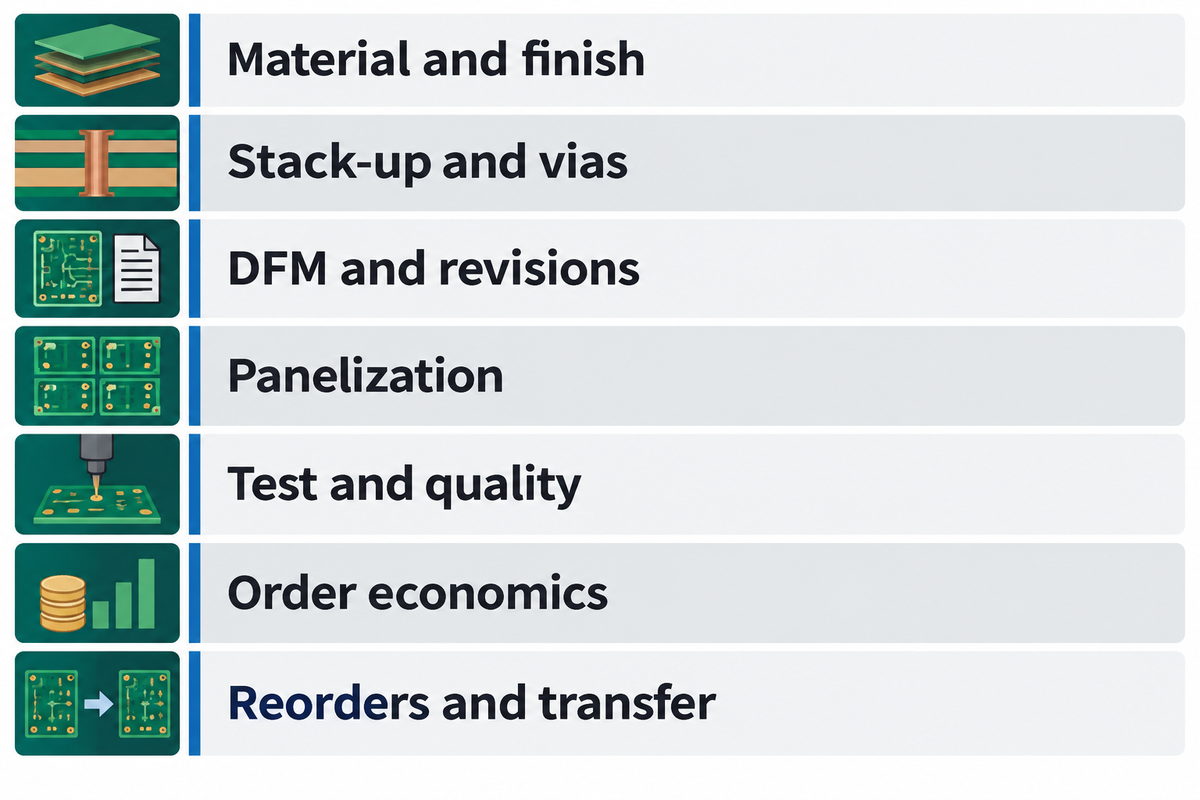
| Material and finish | Specify laminate grade and finish, rather than only FR-4 or “gold.” |
| Stack-up and vias | Agree layer build-up, impedance and blind and buried via structures before release. |
| DFM and revisions | Resolve engineering questions against one fabrication revision; retain the approved file set. |
| Panelization | Match rails, breakouts and fiducials to the assembler’s machine and handling method. |
| Test and quality | Specify continuity/isolation checks and IPC class; match certificate entity and facility to the order. |
| Order economics | Compare MOQ, setup charges, freight and taxes using identical specifications. |
| Reorders and transfer | Keep the validated material, stack-up and test scope, or qualify the changes before production. |
Can you accommodate custom base materials or finishes for PCB prototypes?
Yes, several manufacturers offer custom materials and finishes, but the order must use the appropriate service. PCBark lists RF laminates and multiple finishes, while PCBCart’s dedicated prototype route uses standard FR-4. Eurocircuits also separates RF, defined-impedance and HDI pools. Match the material and finish to the actual service before comparing quotes.
For density-driven designs, review the proposed HDI fabrication route before placing the order.
Do you provide engineering support during the prototyping process?
Yes. PCBark offers CAM/DFM support, Sierra lists dedicated CAM and stack-up assistance for advanced boards, and TTM names field applications and production engineers. Support should produce resolved manufacturing questions and an approved build definition. DFM analysis allows OEMs to test a manufacturable revision instead of carrying unresolved production questions into the next spin.
Pooled fabrication can be cost-effective when a design fits its rules: Eurocircuits’ impedance and HDI pools are concrete examples. Dedicated fabrication suits requirements outside that window. For automotive or other controlled supply chains, include quality standards, material traceability and site-specific certificates in the order review, and treat UL component recognition as component-specific rather than a blanket quality rating.
Frequently Asked Questions
What is PCB design and manufacturing?
Design creates the board definition; fabrication produces bare boards; assembly installs components.
In the PCB industry, design defines the circuit connections, component locations and board layout. Manufacturing converts the released fabrication files into a printed circuit board through imaging, drilling, plating and testing. Assembly then attaches components. Compare bare-board quotes separately from assembled-board quotes, because they cover different materials, processes and inspection responsibilities for the same design revision. See the bare-board manufacturing process for the fabrication sequence.
What are the 7 types of PCB testing methods?
Seven commonly discussed tests cover different stages, so bare boards and assemblies need different plans.
There are several ways to check for defects in the board and the assembly. The methods include automated optical inspection, in-circuit testing, flying-probe electrical testing, functional testing, boundary scan, X-ray inspection and fixture-based electrical testing. Not all of these methods are applicable to bare boards. Ask the fabricator what continuity, isolation and inspection checks are performed; ask the assembler what coverage is provided for the populated board.
What is the typical lead time for a PCB prototype?
Eurocircuits lists three working days for PCB Proto and twelve for HDI pool, before transit.
Eurocircuits lists a manufacturing turnaround time of three working days for PCB Proto and twelve for HDI pool. PCB Proto covers two- or four-layer boards; the HDI service has its own stack-up and microvia rules. These are service-specific manufacturing schedules. Engineering queries, order acceptance and transit can change the date boards reach your bench.
How many prototypes should I build before production?
Order enough for planned tests, parallel development and a retained reference sample.
Prototypes are tested for different purposes, so build enough boards for tests that consume or damage samples, parallel firmware work and one retained reference. There’s no universal quantity. Separate electrical validation from assembly setup and destructive checks, and choose an order quantity to cover that work.
What does a prototype PCB order cost?
Use an identical build specification to compare the delivered order total.
A prototype PCB order requires a unique quote for each design. Board area, quantity, layers, laminate, copper, surface finish, drill complexity and electrical testing affect fabrication cost. Shipping and taxes affect the total delivered cost. Assembly adds components and placement. Compare identical files and specifications across quotes. A low advertised board price may apply only to a defined standard service and exclude freight. For a reorder, compare the cost of repeating the same validated testing scope and stack-up, rather than comparing the lowest unit price.
What does PCB stand for?
PCB stands for printed circuit board; fabrication and assembly supply different deliverables.
PCBs (printed circuit boards) provide a mechanical basis for connectivity and integration of electronic components via conductive features placed on a dielectric substrate. In order discussions, specify PCBs (bare boards) or PCB assembly (populated boards). Fabrication and PCB assembly are different services and deliverables.
Which Prototype Run Fits Your Board?
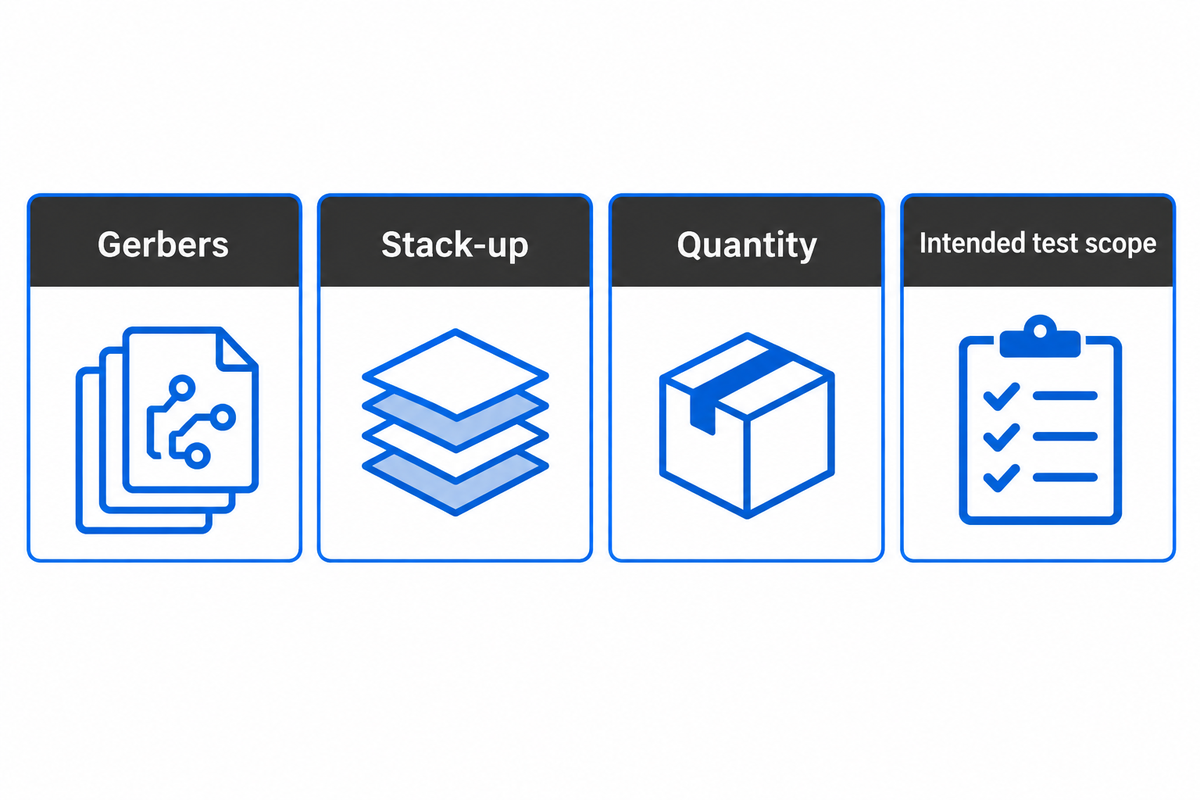
Start with a standard online or pooled service when the board fits its published rules. Use an engineering-led fabrication route for unusual materials, dense interconnects or a controlled production transfer. PCBark supports prototype and repeat manufacturing across its published fabrication window; discuss your prototype board with the Gerbers, stack-up, quantity and intended test scope.
References & Sources
Certification applies to the named entity, facility and construction. Each profile attributes company details and service specifications to the official websites shown, using information checked in October 2026.